Who was Cassandra?
In the Iliad, she is described as the loveliest of the daughters
of Priam (King of Troy), and gifted with prophecy. The god Apollo
loved her, but she spurned him. As a punishment, he decreed
that no one would ever believe her. So when she told her fellow
Trojans that the Greeks were hiding inside the wooden horse...well,
you know what happened.
the cassandra pages
words, pictures, and a life
Friday, December 31, 2004
update: Jan 1 - all is fixed, J. did it, and is collecting real kisses.
HELP?
After the initial enthusiastic announcement, I've realized that my site feed is not updating properly. I got so frustrated trying to figure out why that I finally put in a note to Blogger technical support, but haven't heard back yet. Does anyone out there have experience with this that they can share? I think I've taken care of all the obvious reasons...like making sure the damn thing is actually enabled. Your help will be warmly welcomed, and rewarded with virtual kisses.
The magnitude of the southeast Asian disaster is too great for me to write anything more about it. Have so many people ever left this world in one day before? What is the possible response, other than tears, and an attempt to help? I think of friends who often travel there for work; of friends whose families live there; of books read; of paintings and photographs of idyllic paradises and sandy beaches - everything that is exotic to a person who lives in the company of ice and snow - and of poverty, rickety dwellings, and difficult and often dangerous lives. And then all thoughts return to the images of parents weeping over small bodies, of wailing faces turned toward the sky. There simply aren't words for any of this.
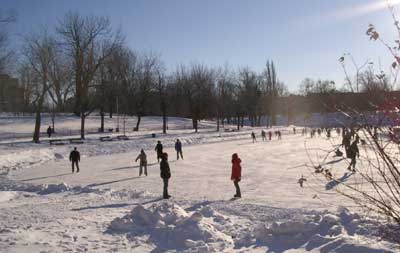
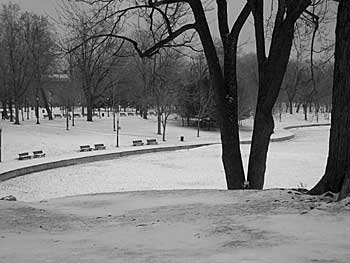
The other appropriate response, I think, is to reconsider our own lives - both the fragile ice on which we slip, and the solid land that feels secure. All of it is life, and we know the one because we know the other. Walking yesterday into the park, I quickly realized that underneath the several inches of snow was glare ice - sheets of rain that had fallen and frozen on absolutely everything. I had to adjust and walk carefully, but I know basically how to do this, having lived in this climate all my life. I walked past the two hockey rinks made of "boards" set up right on the ground and flooded when the weather got cold enough. Out on the ice, some skaters were practicing their footwork and shots, while another boy skated strongly with a shovel, pushing aside the new snow to make a good surface. In the next rink, a family was just leaving, carrying their skates with laces tied over their shoulders. It was just after noon, on a brilliantly bright, perfect winter day, and parents began coming into the park, tugging their little children behind them on sleds. Children ran happily; couples walked arm in arm, bundled behind scarves or fur-edged hoods. I walked over to the lake and down the walk that encircles it, just as I did so many times in the summer. Eager skaters, more sure-footed than I, ran down the icy path. People in skates walked easily down the snowbanks toward the frozen lake, leaving thin herringbone tracks. Two girls skated and talked, animatedly waving their skate guards int heir hands. A woman sat on a bench, smoking, and then got up and glided effortlessly onto the ice to join a throng of other skaters -- from tiny children to old people, all relaxed and totally at home on the ice, no one showing off -- just, in that typically Canadian laid-back way, enjoying themselves. It was... beautiful, and something I had never seen: so many people out in a far-northern city park, embracing winter, revelling in it. Remembering my youth skating on a lake, I longed to run over to the park building and rent a pair of skates, but I was already cold and knew I wouldn't have stayed for more than fifteen minutes more. (I also imagined, too painfully, what it would feel like to fall on that hard ice, which I'd be sure to do - if and when I do try it again, I will go with more padding on certain parts of my body, and hope I don't break a wrist.)
As I've worked here today, occasionally braving the anguished words and images flooding blogs and the media, somehow the images of the gliding skaters have helped me: their frictionless motion a surprise that belies our usual earth-trapped plodding; their joy in a frozen world a reminder that delight is far more often nature's gift to us than sadness.
Several readers have asked me to enable an XML feed; I've finally done it. Sorry to have taken so long on this. The address is http://cassandrapages.blogspot.com/atom.xml; you can also click on the Bloglines subscription button in the left column.
Monday, December 27, 2004
I'm so horrified. It's as if we can't even take a breath without another, amplified example of terrible suffering in our world. The BBC placed the death toll at 23,000 this morning. 23,000 souls! And so suddenly. The magnitude of the tragedy is incomprehensible.
The report explained how a tsunami is created: that after the ocean floor is displaced vertically along the fault - which was 1,000 meters long in this case - the huge waves are created. in deep ocean, they can travel at speeds up to 500 km/hr. When they near the shore, the waves slow down and are compressed upwards to tremendous heights.
When I was in grade school, I read a book for young people about a tsunami. It was The Big Wave by the novelist Pearl Buck, who had become famous for writing a book which seems ironically titled today, The Good Earth. I can still see the pictures in that edition of The Big Wave, and remember how I felt, as a landlocked girl who had experienced no natural force greater than a blizzard or crashign thunderstorm, at discovering that such a thing could happen. It was around the same time when my parents gave me another book about the ocean - a young people's edition of The Sea Around Us by Rachel Carson, which begins:
Beginnings are apt to be shadowy, and so it is with the beginnings of that great mother of life, the sea. many people have debated how and when the earth got its ocean, and it is not surprising that their explanations do not always agree. For the plain and inescapable truth is that no one was there to see...
I've never lived near the sea, but those two books formed an early and lasting impression of the ocean's geology, complexity, and the interdependence of human and ocean life. Every time I've travelled over the ocean or stood at its edge -- or, rarely, entered into its salty, throbbing water -- awareness of that awesome power has always been hand in hand with its majesty and hypnotic beauty. The ocean frightens me far more than a dark forest full of sounds and rustlings, and my heart goes out to the people of Asia whose are now suffering so terribly. A friend in Japan suggests contributions to Doctors without Borders/Medecins sans Frontieres; it is one small thing we can do that will help get aid to the people quickly. But nothing can bring back the lives that have been extinguished by those waves.
During the week before Christmas, I read Stephen Mitchell's The Gospel According to Jesus, given to me by a Jewish friend who likes to talk with me about things religious. Mitchell, who is, I believe, a Buddhist, is interested in what the religions have in common. He has translated varied texts - from the Baghavad Gita to Rilke, the Tao te Ching to the Psalms and the Book of Job - and his Gospel According to Jesus is an attempt to present a Jesus who can speak to Buddhists, Muslims and Jews as well as Christians. Putting aside for the moment my feelings about Mitchell's rather audacious and, I think, very subjective approach to dealing with religious texts, I read the book as generously as I could.
Relying almost entirely on the Synoptic Gospels (Matthew, Luke, and Mark), some of the Gnostic Gospels, and on a selective group of Biblical critics and commentators, he tried to decide which of Jesus' purported saying and actions are authentic, and from these wrote a single, combined text that includes a narrative of the events that ring true to him, and the parables, comments and actions that he feels Jesus really said and did. Mitchell explains his reasoning and his selections in some detail, and whether you agree or not, it makes for interesting reading.
He begins by discarding the infancy narratives, the deification of Mary and her identification as "Jesus's first disciple" (in fact he tries to prove that Jesus was misunderstood by his family, and rejected them to a large extent); and the resurrection. He removes everything from the Gospels that he either doesn't see as authentic or which was, in his opinion, an early-church attempt to discredit the Jews and later became fuel for anti-Semitism - the entire trial before Pilate goes away, for example, as well as Jesus's criticism of the Pharisees.
What's left is Jesus the teacher and healer. In that regard, I think Mitchell succeeded admirably - certainly Muslims, Hindus and Jews can find much here that will resonate with them - and he in fact quotes luminaries from each tradition speaking about the universality of Jesus' message. Mitchell acknowledges that Christians may have a hard time with what he's done, and he's right - even though I'm extremely liberal when it comes to biblical criticism, and very, very far from a literalist, especially on such matters as the virgin birth and the meddling with the story done by the early church for various political and institutional purposes, he went farther than I think he needed to, and probably further than what is justified by history or current scriptural scholarship.
What is striking is that even in this severely deconstructed version, the teachings and the basic message are absolutely shining, and just as immediate today as they must have been when Jesus was alive. That was useful for me to see; as if for once one could view the historical person set against a plain white backdrop, without the overlay of centuries of institutionalization, liturgy, and political wrangling - not to mention bad art and treacly hymnody. Rather than diluting Christmas for me this year, it gave me some new food for thought as I navigated the narratives, the creche scenes, the carols and hymns that in many ways I still associate with my childhood.
As a counterpoint to Mitchell's book, I read this essay from The Guardian, sent to me by a friend, about how the world has never been ready for the real person Jesus was during his lifetime, or the revolutionary message he taught, but has preferred to reduce him to a sweet baby or a victim dying in agony, ignoring what came inbetween. This piece by Rev. Dr. Giles Fraser, a British priest and lecturer at Oxford, is well worth reading.
My rector, a liberation theologian who is courageous - perhaps even foolhardy - preached last week about Joseph as the first feminist, because despite living in a time of strict religious law, he did not follow the verses in the Jewish scripture that called for the stoning of a pregnant unmarried woman, and instead showed Mary compassion, caring for her and her unborn child. (Mitchell makes many convincing arguments, based on the Gospel texts and semitic cultural tradition, that Jesus was always considered illegitimate and a bastard by the surrounding society.) Afterwards, the rector said, a conservative member of the congregation came up to him and said, "Only you would make Joseph into a political figure," while others approached him with tears in their eyes, thanking him for a sermon they viewed as radical, eye-opening, and liberating. Would that more of our churches had the courage to leave aside the simplistic manger images, and preach this sort of sermon during the Christmas season.
Moved as I was by Stonehenge when I finally saw it, fifteen or so years ago, rising above the Salisbury Plain, I’m not a solstice person. Here in the hills of Vermont there are a number of people who observe a self-styled blend of New Age beliefs and pagan practices, including quite a few women my age or older who favor Birkenstocks and long flowing skirts printed with moons and stars, and wear their graying hair down their backs; some of them know how to dowse, or to make aromatherapy essences from flowers; some of them weave or spin; they like to talk about crystals, and labyrinths, and angels in their gardens, and it seems to me that they don’t have much to do with men. I’ve been invited a few times to attend some of their gatherings for one or the other of the solstices, but I politely decline; I guess I’m too much of a Christian to feel comfortable there (while acknowledging the pagan aspects of the holiday I am celebrating!)
But that doesn’t mean I’m not affected by the solstice, or that I don’t notice it. It would be impossible not to, living this far north, where light for living things feels in short supply even in the summer. And still, Vermont is not really northern; it’s barely halfway to the pole. The other night I handed my Icelandic neighbor a couple of radishes from a plate of crudités before dinner. He looked skeptically at the red orbs in his hand, and then bit into one. “Hmm,” he said, looking surprised. “This is not bad!” He explained that in Iceland the growing season is so short that radishes are one of the few things that people grow, and kids are always given seeds and a little plot of ground. “But they always taste awful,” he said. “Woody and musty, or just tasteless. Not like this at all.” According to him, no Icelander even tries to grow a tomato outdoors, or a green bean. I should be grateful.
On these shortest days, I think of the longest ones, when the evening light glances warm and golden against the delphinium and roses. Today, the house is frigid, and by three p.m. it was starting to get dark. Now, at five, there is less skylight than at nine on a midsummer night, and it is a deep blue shading to azure, split by black tree branches, and grounded by coldly reflective snow.
The last year I was in college, my roommate and I had an apartment in the student ghetto. There were two bedrooms, and a kitchen, small bath, and living room between the two. When we moved in, in the fall, we tossed a coin. I got the light-filled southwestern bedroom, and A. got the smaller, darker bedroom on the north side. We planned to switch at midyear. Every evening, we’d emerge from studying in our bedrooms, make dinner, and sit at the little wooden table in the kitchen to eat, watching the sun set over the lake in the distance. Thunderstorms swept across the valley from the west, and sometimes lake-effect snows obscured all vision. But the sun kept up its determined journey.
We got in a habit of marking its setting place each evening on the window glass. In late December, we marked the sun at its furthest point south, and I mentioned that it was time to switch rooms. I hated the thought of moving into that cave, but didn’t say so – fair was fair. But to my astonishment, A. said she had come to like her dark room; she’d come home from several hours at the piano in one of the equally tiny basement practice rooms in the music building, close her bedroom door and study or read with the blinds down all day. It felt safe, she said. I knew she was unhappy about her life, a failed love affair, confused about what to do after graduating. I urged her to take the bigger, lighter room, but she insisted. So we kept things as they were, meeting in the kitchen every night to cook a simple supper and eat together and talk about music, books, friends, professors, love; and watching as the sun now made its slow progression toward the north. We kept marking the days on the window glass, each little dot representing one day closer to leaving this existence we both loved, for another unknown one.
A. lives in Georgia now, and I’ve just set up a household even further north than that relatively northern apartment. Our lives diverged; we traveled miles from those dreams and heart-to-heart talks, and despite a friendship that was once extremely close, we’ve lost touch. But writing this I've realized that back in that apartment, the sun has faithfully traveled up and down the window thirty-one times.
It's been a busy and very Christmasy day. I was up early and at church for choir rehearsal at 9:00 am; sang the 10:00 service; went back home, picked up two pans of scalloped potatoes I made last night and drove with J. to the annual choir lunch at one member's beautiful colonial house in a neighboring town; then back to church for rehearsal for the Lessons&Carols service, which we sang at 5:00. The concert went really well, and it was a joy to sing some lovely music - among them a difficult setting of Hodie, Christus Natus Est by Poulenc, and the totally melodic Shepherd's Farewell by Hector Berlioz - and to be with "my choir" again. I'll sing again with them on Christmas Eve.
This feels just about right. I've sung with this group for the past ten or eleven years, and it is a huge commitment - in addition to two rehearsals a week (Thursday night and Sunday morning) and preparing two pieces to perform each Sunday, we also perform four other events each year - a special fall Evensong, a Requiem Mass for All Saint's Day, this Lessons&Carols service late in Advent, a Bach cantata or the like for Lent - this year the choir will be doing the St. John Passion - and a light, short Mass in the spring - such as a Missa Brevis by Mozart or Schubert. Sometimes we also go on a trip, singing elsewhere - we sang at the National Cathedral in Washington one year; last year we combined with other choirs for Gene Robinson's consecration. I dearly love it, and I love the other singers and the very caring community we create among ourselves. Our director is an enormously gifted and entertaining teacher as well as musician, and I feel like I've learned more about litugical and choral music in the past eight years with him than in all my previous years of singing. But in the past couple of years, the obligation and commitment have felt like they were getting to be too much.
Fortunately, the choir really is like a family, to which one is always welcome to return for one week or a season. I walked into rehearsal on Thursday night after being away nearly the entire autumn, and was greeted with open arms; it was up to me to do whatever I needed to do to learn the music quickly and get up to speed so I could sing this weekend. Past members and friends often come and sing with the choir, especially for special events; the basic core group stays pretty stable but a number of new members have joined in the past few years. I was glad to see that my robe and music cubby hadn't been assigned to anyone else yet.
What I hadn't realized until this week was that I had needed to stay away this fall in order to settle into my new life and make a successful transition. The choir has meant a great deal to me over the years, and music itself means even more in my life. I couldn't really face giving any of that up when I felt uncertain and unsettled about what was in the future, and it was difficult to answer people's questions and concerns about what we were doing; I was a fixture in many people's lives too. At the time I didn't quite understand the depths of the pain and emotion I was feeling; I just knew that it felt better to stay away. But now I seem to be through that, and it felt really joyful to see everyone, to sing, to enjoy that wonderful annual get-together at my friend's house, and especially to share this part of Christmas which means a lot to all of us - doing our very best to make beautiful music together and share it with the many people who come to listen, to think, to reflect, and hopefully be moved in some way.
But I also realize that now I feel free to leave, or - even better - to come and go. At this point in my life, I don't need to (and can't, frankly) sing in a formal group. I can also take on a different role in this particular group than I have for years, and it's OK; I felt just as surrounded by their love as I always have, and was very happy to be able to understand and express to many people how happy I was to be with them again. And to sing! To sing.
It begins in the senses, it is done with words, its end is communicated insight. And when it is truly successful the insight is communicated to the reader with a pang, a heightened awareness, a sharpening of feeling, a sense of personal exposure, danger, involvement, enlargement. It is hard to believe that even the most intellectualized poets and novelists want their messages to come through cold. An emotional response in the reader, corresponding to an emotional charge in the writer - some passion of vision or belief - is essential, and it is very difficult to achieve. It is also the thing that, once achieved, unmistakably distinguishes the artist in words from the everyday user of words." From On Teaching and Writing Fiction, by Wallace Stegner.
We went to see my father-in-law the evening we got back from Montreal. “I don’t know about that - he’s had a bad day,” said my sister-in-law on the phone. She has taken on a kind of gate-keeper/doomsday role after her mother died; the latter had been the repository of negative energy and "whatever-can-go-wrong-will"- thinking in the family.
“He sounded fine to me,” I said. “We just called him and he said to come on over.”
“OK – whatever,” she said.
We took off, and fifteen minutes later found him sitting in his favorite chair, resplendently attired in a dark blue fleece bathrobe, barefoot. He looked glad to see us. “Sit down, sit down,” he said, gesturing magnanimously toward the sofa. “How are you?”
“Fine. How are you?” we asked.
“No good!” he said, cheerfully. “Nothing’s working. And the day is fast approaching when I just won’t get out of bed in the morning.” A wide grin spread across his face, and a look of great contentment. “Bed is so wonderful! When I lie there I haven’t a care in the world! My legs don’t hurt, my back doesn’t hurt…it’s heaven.” Now an evil grimace: “And then I force myself to get up, and I’m reminded of gravity. Aaach!” We all laughed; this is becoming the litany with which each encounter begins; once we get it out of the way we can start talking about something else.
Before Thanksgiving I bought him an orchid plant in the supermarket; he loves his plants and enjoys taking care of them, and this one was a major hit. What we have only come to realize slowly is that the plants – and their flowers or fruit – have become a sort of currency for him. For two summers he has used the cherry or grape tomatoes grown on his balcony as small gifts for other residents of the retirement home – usually women who have been kind to him – putting one perfect fruit in a small basket that he’s scrounged from somewhere and accompanying the gift with a witty poem composed for the person and occasion. Now he told us that he has given orchid flowers to several people. “I’ve gotten a lot of mileage out of them!” he admitted. “People LOVE them.” He also gave away his entire amaryllis plant to a friend who had had a bad fall, announcing bluntly, “I told her I wanted it back after it finished blooming.”
He said he wanted to give another orchid flower to a woman who had helped him in the dining room that day. “She saw me struggling to carry my dishes back to the kitchen, and she came running all the way from the other end of the dining room to help me. I must have looked really pathetic for her to do that! But I was so touched about the way she did it –she was so kind. And she’s an old woman who ought to be dead herself! So I must do something for her to tell her I appreciated it. But I don’t know her name!”
Later on we talked about his sister and how she got married. Her husband had been in love with another woman whose family would have none of it, because he was from an unimportant family in a small village. My father-in-law’s father got wind of it, and sent word to the man’s family that they had an eligible daughter with none of the encumbrances – and eventually the two families worked out the arrangement. “He never got over Alice, though,” he said, laughing. “To the end of his days his eyes would get misty whenever she was mentioned. She was some girl, too – one of the first women to matriculate at the American University in Beirut. Very beautiful, very intelligent. Her last name was “Teen”, and her family was very anxious to be something important. They had someone research the name in England or Scotland and they found that Teen was an old name there and so they somehow concocted a story that they were connected to this old English family - I think they even had some papers drawn up - and people believed it. Amazing.” He shook his head in disbelief. “'Teen’ means “fig” in Arabic, you know.” We didn’t, and shook our heads. “Oh, yes,” he said. “One of the other boys at AUB wrote a poem for Alice that we all quoted."
He looked up at the ceiling, shut his eyes, and recited the first few lines in Arabic, and then translated: “O fig, O apple, O pomegranate, O grape!” “These are all fruits that have ‘feminine connotations’ in Arabic,” he explained, looking at us conspiratorially.
After we went home I looked up “al Teen”, which does mean “fig”, and found that there is a sura in the Qu’ran, the 95th sura, which is called “al Teen, the fig.” Of all the fruits he remembers, my father-in-law becomes the most sentimental and nostalgic when he speaks of the figs, drippingly ripe, bending down the branches of trees. Today when we went back for lunch, I asked him for a copy of the Qu’ran, found the sura, and asked him to read me the Arabic. He took the book and read the verses line by line, a slow smile of pleasure coming over his face as he translated.
“By the fig and the olive,
By Mount Sinai,
And this city made secure" ("By that Mohammad means Mecca," he said)
"We created man in the best design
And then made him the lowest of the low.
Except those who believe and do good,
So they shall have a reward never to be cut off,
Then who can give you a lie after this about the judgment,
Is not Allah the best of the Judges?”
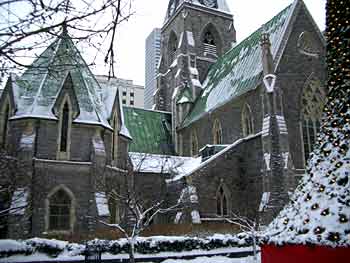
It looks very different in Vermont than it did on Sunday, in the courtyard of Montreal's Christ Church Cathedral (above). There's no snow here! It's very cold though, and dropping - about 10 degrees below 0C.
So I'm back, feeling much improved, and have spent the day working on business stuff, wrapping a few packages that needed to get into the mail, and hauling some Christmas decorations out of the attic. J. went out early and came home with an enormous poinsettia, and I put some candles in the center of our Advent wreath, so the house is beginning to look Christmasy, even if the scene outdoors is not exactly a picture-postcard of New England holiday scenery.
Soon after getting back here last evening we went over to see my father-in-law, and tomorrow I'll write another installment about our talk with him. Tonight he called here, and when I answered the phone he said, "There's a beautiful new moon for you tonight," and we talked about the moon over the phone; he said he could see it from his room - "So delicate! So lovely!" The moon had accompanied us all the way home after sunset yesterday, its tiny points looking as if they were piercing one cloud, as its bottom curve rode lightly, sidesaddle, on another.
Thank you to everyone who sent get well wishes - they were very much appreciated! And I want to say welcome and bienvenue to readers who may not have commented here before, especially to new readers from Canada. Please don't be shy - I'd love to hear from you, in English or in French. This is a friendly, multi-cultural place where your comments are welcome and discussion is encouraged; please join in and help me improve my knowledge of my new second home and second language.
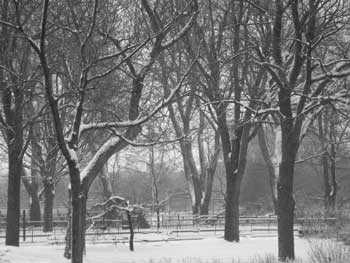
It began yesterday and continues now, the fine sifting-down of weightless multitudes from white skies onto an ever-whiter earth, traced and divided by the charcoal strokes of trunks, branches, twigs.
Inside, another world of white accumulation: weightless tissues floating from white boxes, sheafs of white paper, computer screens filling with black symbols.
Muffled, damp sounds: traffic in the wet street; a voice; a cough.
Patience argues with pity Both are shocked By a red scarf
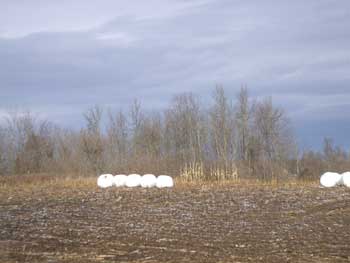
A few years back, the rectangular hay bales of my youth were gradually replaced with the big round "shredded wheat" variety; now many farmers wrap those bales in white plastic, like these, striking one more blow to the natural aesthetics of an agricultural landscape. Maybe someone can explain to me why this method is preferable.
A field like this speaks to me of geese feeding on the bits of corn left among the stubble, mice running from the hawk overhead, a deer standing stock-still on the edge, ears flared, ready to bolt. If it were closer to the bottom-land along the river, you might walk it in the late afternoon and find an arrowhead turned up by the farmer's plow. But in an upper field like this one you'll find much older artifacts: smooth rocks the size of an egg, rolled and tumbled beneath the plow of the glacier. Early settlers gathered the bigger, softball-sized cobblestones, set them in mortar, and built houses of them, and foundations for their barns; some are still standing within a few miles of here.
Thursday, December 09, 2004
And a majority of Canadians support it...
The Supreme Court of Canada rules that legalizing same-sex marriage would not violate the Canadian constitution. (BBC)
The judges said that the federal government's proposed definition of marriage as "the lawful union of two persons" would not violate the constitution. However, they stopped short of saying that the Canadian constitution actually required the government to allow gay marriage across the country...Gay marriage is already legal in six of the 10 Canadian provinces and one of its three northern territories, but it remains illegal in the rest of the country.
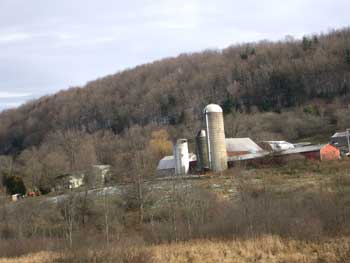
You know what? I'm tired. Words aren't coming easily, I've been working a lot and thinking a lot, I've had a cold, and I need some extra sleep. So I'm not going to push myself to write a lot here for a few days, and instead I'll post some pictures, and maybe a poem or two. The photograph above was taken last week in central New York; this is the sort of landscape that will forever say "home" to me. I can not only see this particular place, turning myself in an imaginary circle to take in the hills, the pond, the field stretching away to the river, but smell it: the dampness of the earth and the cut cornstalks, the pungent barn, the prickling in my nostrils from the cold air. And I can feel the thinly frozen earth: the slight crunch of the ice on top of the mud in the furrows of a field as the hardness gives way under my feet, and in the air overhead, hear the cry of a hawk; in the distance, the lowing of a cow.
Last week, Pica wrote a post about the decline of American fiction that got some very interesting and thoughtful comments. Today, elck wrote about his favorite novels, and the commenters are not only piling up titles that they recommend, but talking about changes in fiction writing - it's all fascinating and I urge other readers to take a look and join the conversation. Which reminds me - I haven't updated my own "book notes" (linked at left, after the list of blogs) for nearly a year. Now there's a memory exercise to tackle...
Sunday, December 05, 2004
A few days ago we received the November “Parliamentary Bulletin” in our mailbox. The MP (Member of Parliament) for our district is Gilles Duceppe, who also happens to be the leader (chef) of the Bloc Quebecois. In his report for November, he talks about how the Prime Minister, Paul Martin, of the Liberal Party, promised to address “inequalities” in the way funds are distributed to the different provinces. There is a surplus of funds, and Quebec is on the short end of what was promised. Duceppe doesn’t mince words: “Decidedly, the new era of cooperation that Paul Martin announced with great pomp is already still-born…he has ample means to address the inequalities, but he doesn’t want to do so voluntarily.”
I’m impressed with the determination of the Bloc Quebecois to tenaciously represent the interests of the province, and also with how much power the party actually has: in the current Canadian House of Commons, there are 134 Liberal MPs, 99 Conservatives, 54 Bloc Quebecois, 19 NDP, and 2 Independents. The four parties represented all are legitimate players in Canadian politics who help frame the ongoing debate about priorities, and who hold the ruling party to accountability. I’m very much a new observer here, but it seems to me that the level of debate in Canada is generally higher, more public, and stoops less to the personal attacks we’re so used to in the US – politicians stay on topic, and seem to see themselves as representatives of their constituencies’ best interests (although I've heard a lot of criticism of the Liberals as waffling moderates who talk a good game but don't necessarily accomplish much.)
One of those interests in Quebec, particularly, is the environment. On the Bloc Quebecois website one of the hot topics is a debate about a U.S. Army Corps of Engineers proposal to greatly enlarge the St. Lawrence Seaway between Montreal and Lake Ontario to allow the passage of Panama-Canal size boats. The party is very vocal about their opposition to this (“Touche pas a mon fleuve!”). They are also proud of recently obtaining an amendment to a law which will levy fines on marine polluters whose actions could harm migratory birds. And imagine my surprise when I opened the inside of Gilles Duceppe’s report, and found that it was devoted to greater awareness of organizations working in our district to protect and improve the environment: groups such as VeloQuebec, which promotes the use of bicycles; EcoQuartier, which tries to educate and involve citizens in beautifying the urban environment and increasing recycling; EquiTerre, which promotes equitable trading and ecological commerce as a choice available to consumers; and – believe it or not – Greenpeace. There was also a sidebar of facts about OGM, the French acronym for GMO (genetically modified organisms) and how different countries are responding. Can you imagine an American political party, let alone the dominant one (which the BQ certainly is in Quebec) endorsing Greenpeace, or the use of bicycles, or coming out strongly against GMOs? I do sometimes feel like I’ve dropped down Alice’s rabbit hole into a different time and space – but it also shows what can happen when a population insists that the political system support sustainable practices and wise decisions about the future.
I’m still very far from understanding how we might bring some of this awareness and involvement to a greater percentage of the American population, but I certainly hope to learn more about how and why it works here. For one thing, when a country is not feeding a military machine and consumed with fighting terrorism, and when people feel their basic needs are sufficiently met, there tends to be money and time to talk about quality of life. And here people seem to see quality of life not so much as one’s personal lifestyle measured in goods and money with which to impress others, but something that is shared and for which they are jointly responsible. There are a lot of people in the US who would agree with that, but as Rana points out, we are neither heard nor organized – not yet anyway.
There are explosions outside, but it's fireworks at the conclusion of the "Marche des Flambeaux", a candlelight citizen's march, with instrumental music and choirs, to kick off the Christmas season in the Plateau and raise money for Christmas meals for the needy - each candle purchased for the march contributes to a fund that is used to feed people. We wanted to go, but I'm coming down with a cold (dammit) and standing around in wet, below-freezing weather didn't seem like a great idea. Instead I've spent the day trying to solve a technical problem on the professional side of my life, as yet to no avail, stopping the head-bashing now and then to read some blogs or knit a few rows, with gratitude for life's simpler things.
The Thai government is planning to drop over 100 million origami birds, made and sent in by citizens, on the disputed Muslim southern area of the country, as "origami peace bombs". The air drop is partially in response to a horrific incident in which 80 Muslim protesters suffocated when they were taken into custody and piled on top of one another in a army vans. Apparently the Muslims in the area of unrest accept the gesture but see it as simply that, a gesture, saying, "a political solution would be preferable". On the other hand..Thai citizens everywhere participated in the paper-folding, and how amazing it will be to see those paper birds fluttering out of the sky. I'm not cynical enough to dismiss the idea that symbolic gestures can spark real change. (from today's BBC)
Marja-Leena recently posted about an exhibition of experimental Inuit prints, and the art was so wonderful that I wanted to encourage you all to go over there and look. As she and I have been discussing, I love a lot of Inuit art and have been sad to see how the rawness and directness of the early work has given way to some commercialism and repetition. But because the printmaking techniques used for this exhibition were new, the work breaks free of convention and the artists seemed free to "play". For those who don't know her site, Marja-Leena is a highly-accomplished Canadian-Finnish printmaker and she often writes about, and links to, works by other contemporary printmakers and art of native or aboriginal peoples. Thanks, M-L, for this link and for all the wonderful art you lead us to!
Tonight we went to a free concert at the Chapelle Saint-Louis of Eglise Saint-Jean-Baptiste, not far from our apartment. We arrived only a few minutes early, after a brisk walk in the cold, and joined a serious audience of fifty or so; the woman next to us in the pew was reading Hegel. The concert was by two groups of young musicians, in their early twenties, it seemed, from the Montreal Conservatory, playing Baroque chamber music. There was a small orchestra of flutes, strings, oboe, bassoon, harpsichord, a lute, and another ensemble of harpsichord, cello, and two flutes. They were quite good - and it was nice to watch their concentrated young faces and the happiness when they played well - but we found ourselves fascinated by the space. The concert was in a side chapel of this enormous church, and it was a confection of over-the-top French ornateness and sentiment - gilded plasterwork, domes, niches, gold mosaic behind the altar, porcelain statuary, pink and yellow painted plaster walls, and maudlin Stations of the Cross paintings on the walls. All rather run-down, but fascinating: my instant reaction confirmed yet again how Anglo I really am, and how Protestant.
At one point we were invited to promener into the church to hear two pieces for tuba and organ. St-Jean-Baptiste itself is a cavern, with an enormous dome; a huge altar like a half-round stage under that dome, with yellow marble pillars rising up to another giant, gilded construction of filigreed blue and gold, with angel faces staring down from the top rim of the dome, chandeliers, carved saints, and huge copper sanctuary lamps, burning red in the half-darkness. There are so many pews, all with brass number-plates on the ends - so I suppose at one time a church like this would have been filled on a Sunday morning. Tonight it felt empty, cold, unused, in contrast to the chapel which was at least warm and filled with an enthusiastic audience of friends and family of the young musicians.
One of the two conductors was a young man obviously in love with the Baroque; he had on a dark shirt under his jacket and a loose dark satin bow at his throat; thin round glasses; his hair, which came halfway down his back, was tied back with a wide maroon satin ribbon; and he conducted while playing his own violin.
We woke this morning to an extremely dark bedroom, and when we looked out the window there was thick heavy wet snow on everything, and falling fast. J. peered out the front window. "Oooh," he reported back to me (still in bed with the covers pulled up). "People don't look happy." There were still bicycles going by, and parents pushing babies in strollers, and joggers...but everyone looked slightly shocked: they were trying to continue doing what they've been doing every morning since April...what had happened? Even the poor kids trapped in their strollers seemed to be leaning forward in alarm, kicking their little feet, or wriggling around trying to get out of the cold wetness suddenly assaulting them from the sky while the earnest parents trudged onward, valiantly trying to keep the wheels moving on the mushy sidewalk.
It would have been a good day to stay inside, drinking tea and eating cake, er, I mean making healthful, warming soups (I actually did do that - the soup part), but instead we went out exploring and came home with a fireplace grate and a set of fireplace tools, and some dark green linen-y curtains for our bedroom, all acquired at RenoDepot (the Canadian version of Home Depot), along with a few Christmas presents. And after dinner I finally got my cake - something called gata that has become a favorite - a Persian sweet bread that has some sort of ricotta-like cheese in the middle and a shiny, deliciously delicate light brown crust on top.
It's still raining/sleeting. I'm going to get in bed.
I just found an online advent calendar that looks quite wonderful. It's called Tate's Calendar(Tate is, apparently "le chat qui rit" - the cat who laughed) and the calendar, drawn by Penelope Schenk, features the adventures of a black cat, with a story for each day. Take a look.