Friday, April 30, 2004
GENEVA CONVENTION? WHATS THAT?
For more on civilian contractor involvement in the Iraqi prisoner abuse scandal (see below), here is an article from The Guardian. We may not be reading these details in the domestic media anytime soon: after all, CBS sat on their photos for 2 weeks at the Pentagon's request. (Thanks, qB!)
3:10 PM
|

The kitchen is clean, laundry done, computers backed up, oil changed, bags packed, plants arranged in one place to make it easy for my friend who offered to water them. So I must be ready, right? Actually, it feels that way. I am ready, and looking forward to both familiar and unexpected places and events. One of those will be our first experience with Canadian dental care. J. has decided to have his surgery and implant preparation done in Montreal, after receiving two totally conflicting opinions - I kid you not - from local endodontists. One sent a report to our regular dentist showing the tooth with a large "X" over it, and the abscess clearly marked, recommending surgical extraction as soon as possible. The other (who had done the original root canal) said he could see no sign of continued infection, and that he'd see J. in three months for a follow-up. The first said the root seemed fractured and the canals incompletely filled; the second said the tooth was intact. This would be funny if it weren't so painful, as they say.
---
Susurra and others have been blogging about recent developments in Iraq and asking how people are dealing with their frustrations and anger. It is truly frustrating. I spent two years doing everything I could to try to prevent the war and the kind of atrocities we are seeing in Falluja and at the prison. I've spent another year using my blog to try to help myself and others live in a world where violence is committed in our name, and despair and hopelessness loom ever larger. Now I'm about ready to get back out onto the street corner with my sign: what shall it be this time? How about simply, "Enough is Enough". But instead I am leaving for Canada, and a different political climate. This is not an escape, but it always gives me a greater perspective. There will be different films shown, to audiences with a different political temperature; the headlines will be different, along with the comments and concerns of people we meet. I hope to talk to the group of fine people we met two years ago at the Montreal Women in Black demonstrations against the Israeli occupation of Palestine. And when I get back, I will again do something more tangible and public here.
Right now I think all of us are in different places on that line between self-preservation and public outrage. Some of us feel numb, some express a lack of surprise. As for me, I will never cease to be shocked by human capacity for violence and atrocity. Last week I saw not only the prison photos but a four-page series of eye-witness photos from the streets and make-shift hospitals and morgues in Falluja. I didn't make it through the second page. I'm not one who can live with phrases like "there will always be wars" or "it's nothing new". While I agree that both statements are true, without people who stand up and shriek with outrage, or quietly commit parts of their lives to waging peace, there would have been far more wars and a future without any hope at all. If we are not surprised, we still must be shocked, and allow that shock to motivate us into action. Are we going to be people who are "shocked" at Janet Jackson's tits, or at dead children and flagrant abuse of prisoners?
What does no good at all is preaching to the left. If you want to do something, talk to people who don't agree with you, write Congress to get off their fat, special-interest-rich tails, and pressure the American media to cover the deteriorating situation in Iraq as vividly and fully as it is being shown to the rest of the world. The media is key, and has been key all along, to whether this administration gets away with murder or not.
Today, the prison scandal is the lead story on the BBC. It was mentioned as an aside on CNN and CBS, and not on any of the other major online network news sites I checked this morning; the media pegs us as people who are far more interested in Michael Jackson's day in court. But you know what? I think they're wrong about that. There was no mention on The New York Times. They got a letter from me.
(Blogging may be spotty for the next few days as we get settled, then I?ll be back.)
1:50 PM
|
Thursday, April 29, 2004
The fire department wouldn't let us have a bonfire today - "too windy" even though the air was absolutely still in the village - but we pulled all the silvery-grey, dried stalks of Jerusalem artichokes on the bank, and cleaned up the vegetable garden, and I held the extension ladder while J. cut a big, overhangng branch out of the apple tree. All day long the whir of the tape backup system ran in our ears, copying hundreds of gigabytes of data, while I attended to totally analog chores like cleaning out the refrigerator.
This evening after dinner we went over to our neighbors' for a goodbye glass of wine. It was the first day wam enough to sit outside at night, so we reclined on our elbows in their backyard, under the tall spruce trees, drinking one bottle of good wine, and then another, while the planets and stars made their appearance in the heavens. I hadn't watched the stars come out for a long while - not since last summer - and it was magical to see them materialize one by one, until they populated the sky, and then were gradually covered by thin high clouds. Our neighbors are from Iceland, and they said that Icelanders get into some sort of cocoon-like sleeping bag affair, lie in a snowbank, and drink beer while watching the stars in the middle of winter. Sounds good to me. City nights won't be like this, I reminded myself; we won't see these stars again until we return home in June.
10:33 PM
|
Wednesday, April 28, 2004
My father-in-law was already exhausted when we arrived for lunch. I was carrying a vase full of yellow blossoms. “Forsythia!” he said, his face lighting up as he struggled out of his chair to go into the dining room “It must be spring.” He had told me last week that when he first came to America it was winter, and in the spring, in New York, after that first long lonely winter, the forsythia bushes suddenly bloomed and he couldn’t take his eyes off them. “They’ve always meant America to me,” he said, smiling to himself, remembering. “Beautiful!”
Today, though, all his ninety-five years were showing. His blood sugar, which has been high, had plummeted, and he said they had stopped hsi medication and told him to eat sweet things: he had lentil soup, and then a plate of mandarin orange sections and strawberries. “I don’t understand it,” he said, and when he got up to get some water we decided to talk to the nurse on our way out. We went up to his apartment but left pretty soon after searching through piles of magazines for the latest New York Review of Books, with an article he recommended to us. He had an Arabic lesson to give at 4:00 pm. “Sleep,” we said.
“I have to,” he replied.
Later I did errands: a new pair of jeans, some toiletries, socks, and a mini book-light for late night reading, since we won’t have a second room to go to. There’s a pile of carefully-folded clothes in the bedroom, awaiting my duffle bag, and a growing pile of books, some associated with my writing project, along with a French dictionary and phrase books in French, Arabic, Farsi and Chinese. I considered taking my neglected knitting project and haven’t decided: will it be a distraction, or will I be glad to have it? The knitting bag is definitely going: it was a present from a friend, bought for a few dollars in Cambodia from the woman who wove it, and it’s perfect for market shopping. I think of that woman every time I use the bag and her comment to my friend: “Thank you very much, that is my treasure for today.” One day’s income, greatly appreciated, about equal to what I’ll pay for a couple of avocados, or a mango.
Downstairs, dahlia roots are soaking in a bucket of water and will be potted tomorrow; I put out two other pots for sweet pea seedlings that a friend will tend for me. Leaving my garden at this time of the year is the only wrenching part of this trip. Everything is so fresh, new, eager to thrive. I’ve done what I could, knowing I’ll come home to chaos, and flowers overrun by goutweed, but the garden is always in my head and my heart, ever willing to be considered and walked-through, whether from the perspective of February, or a city apartment.
10:24 PM
|
SPRING
 Poppy Frills Poppy Frills
6:49 PM
|
Tuesday, April 27, 2004
My restless sleep pattern is continuing. I fell asleep at 10:30 and was up at 12:30, went to the couch, and slept fitfully until 3:30, when I went back to bed. I’m worrying about several things, all of which loom larger in the middle of the night, like shadows cast by objects familiar during the day. At least, once I leave here, some of those things will recede because I won’t be able to do anything about them. But the dread I’ve felt all year about mortality is all too portable. All other fears seem manageable intellectually, but not that one, tied as it is to factors totally beyond my control and fueled not only by the turn into my fifties but by a spate of illnesses and deaths among family and friends. What have been underscored, and what I haven’t faced squarely, are the strength of my ego-attachments, and the weakness of my faith that this dread reveals. How interesting it is that I believe in judgment, but find it so difficult to believe in eternity. I do feel responsible for my actions, and even though I would live the same way, I think, and make similar choices, I know I have believed that I’d be held somehow accountable – whether by God or by the laws of karma - ever since I was a child. Judgment isn’t the problem, though. I don’t spend my nights wracked with guilt; I know I try very hard to do the right thing. It’s the possibility of extinguishment that haunts me, the loss of that most precious attachment to my consciousness, as well as the loss of all that is familiar and dear. And yet I would tell anyone else, with certainty, that death is not forever, that it is a transition – to something unknown, certainly - but to something. I believe so strongly in the power of love and in what we are called to do here on earth; I believe in grace and have felt it countless times in my own life. Yet I come face to face with this wall of my own doubts. I thought, naively, that I'd already dealt with this. But it seems this is what I’m being asked to confront: more deeply, and head-on.
In a few minutes I need to prepare the service leaflet for today’s interfaith prayers and figure out a reflection or a reading. I’m cleaning out the freezer and took out two big containers of soup for our communal lunch. Because some of us are Muslim, we always have vegetarian soup; one container is carrot/tomato, but the other is split pea with ham. Being very careful to use separate spoons as I heat the two pots, I’ve been mulling whether it is all right to take the split pea soup or not, and decided after three years we know and trust each other enough that the Muslims won’t be offended. If they are, I will have learned something else that I needed to know.
Yesterday I made a to-do list for the trip, including a long list of what to pack. “I’m going to have to take a box of books,” I told J. “Sorry.”
Later: As it turned out, I decided not to take the split pea, and instead made a quick pot of red lentil soup. We met, had our service, prayed for peace, ate a good, simple lunch of soup, bread, cheese and fruit. I did the dishes while J. dried plates and silverware and put things away in the church kitchen. A light rain began falling as we drove home, and I looked out the window at the budded crab apple trees and the New England houses with their daffodils and forsythia bushes. It was beautiful, quiet, idyllic. “I can’t wait to get out of here,” I said.
I’d be a terrible Muslim and a terrible monk; repetition eventually drives me nuts. Ever since I was small, I always had a hankering for the strange food, the different person, the odd color, and most especially something different to do: something that would shake things up in my predictable world. It never got out of hand; I wasn’t a rebel in the classic sense. But I find sameness, eventually, more stifling than comforting. Paradoxically, perhaps, my spiritual life has been a way of coping with the sameness and the constraints that life imposes. I’ve found that one good aspect of repetition is that it creates a framework against which you can see yourself change. A meditation practice can be boring, just as liturgy can be boring. Work can be boring, and so can a long-term marriage. There are some limitations I willingly accept – loyalty and faithfulness to my partner, for one. The need to work hard and steadily in order to have financial security, as well as some freedom. Responsibility and commitment to friends and family, and certain organizations and institutions. Discipline and practice moving along side-by-side with creativity. I know that sometimes these things will feel exciting and joyful, and sometimes they’ll feel dull and nearly lifeless; this is reality. I also know that sometimes it’s important to be jolted - to experience a seismic shift – in order to see life and self afresh.
The place I live now is one where many people come to retire, or to find a lifestyle that is predictable, clean, pleasant, ordered, safe, white, liberal, Christian and…”nice”. When I moved here, back in 1976, the place was a lot more raw around the edges. Now it is, as someone at our lunch remarked, “a nice small town in Connecticut”, except that it’s a couple hundred miles north. A while ago a journalist wrote a series of newspaper articles skewering life and attitudes in the flagship town in our region, which he never named except to call it “Nicetown”. People were outraged, but they could hardly argue; he had it absolutely pegged.
I’m tired, I guess, of niceness in a world which is anything but. It’s time for a jolt that lasts longer than a weekend in the pulse of Manhattan; it’s time to immerse myself in a totally different environment and see if I can adapt, and see what it teaches me about myself and about this place that I’ve called home for nearly thirty years. Like a turtle, I know I carry my most essential “homeness” on my back and can’t shed it, even if I should want to, but I want to know what it’s like to swim in salt water rather than fresh.
On the other hand, all the solitude I’ve ever found was right here, which tells me that it is something I carry with me, too. Solitude is more a potential than a place; I just think the press of patterned behaviors and the weight of responsibilities have shoved that potential somewhat into the background lately. And I am rarely alone. Being alone – alone in the house, alone in nature, alone in a cathedral or a café – is a prerequisite to contemplation for me, and those opportunities are exceptionally rare in my normal life. Because of the way I’ve lived, I’ve learned how to pull a cloak of solitude around myself, even when I am not physically alone, but I think I yearn for an easier time of it.
We’ll see: we’re about to live for a entire month in one room instead of nine, but in a large city where one can either lose oneself in the crowd or find intimate, anonymous places in which to be alone and undisturbed. The seismic jolt is coming.
3:20 PM
|
Monday, April 26, 2004
RED AND BLUE AMERICA
Highly recommended: a three-part series from The Washington Post on the ideological and cultural polarization of America, and, by extension, the American electorate. The first installment is an overview. Today's article is a visit with a "red" (conservative Republican) family in Texas; tomorrow's will be with "blues" (liberal Democrats) in San Francisco.
8:24 PM
|
In winter the stripped landscape of Nelson County looks terribly poor. We are the ones who are supposed to be poor; well, I am thinking of the people in a shanty next to the Brandeis plant, on Brook Street, Louisville. We had to wait there while Reverend Father was getting some tractor parts. The woman who lived in this place was standing out in front of it, shivering in some kind of rag, while a suspicious-looking anonymous truck unloaded some bootleg coal in her yard. I wondered if she had been warm yet this winter. And I thought of Gethsemani where we are all steamed up and get our meals, such as they are, when meal time comes around, and where I live locked up in that room with incunabula and manuscripts that you wouldn’t find in the home of a millionaire! Can’t I ever escape from being something comfortable and prosperous and smug? The world is terrible, people are starving to death and freezing and going to hell with despair and here I sit with a silver spoon in my mouth and write books and everybody sends me fan-mail telling me how wonderful I am for giving up so much. I’d like to ask them, what have I given up, anyway, except headaches and responsibilities?
Next time I am sulking because the chant is not so good in the choir I had better remember the people who live up the road. The funny thing is, though, they could all be monks if they wanted to. But they don’t. I suppose, somehow, even to them, the Trappist life looks hard!
Thomas Merton, The Sign of Jonas. An entry from January 8, 1949.
It’s a grey, dark day here, and when we woke there was rain pelting against the roof. It’s let up now, and in the bathroom the rainwater is slowing sliding down the incline of the skylight, blurring the silhouettes of the bare-branched treetops. This is the sort of weather that has been depressing me all through the late winter, but today it seems almost indescribably beautiful. It is practically the last day for bare trees; leaf buds are swelling on all the red maples and the honeysuckles are already covered with a cloud of pale green. On the apple tree outside the bedroom window, drops of water hang from the ends of each black twig, daring both gravity and time.
In less than a week, we’re heading to Montreal to live for a month. This will be the longest amount of time I’ve spent in a city in my half-century of life. We’re going as a change from the life we’ve led here, from the house we’ve inhabited for more than 25 years, from the rural countryside, from the particular web of responsibilities and patterns we’ve woven. Besides being urban, Montreal is an international city: proudly and gracefully maintaining its French heritage and a broad ethnic and cultural diversity despite its proximity to the United States and the English-speaking provinces of Canada. It is a mere three-and a half-hours from here, and a world apart.
We’ve been thinking of this month as an experiment. After several years of weekend trips and the occasional week-long stay we want to find out what our commitment to this city really is: how much do we really like living there, and what might that mean for our future? This is what I thought the month was going to be about: practical matters, finding out how we felt, considering some changes and potential investments at this gently teetering point of midlife.
Strange, then, that on this wet dark morning I felt, for the first time in several years, a strong call to contemplation. Could it be that part of this journey might be a sort of retreat, bizarre though it seems to retreat to a city? And yet I feel the call so clearly, bidding me to use the coming time and change of place not for distraction and escape, or merely for outward life decisions, but to learn something inner and as yet unrevealed.
For those who believe in God and believe, further, that She has a sense of humor, consider the idea of moving a writer - especially one steeped in the ultimate contemplativeness of rural Vermont life, complete with clapboard-clad house and vegetable garden, and a pervasive silence punctuated only by bird and cricket - to the bustle and endless distraction of a city of three million souls for the purpose of contemplation. Funny, even preposterous. But that’s what may be happening. I’ve been on this winding, unpredictable, and largely dusty spiritual path for long enough now to recognize the changes and imperatives when they come - and for the most part, they have come like this, of the blue.
What immediately fits is the fact that contemplative solitude, for me, is actually easier to find in the city. Having lived my entire life in the fishbowls of small towns, where I cannot step outside my door or buy a bag of carrots without running into someone who knows me, the anonymity of the city is a huge relief. It creates a sense of freedom that is impossible for me here. Perhaps because of living so many years in the country and close to nature, solitude, for me, is not dependent on silence, but on being removed from the obligation to talk, interact, and plan. And yet, being a social creature and a moderate extrovert, and knowing that my husband – the opposite - likes to take off for long periods of photographic exploration on his own, I’ve been a little worried about having to deal with too much solitude during an entire month of urban living. “Use it,” I hear now. “It’s a gift.”
This morning there’s much that I don’t understand. Is this simply an emotional reaction to the Merton I’ve been reading – the kind of excited, creative impulse I often feel when reading or seeing something that inspires me, but which afterwards reveals itself as just that – a kind of steamed-up excitement that quickly evaporates when I steps out into the daily reality of life? Or is it the real thing, which, if I follow it out, will lead me somewhere I’m meant to go? And in that case, what was that decision to pick up Merton during Holy Week? How do we ever know these things? All I know is that certain books have leapt off shelves into my hands for years, and changed me, and changed the course of my life and my thinking. What I suspect is that in this case, choosing to read this particular volume of Merton again was a sign that I was entering into a psychological place that was receptive to contemplation. What I didn’t do was connect it to the upcoming travel. And whether that happens or not depends on my assent to the invitation.
(I'm planning to keep a journal over the next five weeks and to blog pieces of it; this is the first installment. Please don't stop talking to me, though!)
8:14 PM
|
Sunday, April 25, 2004
My parents came to visit this weekend, and we had a good time. In addition to the usual conversation, cooking, eating, and a little shopping, we had a Ukrainian egg-decorating session, and watched two movies in the evenings: Master and Commander, and the new Jack Nicholson/Diane Keaton romantic comedy for the reading-glasses generation, Something's Got to Give. Enjoyed both, although I had to shut my eyes during the shipboard surgery scenes in Master and Commander. I've never read the O'Brian books, having gotten a bit turned off by some over-enthusiastic Anglophile fan-friends of mine, but the movie piqued my interest through the terrific characters and by bringing up a lot of esoteric sailing questions (how many replacement sails did those boats carry, anyway?) Any of you read them? Comments? My favorite part was, of course, the Galapagos sequence. Chris, wouldn't a nice, big, gentle tortoise be a great addition to your growing menagerie?
-----
On Saturday, Denny wrote about hearing a performance of Beethoven's Ninth Symphony at St. Paul's Cathedral in London one July Fourth, and today he wrote some thoughts about our military personnel. These posts jogged a couple of memories for me. First, I know exactly why Denny got disoriented getting off the Tube at the stop for St. Paul's because the same thing happened to me the first time - you'd think the cathedral would be right in front of you, and it is, sort of, but you can't see it. He said he asked directions from an old man selling newspapers, and when the man asked him if he was American, he said yes, and the man said, "Happy Birthday."
I've had similar experiences in London with older people for whom WWII was still the defining event of their lives. What I heard in their voices and saw in their faces was totally undeserved gratitude to me for being American. The memorials to Allied servicepeople killed in that war are in many places in London, but nowhere so poignantly as in the chapel behind the high altar at St. Paul's, which was rebuilt after German bombing.
My father was a tank driver in WWII, and he crossed the Channel to land at Normandy the day after D-Day. He had been in London briefly, and then was in engagements in France, Belgium, Germany and Poland, including the Battle of the Bulge. He was eighteen years old, the son of a small-town Methodist minister. Like Denny, he came home. A number of his friends didn't. If he hadn't, obviously I wouldn't be here.
Anyone who reads these pages regularly knows my feelings about war, but I want to make clear that one reason I hate it so much is the price that young people are asked to pay by serving in the world's armies. I know a little bit about this because of growing up in a houseful of adults who had all been profoundly affected by WWII. I couldn't agree more with most of Denny's reflections about the sacrifice these young people are being asked to make; and frankly, if the leaders who've sent their nations' youth into battle throughout history had had to make those sacrifices alongside them, we would have had a lot fewer wars. We talk about governments going to war because they can rely on stockpiles of armaments, but less is said about the way they have always relied on the supply of young human beings, without whom armies would be impossible.
In that back chapel in St. Paul's, there are stained glass windows honoring the Americans who served and helped save Britain. There is also a huge book in which are written the names of the 28,000 identified American soldiers who were stationed in the United Kingdom for a time and died in its defense. You can ask to be shown any name. I looked at that book, and I wept for a long time.
There was a lot more to that old man's "Happy Birthday" than mere hospitality; I'm not sure it's something that we can even comprehend from this distance of time and experience.
3:55 PM
|
Saturday, April 24, 2004
MERTON ON ELIOT
"For the first time it has been warm enough to sit outside. After dinner I sat in the sun and read T.S. Eliot's 'East Coker' and part of 'The Dry Salvages' from Four Quartets. Eight years ago when we were at the cottage at Olean, Nancy Flagg had 'East Coker' in manuscript, for it was still not published. We all said we didn't like it, but today I like it quite a lot...I was surpsied to find him drawing so heavily on St. John of the Cross; I do not see immediately how it fits in...but the beginning is fine and the rhymed sections are very beautiful - as beautiful as anything that has been written in English for fifty years or more.
Thunder rolled by the rolling stars
Simulates triumphal cars
Deployed in constellated wars
Scorpion fights against the Sun
Until the Sun and Moon go down
comets weep and Leonids fly
Hunt the heavens and the plains
Whirled in a vortex that shall bring
The world to that destructive fire
Which burns before the ice-cap reigns.
I think this book is the best of Eliot. Also, I admire Eliot's literary chastity. he is not afraid to be prosaic, rather than write bad verse. but when he is very prosaic he is weak...
...As a poet, I have got to be sharp and precise like Eliot - or else quit.
Thomas Merton, The Sign of Jonas, an entry from March 14, 1948
4:01 AM
|
Thursday, April 22, 2004
Thomas Merton was always struggling to find a balance between action and contemplation, mostly complaining that he couldn't get enough quiet or contemplative time in the "busyness" of the monastery, despite the vows of silence and the goal of contemplation. He tells the following story, at his own expense, about a fellow monk who had recently died. I guess I could imagine myself getting the same kind of comeuppance.
I asked Reverend Father what made Brother [Gregory] so saintly. I don't know what kind of answer I was hoping to get. It would have made me happy to hear something about a deep and simple spirit of prayer, something about unexpected heights of faith, purity of heart, interior silence, solitude, love for God. Perhaps he had spoken with the birds, like Saint Francis.
Reverend Father answered very promptly: "Brother was always working," he said. "Brother did not even know how to be idle. If you sent him out to take care of the cows in the pasture, he still found plenty to do. He brought in buckets of blackberries. He did not know how to be idle."
I came out of Reverend Father's room feeling like a man who has missed his train.
(The Sign of Jonas)
11:03 PM
|
Wednesday, April 21, 2004
I was stunned yesterday when I visited CommonBeauty and saw that he is probably giving up his blog, and today I've felt really sad about it. A loss for all of us who have been privileged to read his fine writing, glimpse his thoughtful mind and sensitive heart, feel his generous spirit, and see his drawings. He's busy with so many wonderful things in actual life, though, I can hardly blame him, just wish him the very best.
Usually I think of myself as dealing with change pretty well, or at least being philosophical about it, but this sudden potential departure made the ground quake under my feet a bit. A while back some of us - led by Butuki, I think - were speculating about whether web friendships are real or not. They feel real to me, but we are not responsible to each other in the same way; it is as easy to pull the plug and disappear as it is to one day stop clicking on a link we've clicked on for months. Gone!
I realize, thinking about this, that I'm not very good at protecting myself from disappointment and loss. I tend to engage and pick up the pieces if they fall later on, and I doubt that characteristic will change. It's like the students who I come into contact with through church and the college: you can either engage and be fully present, knowing it's temporary, or not. I suppose all relationships are like that, really, aren't they?
9:30 PM
|
Tuesday, April 20, 2004
"According to the Franciscan priest Richard Rohr, spirituality is not for people who are trying to avoid hell; it is for people who have been through hell. In many ways, spirituality is about what we do with our pain. And the truth is, if we don't transform it, we will transmit it."
- Al Gustafson
via whiskey river
10:14 PM
|
Kurt is blogging today, with his usual perceptiveness, about that recurrent subject of whether to write about politics or not, and how to deal personally with the anger he feels about current events. We've talked about that here but it's one of those bottomless subjects, always with room for another take.
One of the great hungers I sense is how to observe and absorb the horrors of today's world, and yet remain open to its beauty and functional as a human being. And many of us want to make a difference. I've been very engaged politically and as an activist for big chunks of my life, and there have been other times, like the present, when I've stepped back. Usually that's because the protest has run its course or lost effectiveness, or because I've come close to burning out, or because other priorities in my life came to the fore. Sometimes I've stopped reading or listening to the news very much, as self-preservation. So I think the first requirement is to listen to your emotional and physical self and try to see what you have strength for, remembering that sometimes it takes more strength to disengage than to engage. Right now I'm not standing on street corners holding signs. Last year I was. This fall I may do it again, or be more involved in the campaign; I'm not sure. I've wanted to sponsor a Palestinian child; maybe the current situation will make that decision finally happen.
But I try to never stop being a witness. Wherever I am, if talk turns to politics or ethics, I speak up for what I think is right. Often a dinner party or even some chance encounter is a time when a few well-chosen, calmly-spoken words can help somebody move in a more constructive direction. I've kept up leading the monthly interfaith gatherings because I think it's important and because that community of cross-cultural people needs each other. When I'm asked to speak about interfaith issues, or being motivated to social justice by my faith, I nearly always say yes.
The other thing is that I think we can try very hard to "be" peace, and to find the beauty and joy around us. Our attitude toward each day is really a choice that is ours to make; people who live with adversity every day show us that way. I am most inspired by those, like Desmond Tutu, who fully know what is going on, never ignore it, and are full of joy and hope anyway. It's become clear to me that these people are the real saints, not the ones who preach gloom and doom; it is, frankly, a much harder path to get onto than the one of despair and cynicism, but once you're on it, the light you need becomes available and your eyes - even with tears in them - become much more open and receptive to the good and the beautiful.
3:07 PM
|
Monday, April 19, 2004
Last night, late, a thunderstorm came through from the west. My mother, in New York State, had told me they'd had a big storm with lots of rain, wind, and enough hail to whiten the lawn.
We were in bed, reading, when we heard the first distant drum-rolls of thunder, but they advanced quickly, louder and louder, and pretty soon the first fat drops were hitting the windows on the west side of the house, and then cascading onto the skylight. It rained hard for an hour or so, and then let up, and this morning we woke to clear skies and 55 degrees. By 2:00 pm the thermometer said 88 degrees, and when we went out to see if that could possibly be true - it was - J. flopped down on the grass and announcd that summer had come. It was very windy: kite weather, I thought to myself.
I got a towel - the ground is only recently thawed and still pretty damp - and laid down beside him, my dark clothing instantly soaking up the heat. Little goldfinches, newly yellow, chirped at us from the thistle feeder, and on the neighbor's bank, above us, the tall Norway spruce trees swayed and tossed in the stiff wind, while our own maples scraped against each other and complained.
When I finally opened my eyes I saw a scene that I exists in the far recesses of childhood: my own hair, blonde and back-lit by the sun, a few inches from my eye, forming a golden, slightly-out-of-focus curtain beyond which, without moving, I could watch the drama of life that moved on the blades of grass and along the moist earth. The first open daffodil swayed, at eye-level, in the perennial bed. The sun warmed my hair and gave it that special hot, organic scent, and I lay there, quiet, for a quarter of an hour, knowing it might snow tomorrow but sure that spring had arrived.
4:53 PM
|
Sunday, April 18, 2004
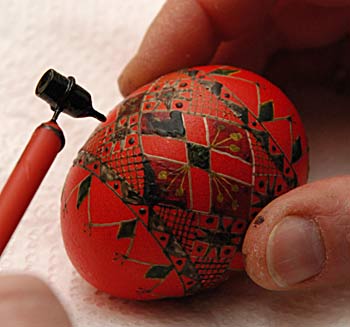
We spent some very happy, meditative, and fun time yesterday afternoon learning how to make Ukrainian Easter eggs. A good friend of ours, who happens to be an Episcopal priest, is an expert at this craft, which is practiced by Ukrainians especially during Holy Week, almost like icon-writing. I've always wanted to learn how to do the technique, which is a sort of batik/wax resist/dye process, but it seemed enormously complicated until the process was carefully explained and de-mystified by our friend. Sitting around a kitchen table with burning candles, cubes of beeswax, stacks of paper towels, white eggs, and the special wax-melting-writing tools with which you "draw" on the eggs was a wonderful way to spend an afternoon. J. and I made several eggs which had a naive, beginner's charm, compared to our friend's professionalism (that's her hand in J.'s picture above), and I liked the process so much I ordered some supplies. My mother and I have made dozens and dozens of Easter eggs over the years, so this is a new technique to add to many others.
7:55 PM
|
READ AT YOUR OWN RISK
WildfireJo is an English activist who writes a blog from Iraq. Her most recent post (April 12) tells of working with an ambulance crew under fire in Falluja. It's difficult and heartwrenching reading, but anyone who has any illusions about what's going on over there ought to read this, and then consider the story we're getting on our news.
2:28 PM
|
Saturday, April 17, 2004

Shoes in a New York window
WELCOME...to the new commenters who have written over the past week. Not only am I delighted to have your articulate, thoughtful voices here -- I got to find your blogs! That is a real gift to me and to others. I hope people read the comments, because a lot of the best stuff at Cassandra goes on there; that has certainly been true this week.
Sometimes, I think, readers are reluctant or nervous about commenting, especially on blogs that are thought of as "literary" or "intellectual", or where there seems to be a community of articulate commenters already. I remember feeling very nervous about making my first comments on other people's blogs, not much more than a year ago, thinking "nobody will talk to me, my comments will lie there like rocks, all these people already know and like each other." I also felt outside the loop because I didn't yet have a blog of my own. It took a while, but now, of course, I realize the latter is not important at all, and that bloggers - at least the ones I know - are a very accepting, kind, appreciative, and hospitable bunch. In other words, this is not high school.
I want to do everything I can to encourage dialogue here and everywhere on the web. It's good for all of us, and frankly, it is an antidote to what goes on in the world of daily life where rejection, disappointment, despair and loneliness are too often the dominant emotions. My only sadness about having a blog that is read by quite a few people is that I cannot enter into an extended conversation with everybody. Yet, there is a lot of exchange, genuine friendship, and a loose, ever-changing, and vibrant community that truly feels like a moveable feast. It's changed my life.
10:40 AM
|
Thursday, April 15, 2004
THANK YOU
...for all the insightful and helpful comments that have been coming in on yesterday's post. I quote only one of many here, this by butuki:
If there is one criterium I have for my own blog it is that I present the best of what I am able to create: the best of my words, the best of my thoughts, the best pictures, the best interaction with others... even if to others that "best" is only mediocre. I've had enough of mediocre daily life. The blog is one opportunity to make a moment in the day shine and speak for the reason of my existence, however small.
1:37 PM
|
CONSUMER REPORTS? WHAT'S THAT?
Last night, we watched a movie in the luxury of our bedroom home theater - which we set up for the price of a digital projector (needed for our business anyway), a screen that folds up and stores under our bed, a $47 DVD player from a discount store, and a $77 home surround-sound system with five small speakers and an amplifier. It's not fancy, and it won't impress our friends, but let me tell you, it's a great way to watch movies.
Thus I was interested to read, in today's NY Times, an article entitled "Finding Glamour in the Gadget" about Sony's plans to launch a luxury brand of electronics - and how they plan to market it to Americans:
Initially anchored by a $3,900 miniature digital camera, a $15,000 stereo system, a $12,000 television and a $30,000 home-theater projector, the product line, called Qualia, is intended to compete with (and complement) fancy cars, furs and rare wines, rather than the rows of anonymous boxes at Best Buy or Circuit City. From the nature film to the products’ oblique numbering system (the projector is formally known as Qualia 004, for instance) to the by appointment-only showroom under construction in Midtown Manhattan, Sony is meticulously calibrating every aspect to exploit and influence the psychology of consumerism.
“We want Qualia to change the way that people relate, emotionally, to these technologies,” said Ken Sugawara, head of the United States Qualia team..."
Sony seems to have it all figured out, from the demographics of the likely buyers (affluent, childless couples in their 40's), to the way their customers -oh, excuse me, "guests" - want to be treated. I had a definite emotional reaction, but it wasn't exactly the one Sony is looking for.
I admit that sexy gadgets are sexy and cool, but does anyone need diamond-encrusted cell phones, or a mini-camera that comes in a scientific-instrument case? I'm writing here on my sleek little Dell Inspiron laptop - and I love it - but I love it because of its functionality. What emotional need are we feeding here? I'm interested in what drives this partnership of over-the-top capitalistic exploitation and consumer desire: do you buy in? If so, why? If not, why not?
1:15 PM
|
CLIMATE CHANGE HOTMAP
A world map that shows climate change fingerprints (glacier melts, weather trends) and harbingers (such as species movement and population declines) along with written details, as well as a lot of other information about global warming. You can click anywhere on the map to zoom in and see detail for a particular continent or region. If you are someone who gets into conversations about this issue, here are facts down to a local level that will help you relate worldwide trends to the longterm impact likely for a particular place, and make a stronger argument.
12:46 PM
|
Wednesday, April 14, 2004

Last night I had a conversation with an excellent writer who is working hard on her first book. "How's your writing going?" she asked, and, as writers do, I deflected the question back, "Oh, no, let's talk about how yours is going." The reason I did that is that mine is going damn slow, or so it feels to me. "If I didn't have to take care of Cassandra," I mused, "maybe I'd get more done on the book."
We talked for a while, a long, mutually-supportive conversation. One of the things she said was, “All writing needs to beget other writing”. I went to bed pondering that, and woke up thinking about it. And I’m not sure I buy it, at least not for me.
The forms of blogging and letter-writing are primary writing for me. They satisfy me just as much as a finished book would – I am quite sure of this now. We find time to do the things we really want to do, and I have found time to do this blog for a year with no sense of waning enthusiasm. I do these less formal forms of writing to get the stuff out – to write for writing's sake, for record, for memory, for joy and satisfaction – but also for the conversation. I love the communication, the relationships, the way one subject and one person feeds another. I like being known for my own quirky mind and way of expressing myself, and being loved anyway -- or even because of it. And I’m anxious to see what my friends have said and done last night, how they are doing, what is most important and most central to them right now, today, and how they have tried to express it. That never ceases to be interesting to me: frankly, it’s just as interesting and compelling as a good book.
Blogging is the most creative outlet I've ever had, and the most satisfying: here are real readers who comment and care, and come back for more - I mean, isn't that what we want? Maybe I'm just getting old and jaded, but walking down the street in New York, past bookstore windows filled with titles screaming for attention makes you realize that you and your precious book are probably not going to last very long in the public's attention; we are not that kind of society. Your book may affect someone deeply, and you may hear about it, and then again you may not. So we had better know why we're writing, and what we want to get out of it, and be pretty realistic about those reasons. Take a look at this piece from yesterday's NY Times if you are prone to romanticizing "getting published".
There's also another side to how we view creativity, and the way we put certain types of achievement up on a pedestal. If we insist on seeing creative work as heading toward specific public goals, and Art as being defined by these big monolithic accomplishments – the book, symphony, masterpiece painting – we will not only set ourselves up to fall short, but we run the risk of being blind to the art that exists in everyday creation, in the thoughts and creative acts that arise when we lift our eyes from a book, or making a meal, or stop to hear a bird song. All those things need to go into our “big art”, if that’s where we’re headed, but they are also important ends in themselves, as blogging and letter-writing remind us. I think we need to remember that, not only to validate what we are doing but because so many people are also doing this process -- of perceiving and thinking and expressing or remembering -- everyday, without ever writing anything down. It’s important to remember that their thoughts and perceptions also layer throughout life to create masterpieces: wise, perceptive, interesting people, without whom the world would be so impoverished.
Having said that, I'm still trying to write my book and also to publish my cycle of village poems, and a fascinating memoir written by my great-aunt about her childhood in rural upstate New York. Is all the above an excuse for my slow progress, if indeed it is slow? Should my blog be feeding my book more directly? If I were thirty would I feel different? Maybe I would if I were more invested in writing THIS book, or if it felt more like my own magnum opus rather than a history/biography that sort of fell into my lap and needs to be written, probably by me.
If I look back I can see that my ideas about Art and Accomplishment have changed over time: they're no less intense, but they're different now; I'm different. What hasn't changed is that I've never been very willing to play the game by somebody else's rules.
3:16 PM
|
Tuesday, April 13, 2004
Saturday night was the traditional Easter Vigil. I was in church, reluctantly, because here at home was a vigil of a different sort: J. was developing an abscess at the site of a failed root-canal, and when I got home he was one sick puppy. That was a miserable night, made only moderately bearable by Percocet and a lot of hand-holding; Sunday was bad too, but by then we had some antibiotics. By today he's much better but still pretty knocked out. A major dental infection is not anything to fool around with, and although he's had others, this was the worst.
Not having children, I haven't had years and years of training in bedside nursing and patient encouragement, but the skills are usually there when I need them. And when you love someone dearly you would do just about anything to spare them from suffering. This past year I think I've spent more days taking care of people I love than in all the previous years put together. It makes me tired, and at times discouraged and drained. But it has also snapped my priorities into crystal-clear perspective. Although there are things I very much want to do and accomplish, putting them aside in a crisis is such a quick decision as to be no decision at all. And there are moments I cherish, as I'm sure all parents do, of sitting up with someone you adore through a long night, with hours to think about that relationship and why it is so precious, and knowing that the touch of your hand, and the meaning of that touch, is being transmitted even through sleep. What I find hardest is maintaining my patience, steadiness, and cheerfulness after the immediate crisis, but during the days and weeks when I'm still needed. How did my mother do that for me? How do some people manage to be constant, selfless care-givers?
I sometimes think about the possibility that I, an only child without children of my own, could spend my last days not with people at my side, but alone. I'm trying to get strong enough so I could do that. I think about all the people out there, including some of you, who don't have a primary relationship in their lives, and are coping all the time with solitude and loneliness, often with pluck and humor despite the difficulties. This might be a good time to say I admire you, and try to learn from you.

Last night we watched "Burnt by the Sun", a Russian movie dedicated "to all who were burnt by Stalin's revolution". It was very good, human, often funny, often very sad, with a remarkable performance by a young child, a girl, who plays the protagonist's little daughter. Wheat fields, a dacha, peasants in kerchiefs and aristocrats in their summer white linens, tea with jam; eager troops of young, red-scarfed Pioneers; frightened young soldiers; and the constant undercurrent of fear and betrayal by one's closest intimates. Immersed as I am in Rybakov's endless trilogy about the years under Stalin, the movie added real images to the ones in my imagination. The waste of millions of lives was there, but also the spirit of people finding different ways and different philosophies for survival. I'd highly recommend the movie, some night when you're feeling resiliant. There isn't much violence, but sometimes not seeing the blood makes the unseen acts all the more terrible. This wasn't really a movie about death, but about relationship and loss, and in that way it transcended its specific time and place.
3:55 PM
|
Sunday, April 11, 2004
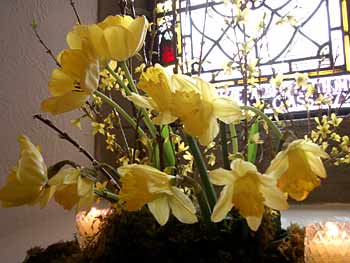
HAPPY EASTER
My evening and morning were spent in church, last night for the Easter Vigil and this morning for two services, complete with all the "smells and bells", as the incense and formal liturgy of a festival eucharist are affectionately called. It was a pretty dramatic morning - during the first service, the woman behind me, who is going to have a baby any day, uttered a loud "aaagh!" at one point, but in a few minutes decided, smiling, "I think it was just a cramp," so we didn't have a baby arrive in the middle of the choir. During the second service, just before communion, one of the lay people serving on the altar became faint and collapsed. This was an older man, red-faced and overweight, well-known to all of us for his fiery temper and strong opinions, for whom this church means just about everything. The priest called for a doctor from the congregation, and in a few minutes the man was stretched out behind the free-standing front altar, surrounded by doctors and other medical professionals. I was about two feet away, in the choir, holding my breath as I watched this friend, with whom I've served on the vestry, turn gray and become covered with profuse sweat. We were all sure he was having the heart attack we've feared during one of his near-apoplectic rants in various meetings. The ambulance arrived, he was taken to the hospital, given tests, and eventually pronounced all right - maybe it was the heat, maybe the clouds of incense and lily perfume - anyway, the service went on and we were all relieved to hear he was apparently all right.
In the midst of all of this, there was an encouaging and hopeful sermon. Its chief message, spun from a central theme of the Irish Easter Uprising, and brought forward into today's world of strife, was that we can choose to live in the shadow of death, or we can live as resurrected beings, choosing the path of love and fearlessness over darkness. Given by a priest who spent much of his clerical life in El Salvador, these were words full of authenticity.

If I weren't so tired, I'd try to weave all of this together into something profound, or at least more poetic, but tonight that's not to be. This was a day when I felt grateful and, for the most part, in the moment: happy today to be singing, happy to see the beautiful bouquets of pink tulips and white lilies on the altar and the narcissus adorning the windows, on a spring-like day that really felt like a victory over winter.
7:49 PM
|
Saturday, April 10, 2004
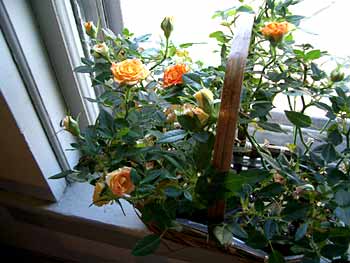
My Good Friday fast this year consisted of - even I can hardly believe it - not using my computer. No e-mail, no blogging, no *anguished sigh* reading of blogs. In retrospect, it was good to take a day off for a reason other than travel or logistics - to consciously refrain. It showed me just how connected I am to the damn thing (not so good) and to all of you (very good indeed). Instead, I spent the day meditating, reading (Merton and a good chunk of Elaine Pagels' "Beyond Belief", since I have to faciliate a discusison on the book in another week), and singing at two services - noon and evening.
Today I've been baking my traditional Easter bread for our choir breakfast between the services tomorrow morning. The recipe is Scandinavian, and the shape Greek in origin (I think); it's supposed to represent Jesus in swaddling clothes - which seems much more Christmasy than Easter-y, doesn't it? I think the finished loaf, while impressive, looks more like a giant slug or maybe an Egyptian mummy, than a wrapped-up baby. It is, however, delicious, and since I am always talking about food but rarely post recipes, I thought I'd write this one out for you. This is a case where only white flour, sugar, and butter will do, so indulge.
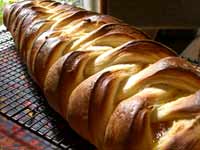
Pulla: Finnish Cardamom Bread
1 T yeast
1/4 warm water
1 1/3 C lukewarm milk
1 egg
1/2 C sugar
1/2 t salt
1/3 C soft butter
4 1/2 C white flour + more for kneading (it always takes 5 1/2 when I make it)
1 T powdered cardamom
1 beaten egg for glaze
1 jar apricot or raspberry jam
(optional: 1/2 C raisins, 1 T finely chopped lemon or orange peel)
Dissolve yeast in warm water. Add milk, 1 egg, sugar, salt, butter. Stir in 2 C flour and cardamom. Beat until smooth (I do this in a KitchenAid mixer). Add remaining flour and raisins and peel, mix until a soft dough forms. Turn onto a floured board and knead, incorporating more flour as needed, until smooth and elastic. The dough should still be soft. Let rise until double, at least 1 1/2 hrs. Punch down.
Roll out into a large rectangle the size of a large cookie sheet. Transfer to an actual cookie sheet, without edges, that has been greased (I use butter). Place the cookie sheet vertically. Divide the dough visually into thirds, the long way, using the tip of a knife to gently mark the rolled dough. Spread jam 1/4" thick down the center third of the dough. Using a sharp knife, now cut an equal number of 1-inch horizontal bands on the right and left sides of the dough, cutting all the way through the dough and ending close to the jam. Now take the uppermost left of these strips and fold it over the jam, diagonally down and to the right, securing it againt the righthand strip two down from the top. Now do the same with the uppermost righthand strip of dough, going over the jam and the previous strip diagonally and to the left. Alternating sides, weave a lattice this way to encase the jam completely. Let the loaf rise fo another hour, covered loosely with plastic wrap.
Brush lightly with beaten egg. Bake for 15-20 minutes at 350 in the middle of a preheated oven, watching carefully so that the loaf doesn't burn. If it starts getting too brown, lay a sheet of aluminum foil over the top duirng that final minutes of baking.
After baking you can glaze it with dilute apricot jam, add frosting, slivered almonds, pearl sugar - whatever you want. I usually leave it plain, and I don't usually use raisins - sometimes a little lemon or orange peel in the dough. Bon appetit, and happy holiday breakfast!
3:06 PM
|
Thursday, April 08, 2004
In an hour I'll be going to church for a half-hour choir rehearsal before our Maundy Thursday liturgy. This service commemorates the Last Supper, and includes a ritual foot-washing, where members of the congregation and clergy wash each other's feet in remembrance of Jesus washing the disciples' feet at that final gathering before the crucifixion.
I remember how difficult it was for me to participate the first time - it took all the courage I could muster to overcome my embarrassment. The person who washed my feet became, in subsequent years, a good friend, and the person whose feet I then washed was the Senior Warden of the church, an older man who was well-respected. I think it became a little bond between us; quite a bit later, when I was serving on the vestry (the elected lay governing board of the church) this man was a kind, gentle advisor and friend who appreciated my forthrightness and willingness to stick my neck out (and told me so). His wife has had Alzheimer's for nearly a decade, and he has cared for her at home, with some help, all that time. I know the church community means a great deal to him, as it did to both of them.
Not long ago we knitted a prayer shawl for his wife, with as many people as possible knitting a few stitches. There's a picture on the church bulletin board of the Rector at her bedside, giving her the shawl; they're both smiling. I have no idea what she understood, but as I think about the foot-washing tonight, and the community it represents --where leaders are willing to become servants -- it seems much more like a circle than a hierarchy.
5:32 PM
|
Wednesday, April 07, 2004
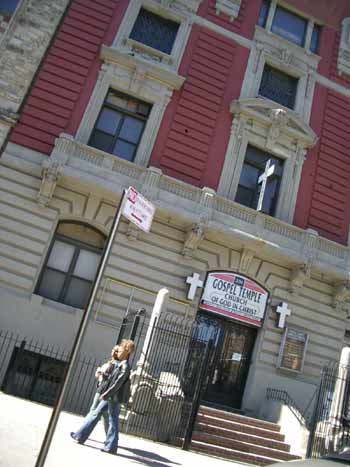
GOSPEL TEMPLE CHURCH, HARLEM
This morning I spent an hour and a half at the dentist - oh joy - and then had lunch with my father-in-law at the retirement home. This afternoon I've been preparing for another interview with GR tomorrow. After writing out my questions, I made a cup of tea and sat down for a minute with my Holy Week reading - my favorite Merton book, The Sign of Jonas, which I re-read every few years. I pulled it off the shelf this time because of what I wrote a few days ago about the various emotions I've experienced duirng this time of year at different times in my life. Merton's book covers the years between 1946 and 1952, during which he took his solemn vows of profession at the Gethsemanii monastery, was ordained to the priesthood, and experienced his first few years as a priest. You can read his April entires, for example, through the six years and see the same range of emotions I've spoken about - and that's comforting.
One of my attractions to Merton has always been his direct writing about his emotional and intellectual life and his unflinching honesty about his failings, his struggles, his faults, his desires, his attachments - as well as his often-gorgeous writing about the beauty and joy he finds in nature, books, and simple pleasures. (Merton would have LOVED blogging - I'm glad he didn't have to know and resist that temptation - and he was a prolific letter-writer.)
Each time I read the book (my favorite part of his long journals) I find something new. Today I saw this. I'm not quoting it because I agree, completely, but because I empathize with Mertons' struggle to know himself fully, and to write with integrity:
Dylan Thomas's integrity as a poet makes me very ashamed of the verse I have been writing. We who say we love God: why are we not as anxious to be perfect in our art as we pretend we want to be in our service of God? If we do not try to be perfect in what we write, perhaps it is because we are not writing for God after all. In any case, it is depressing that those who serve God and love Him sometimes write so badly, when those who do not believe in Him at all take pains to write so well. I am not talking about grammar and syntax, but about having something to say and saying it in sentences that are not half dead...
Imperfection is the penalty of rushing into print. And people who rush into print too often do so not because they really have anything to say but because they think it is important for something by them to be in print. The fact that your subject may be very important does not in itself necessarily mean that what you have written about it is important. A bad book about the love of God remains a bad book, even though it may be about the love of God...
5:01 PM
|
I absolutely cannot believe that the U.S. is bombarding a mosque in Iraq. The stupidity, arrogance, and total lack of comprehensive thinking - not to mention foresight about the consequences of their actions - the administration is exhibiting are so appalling that there is nothing to say; one listens, reads the headlines, and goes away slack-jawed and stupified, and --shaking that off -- desiring nothing more than to climb to the top of the highest building and shout "WAKE UP!!!" But what would come back? A giant, empty echo?
4:40 PM
|
Tuesday, April 06, 2004
Busy, too busy today. We're heading over to the neighbors' with a cake and ice cream after a long day of work: I was editing and transcribing interview recordings; J. was cataloging pictures, fixing his radio-sync flash unit, and doing some lighting tests.
Before dinner I talked to my parents. Mom said that the ice has gone out on their lake, and the morning after it went, a flock of mergansers appeared and have been there ever since. Today, in the late afternoon, she spotted a loon. She's hoping a pair will decide to spend the spring there - one advantage of a relatively unspoiled small lake without motorboats is an abundance of reclusive waterfowl. Although I have to admit the loons are more adaptable than one might think. In the summers we often go to visit friends at Lake Winnepesauke, just below New Hampshire's White Mountains and next to Squam lake, of "Golden Pond" fame. All day long the motorboats and jet skis race around the lake, but when the sun goes down, the loons start to call, and you can see them, solitary, in the water on the remote edges of islands.
Here, I still haven't seen geese overhead, but we aren't on a major flyway. What I have seen are migrating hawks, and on Saturday the osprey was wheeling above the river, accompanied by a chorus of redwing blackbirds. Spring is coming, steadily, despite persistent cold temperatures and even snow to the north.
And, continuing on in the good news department, congratulations to Dr. Lorianne! Yeah!
8:29 PM
|
Monday, April 05, 2004
Last night I finished Michael Ondaatje's memoir of his childhood in Sri Lanka, "Running in the Family". It's a strange book, rather experimental and somewhat rough, like pages out of a personal journal; here a remembrance, there a poem, a sketch, an essay. Once I stopped trying to make it be a totally cohesive piece of writing, like his other books, I relaxed and enjoyed it, much as I enjoy all the personal writing we do here.
There is one section that's all poetry, and of these poems, I especially one called "The Cinnamon Peeler":
If I were a cinnamon peeler
I would ride your bed
and leave the yellow bark dust
on your pillow.
Your breasts and shoulders would reek
you could never walk through markets
without the profession of my fingers
floating over you. The blind would
stumble certain of whom they approached
though you might bathe
under rain gutters, monsoons.
here on the upper thigh
at this smooth pasture
neighbor to your hair
or the crease
that cuts your back. This ankle.
You will be known among strangers
as the cinnamon peeler's wife.
I could hardly glance at you
before marriage
never touch you
- your keen nosed mother, your rough brothers.
I buried my hands
in saffron, disguised them
over smoking tar,
helped the honey gatherers...
When we swam once
I touched you in water
and our bodies remained free,
you could hold me and be blind of smell.
You climbed the bank and said
this is how you touch other women
the grass cutter's wife, the lime burner's daughter.
And you searched your arms
for the missing perfume
and knew
what good is it
to be the lime burner's daughter
left with no trace
as if not spoken to in the act of love
as if wounded without the pleasure of a scar.
You touched
your belly to my hands
in the dry air and said
I am the cinnamon
peeler's wife. Smell me.
8:29 PM
|
Sunday, April 04, 2004
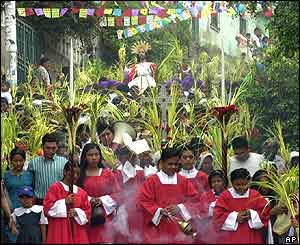
PALM SUNDAY in El Salvador, from a portfolio of pictures via the BBC
We had a procession with palms today, too, but I never got any because I showed up at church just as the procession was beginning - I'd forgotten to change my clock. This is what happens when you don't listen to much radio or watch TV. We had a very quiet day yesterday, didn't go out at all, and in the morning it never even occurred to me that this was The Day. In fact, walking up the hill to church in time for - I thought - choir practice at 9:00 am, I saw a lot more cars parked than usual and said to myself, "Oh, the 8:00 service must have run late." Even when I entered the building and saw people in the sanctuary I was still in that mindset - but then I heard the processional chant begin in the parish hall, looked up and saw the cross and acolytes at the head of the procession, and said to myself, "Oh, shit!" I rushed downstairs, grabbed my music, threw on my robe, and met the procession just as the choir was heading into the church. My seat-mate, Anne, gave me one of her patented Looks, and said "clock trouble, sweetie?" in-between words of the processional hymn. I rolled my eyes, and we were off down the aisle.
Shirin came to church today because she was curious about the Christian observance of Palm Sunday - "You really mean it starts happy and ends up sad, all in one service?" she asked on the phone. As a Shiia Muslim from Iran, she is used to passion plays - nowhere in the world is there a greater re-enactment of religious grief than in Iran during Ashoura, the observance of the martyrdom of Hussein that began the Shiia/Sunni split. Today she saw the congregation and clergy come into the sanctuary carrying palms, re-enacting Jesus' entry into Jerusalem, and then heard Luke's version of the passion story in a dramatic reading.
After the service she stayed for the coffee hour, and then we left the church together. "It was very interesting," she said - a comment that can mean many things. We've known each other long enough now to appreciate our traditions, understand the differences, and not need to explain too much. I knew that a lot of today's service would have been anathema to a devout Muslim, which made me appreciate her presence, interest, and friendship all the more.
One major difference between our cultures is the sense of Western self-determination versus Muslim/Middle Eastern reliance on God's providence. I've gotten so used to this that I automatically add "Insh'allah" - "God Willing" - to any phrase expressing future expectations when I'm with Shirin. As we left the church today, we walked past a choir member sitting on a bench waiting for her husband. I said, "See you Thursday night."
"Definitely," the choir member replied.
"Insh'allah," said Shirin, under her breath, and we both started laughing, and laughed all the way out of the church.
8:06 PM
|
Saturday, April 03, 2004
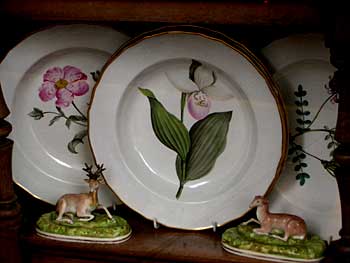
French porcelain in a New York shop window
Mikhail Pletnev is playing the Chopin Scherzo no. 4 in E major. It's the live recording of his Carnegie Hall debut. J. put it on and we listened to the incredible Bach-Busoni Chaconne in D minor that begins the two-CD set; I've heard it many times now and it still gives me goosebumps: no one should be able to play like this. Then the Beethoven, Piano Sonata no. 32. We were lying on our bed, and J. rolled over and put his head on my chest and fell asleep. I listened more intently and appreciatively than usual, but somewhere in the second movement I fell asleep too, and woke up to applause. I gently lifted J.'s head, whispered to him to go back to sleep, and came out here to the computer. Now the Scherzi are ringing in the background; it's a brilliant performance. A dear friend recommended this CD to me after hearing it on a long flight between Thailand and Europe, and I play it more often than any other piano recording I own. What I would have given to have been at that concert! You can hear the crowd's shivery excitement at the end of the Bach-Busoni; they are ecstatic at the end of the Beethoven and wild from the Chopin on. Pletnev played five encores, enough for another entire CD: Rachmaninoff, Scriabin, Scarlatti, Moszkowski, and finally the "Islamey" oriental fantasy of Balakirev.
. . .
Tomorrow, Holy Week begins, always an emotional and musical marathon for me. (If you haven't read what Blaugustine had to say on March 27th about Mel Gibson's Passion, please do.) It's a strange thing to live with the event for a week, as I do with my choir responsibilities and seven services to sing between Palm Sunday, tomorrow, and Easter. We hear the story read, we sing it, we chant it on Good Friday as a kind of opera/passion play that is the focus of our church's deeply meditative evening service, with the choir playing the "role" of the crowd. What one cannot do is ignore it.
I find, having done this now for many years, that Holy Week is a sort of touchstone, a way of checking in with myself spiritually and emotionally. Although I can't remember exactly what I felt like last year, or five, or ten years ago, I definitely remember the range of feelings: involved, bored, sad, reflective, inspired, restless, moved, distant, accepting, resistant. The fatigue that builds as the week goes along contributes to this experience. No other time in the liturgical year has the same effect; there is never the same intensity of shared experience that is also so utterly individual. It is a retreat while being in the midst of one's regular life, and if nothing else it brings an awareness of the strangeness of the sacred embedded in the secular: society moves noisily on, oblivious except for the mounds of Cadbury eggs, chocolate bunnies on plastic grass, yellow and lavender marshmallow Peeps. There is much of the story of this week that I cannot fully accept, but the cruelty and truth at the heart of it is the story of humanity, of the ongoing struggle between what is best and worst in us. Spending one week per year meditating on that, and on my place in the Crowd, is not much sacrifice to make.
6:15 PM
|
Friday, April 02, 2004
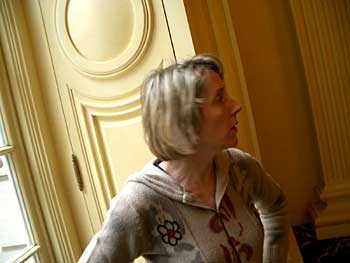
LOIS at the Frick
As CB and I turned the corner and walked toward the entrance to the Frick Collection, a woman in a tan coat came racing toward us, arms wide. "Is it really you guys?" she cried. It was Lois of Heart@Work, discovered by CB to be in NYC for a few days coincidental to my own visit. The conversation began and didn't stop for the next two hours, as CB gave us an erudite tour of the highlights of the Frick, the art-centric conversation spiced and diverted by frequent detours into religion, spirituality, literature, and, of course, blogging. At one point, in front of CB's favorite Vermeer, we realized several people were listening to us rather than the guided tour in their museum-supplied headsets. Well - alternative media has its appeal, even off the internet! It was a wonderful encounter, and many of you were fondly mentioned, and your presence sorely missed.
We had two and a half hours this morning with Bishop G.R., and it was some of the most productive and interesting interview time I've ever spent. After the first half of the interview, we took a break, and G. went downstairs to check his mail. He came back with a fistful of letters. "Here," he said, reading highlights of several. There was hatemail from someone in Tennessee, an admonishing letter from a woman in the Diocese of NH who wanted him to stop appearing on television and in the media -- and a get well card (he's had flu) with personal messages from the inmates at the NH women's prison. "That's my life," he said, smiling, and handing us the card. "But look, isn't that just great?"
When we resumed I told him about this blog and the questions I'd asked you to send me. I read him the first one I received, from Dale. The Bishop took a deep breath, and said, "Do we want to go there?"
I said, "Yes, sure," and go we did.
At the end of his long answer, which took us back to Lexington, through seminary and therapy and marriage, he went over to his desk and brought out a well-worn, underlined copy of the book that he said had changed his life as he was struggling to accept and live his gayness as well as his priesthood. It was "Embracing the Exile" by John Fortunato. He then read aloud the passages that had been most relevant to him. It was an extraordinary, intimate moment. I held my breath, trying unsuccessfully to fight back tears. As he read, a marriage dissolved, a person accepted himself in his wholeness, a life was transformed, and the necessary courage was found to create the person who sat in front of me.
We have another interview next week, on Maundy Thursday. Please send me more questions if you have them.
7:17 PM
|
SNIFF
The excellent Ecotone topic for April 1 is "Smells and Place". I haven't posted yet, and nether have very many others, so I'm making a pitch for you all to do some good writing and post it over there. I'll have something up in a few days too.
4:38 PM
|
Thursday, April 01, 2004
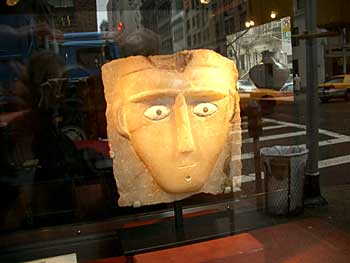
SOUTH ARABIAN MASK, in a gallery window on Madison Avenue, New York
Walking meditation can happen even in a city. Yesterday I arrived early for a rendezvous with two fellow bloggers after taking the Lexington Avenue subway uptown, so I walked down one side of Madison Avenue for ten blocks or so, up the other, and then over to Fifth. This section of the city, known as the Upper East Side, and bordered on one side by Central Park, is a toney place filled with fancy apartment houses, museums, and high-priced designer shops and art and antique galleries. After the Cartier amethyst-and-coral necklaces, Prada handbags, and Sonia Rykiel frills, I came upon this face, or perhaps it came upon me.
It was a drizzly day, and the park was filled with a dreamy fog punctuated by the wet trunks of plane trees and the ethereal pale yellow foam of new forsythia blossoms. In the garden of a museum, beyond the wrought-iron fence, pale fat buds of magnolia were like pink, anxious fists against the grey sky, and below them, phalanxes of shield-like tulip-leaves rose, strong and stiff, from the earth.
In my black anorak, I stood gazing into the park: the wet grass, the tracery of the yellow blossoms, the architecture of the plane trees drawn across the scene as if with a few deft strokes of a sumi brush. Another figure in black -slender, handsome, intelligent - strode along the fence. I looked away, looked back; he looked twice at me, tentatively, then with assurance. "Yes," our smiling eyes agreed, "it must be you."
I'll write more about the meeting tomorrow; for now, two more pictures:
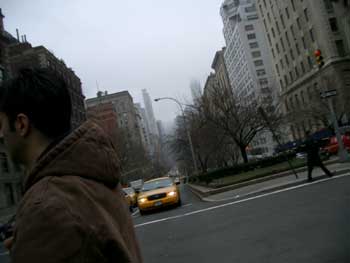
PARK AVENUE

WAITING FOR THE LEXINGTON AVENUE LOCAL
4:43 PM
|
|
|


