Sunday, February 29, 2004
THANK YOU
Could anything be more heartening than having a group of supportive friends like those of you who have written and commented in the last few days? Or could there be a better reason for taking the high road? The only better thing would be having a big party with all of you there. Thank you so much.
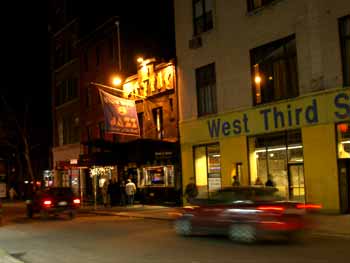
If I had a trumpet, I'd play you an extended riff, like the music that wafts out of The Blue Note, maybe the most famous jazz club in Greenwich Village. Our close friends live around the corner. When you come out of the subway onto West 3rd, you pass the handball courts and the parking garage, and then the clubs start, along with the neighborhood groceries and little restaurants. Unlike 42nd Street, uptown, where the dealers and hookers and bums have been shoved out and replaced by cops, here the Village seems unchanged. Late Thursday night, after our meetings, we were glad to come downtown to more familiar territory, where improvisation is favored over strategic decision-making, and raw art still an appreciated currency.
10:17 PM
|
I'm so relieved! There will be a five-second delay in the broadcast of the Oscars so that any unexpected indecency can be scrubbed. For the British take on our foolishness, read No sex, please, we're American from today's BBC.
10:09 AM
|
Saturday, February 28, 2004

NEW YORK PUBLIC LIBRARY. The banner reads "Russia and the World".
Well, we ran into three problems with our book contract. The first was a completely unexpected bombshell: the sales manager insisted that the book needed to be completed not by the end of July, but by the end of MAY in order to make the annual religious bookseller's fair, and have a chance of being reviewed in Publisher's Weekly and in major newspapers. She's probably right - but why weren't we (and the editor) told that before we came up with an approved schedule? The second problem was money - we would be underwriting the cost of the book to a very significant degree even after the advance, and the accelerated schedule would make that cost even greater and more disproportionate. And the third, and to me, most serious problem was a clear indication that there would be editorial interference with the content and tone of the book. This is, after all, a book about integrity. I'd like to preserve mine as well.
So we didn't sign, and will make a final decision soon after talking to some other people. I'm disappointed but not devastated, and grateful that I'm 51 and fairly savvy, as opposed to being so eager that I would have leapt at any chance and found myself in a mess.
Thursday was a strange day. In the morning I took a long walk by myself up Fifth Avenue, all the way to Central Park. I passed the New York Public Library: there's a photo of me there, next to the lions, from my very first trip to New York when I was five. I walked past Rockefeller Center, and stopped to admire the window displays at Saks, and listened to the bells reverberate off the skyscrapers from St. Patrick's Cathedral at exactly 10:00 am. I gave some change to a homeless man sitting in front of a fancy store, and waited for the next light next to a woman in high heels, a sable coat, and carrying a big Vuitton handbag. That's New York: all the extremes, all at once. As I stepped onto the pink granite tiles that form the sidewalk in front of the Trump Tower, a young woman came toward me talking earnestly on her cell phone. "You can't believe it," she was saying to someone far away. "This place is just - awesome."
I thought about being that little girl in front of the library, dazzled by Manhattan; about how she turned into a bookworm; about all those New Yorker magazines my family had read for years; all that talk of the literary scene; the dreams of one day writing a book myself. There was no telling what would happen in our meetings later that day, but I knew that a board of New York editors had read and liked my writing enough to recommend pubishing it, and that there was a contract in my room, ready to sign if I wanted to. It was a beautiful day, the warm morning light shining on the buildings, cool air on my face as I walked, light on my feet: it was a great feeling, and the memory of it will stay with me. That night, after the meetings , I felt sad and disappointed and angry, but I still felt like I was part of this great city in a new way, a way I never had before. Or maybe I felt like I could finally take it or leave it; that I was less dependent on its steely, glassy, lofty judgment, and that I'd arrived at a different definition of success.
10:22 PM
|
Friday, February 27, 2004

TAXI
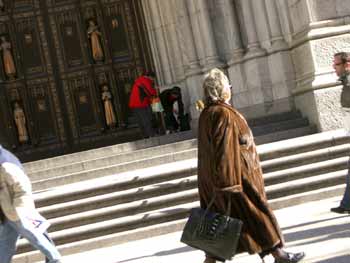
ASH WEDNESDAY FURS (Outside St. Patrick's Cathedral, Fifth Avenue)
We made a very good presentation but came home without making a deal; more news on that front tomorrow. But in blogging news: Cassandra and Language Hat got together for a drink close to the New York Public Library, and she would like to report that LH is just as erudite, charming, and amusing as you would expect from his blog, that he arrived wearing a hat, has good taste in beer, and that he had just bought a book from the Library sale (which she never got to, sad to say).
New York was exhilarating and exhausting, and we're glad to be home.
8:58 PM
|
Tuesday, February 24, 2004
 
ONLY IN QUEBEC
Fortune cookies, Montreal-style (I've flipped the paper over in the second view).
I hope these, from last weekend, are accurate. We're heading to the Big Apple early tomorrow morning for two days of meetings and talks about the potential book and the contract details. We'll be giving a presentation on Thursday morning to the corporate, editorial, sales, and marketing people and having a business meeting later in the day.
It will be good to be in the city again. We haven't been in New York for a year; the last time was for the big demonstration against the Iraq war last February 15th, and that was a day trip - down on a very early bus and back late that night - a cruel way to encounter and be yanked out of our favorite city. Yes, I do love New York best, but it's too expensive now for us to even consider living there or going for more than short visits. Still, there's no other city like it, and I look forward to feeling that pulse again - camera in hand.
5:22 PM
|
Monday, February 23, 2004
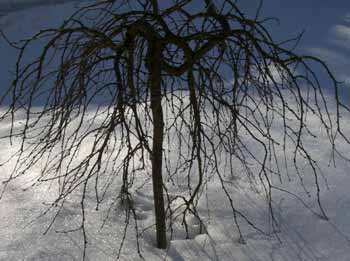
SIBERIAN PEA-BERRY
The light streaming in from the south is so dazzling it burns my eyes, and I have to get up and walk away from the window. I carry the teapot back into the kitchen, and crouch down, cat-like, to stretch my back, looking out in the other direction. Here on the north side the world is still cool, caressed by long blue shadows of trees. Elliptical snowshoe tracks lead to the bird feeder -- and delicate hopping tracks lead from the feeder to the cherry tree. The shadow of the feeder sways against the snow, and behind it, stiff wheat-colored stalks of hosta click dryly against each other. Out in front, by the street, water is dripping over the stone wall, and moss softens, greens. But here the tears of the weeping peaberry are frozen like a Russian heroine's, abandoned on the steppes, listening for wolves.
4:20 PM
|
Sunday, February 22, 2004
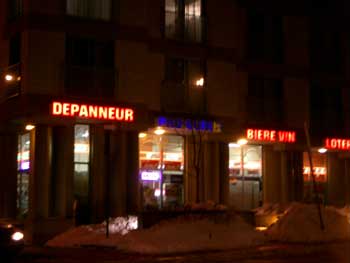
All-night grocer, Montreal. We double-parked here while J. ran in to a place called Al-Taib - ("Good") on the other side of the street to get Middle Eastern fast-homecooked-food.
Last week at this time we were driving back from Montreal. This morning the preaching went well - I was relaxed, and people were open and responsive. It was World Mission Sunday, and I spoke on "Re-Thinking World Mission", saying basically that the time for Christian mission to convert people is over; mission now needs to mean learning to respect and get along with each other - especially Christians and Muslims - despite differences.) Later we had brunch with the priest and her partner, I ran some errands, took an unusual (for me) nap and then we worked. It was pretty warm today - over 30 degrees.
Shirin just called from Santa Monica where she's vacationing and having a few job interviews. All winter she's been pining for Shiraz and telling us, "There really are warmer places to live, you know." When we go north for a break in the middle of winter, she just shakes her head and says, "you're crazy."
"I'm not coming back," she announced today on the phone. "It's like June here. Flowers everywhere. The bougainvilla are blossoming, the impatiens are tall, almost gone by."
"I know," I said, a little sullenly.
"I told my husband he can come back and sell the house. I'm staying here."
"You don't love me," I said. (She likes this sort of banter; it's very Middle Eastern. I've learned how to do it as a means of self-preservation, like learning how to refuse food. Otherwise it gets done to you.)
"You can come visit. "
"Now I know you really don't love me, if you're talking like that."
"It's easy, you just get on a plane. You wouldn't believe how beautiful it is out here, flowers, warm..."
"I do know. My California blogger friends have been posting pictures and talking about blooming trees. It's awful."
"No, it's great!"
"You can't move. If you move I'll starve."
Silence. "Oh."
"I mean it. What will we eat if you go away?"
"OK." She's laughing now. "Then I guess I have to come back."
She doesn't know I'm serious!
8:47 PM
|
Saturday, February 21, 2004
Ivy, who writes one of my new favorite blogs, Tonio, and others have been talking about authors giving readings, about stagefright, about how much talking the writer should do by way of explanation or introduction. It's all very interesting to me, since I used to have really bad nerves about reading and public speaking, but have (mostly) gotten over it just by dint of performing and reading again and again. I think maybe you just wear the fear out, or the kindness and generosity of strangers softens the edges enough that you can cope.
I remember being forced to enter a prize-speaking contest in high school by my social-studies teacher. We had to write, memorize and deliver a ten-minute speech from the assembly-hall stage to the entire student body. The topic was "What the Flag of the United States Means to Me", and the sponsor of this annual contest was the American Legion. Out in the back somewhere were judges who scored each contestant, and the winner went on to the county level. It was 1968. Great topic for those years, wasn't it? I have no idea what I wrote, but I remember practicing and practicing, feeling like I was preparing for my own execution. Right before the speech, I was walking down a school hallway and somebody opened a door into the side of my head. I stood in the wings of the auditorium, with an ice pack pressed to my ear, knees knocking, palms sweating, sure I would either throw up or faint. When it was my turn, I went out, gave the speech, didn't forget anything, and rushed off the stage in relief. An hour later, when everyone had finished, the judges announced the winner - it was me. I was in shock - that meant I had to go through it all again. At the county level, I started my speech and delivered the first paragraph, then two out-of-order sentences, and went mute. I stood in the center of the stage while my best friend and prompter tried to find the cue; it remains one of the longest pauses of my life. She finally whispered the right lines, I went into auto-pilot, finished and came in last.
Tomorrow morning I'm preaching at the 8:00 and 10:00 services in a friend's Episcopal Church, and actually looking forward to it. Preaching has to be one of the weirdest forms of literary performance; although I'll have my written text I'll try not to "read" it word for word but to use it as a guide. But you never know exactly what's going to happen with the spoken word, or so it seems to me. The audience is always different and impossible to judge beforehand; sometimes indifferent, sometime receptive, occasionally right there with you.
I'm very grateful when I get the opportunity to read my work or speak in public. You learn a lot about your writing in a very immediate way that isn't even apparent when you practice: the awkward phrase stumbles across the room; the uncertain statement sounds metallic and brittle when spoken; you inwardly cringe at excessive wordiness you never quite noticed, and fall into the gaps left in your logic; you trip over missing beats in the rhythm of phrases. It's humbling but illuminating, and still some dear person usually comes up afterwards and says something sweet, and if you've managed to reassemble your wits you can say a simple "thank you" instead of some self-deprecating remark you'll regret all the way home.
8:41 PM
|
Friday, February 20, 2004
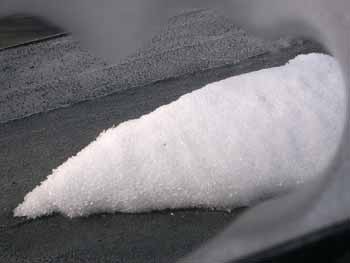
CORN SNOW forming on the porch roof
Awoke this morning in a very cheery mood. "I'll get the coffee," said J., emerging from our six-inch-thick down comforter and leaving me there to snuggle for a few more minutes. "Oh!" he said, passing unde the bedroom skylight that gives us a view of daylight sky to the south, and the moon and stars at night. "It looks like a summer day." "What do you mean," said the sleepy voice from the bed. "Hazy, a few high clouds, bright sun. Looks like it's about 70, and headed for a 90-degree and humid."
These are the kinds of mind-games we indulge in up here during February and March as insanity plays about the edges of our cooped-up, frozen consciousnesses. The actual temperature was 10 degrees, and from my window, as I sit as the desk with my coffee, already feeling my feet grow cold, I can see the snow-covered roofs and lawns that the skylight view hides. But in a way, he is right. The light is changing now, not just in duration but quality: brighter, higher, and a different color temperature. Maybe I wouldn't notice that as much if I weren't married to a photographer who talks about color temperature. But I find that we are highly sensitive to the most subtle changes in light, and in environmental sounds - and this is from a bumbling human perspective. How much more we would notice if we were finely-tuned, by habit and the imperative of survival, to our natural environment.
Yesterday morning, an unfamiliar bird sound. Just a few notes, and it was gone - but a redwing, I think. Something I haven't heard for many months, and may not again - he's very early. But the willows are turning yellow, and the snow is "rotting", as we call it up here - turning old and crystalized, breaking up into the granular spring consistency called "corn snow". It won't be long before the first sap buckets hang on the knarled old maples, and the frozen ground yields mud.
8:46 AM
|
Thursday, February 19, 2004
A poem by Peter Balakian from Sad Days of Light. I found this one at The Legacy Project, which is a repository of visual and literary art created in response to the great losses of the last century. Balakian's book of prose, Black Dog of Fate, tells the story of how he finally pieced together his own Armenian heritage and the harrowing story of what had happened to his people. My mother-in-law gave us this book, in lieu of telling the story herself. It always reminded me of giving a child a book explaining sex when the parent cannot bear to talk about it, except that this book explains death. (Balakian is a professor of English at Colgate University, and he has also written some very beautiful and funny poems.)
For Grandmother, Coming Back
For the dusty rugs,
and the dye of blue-roots,
for the pale of red stomachs of sheep,
you come back.
For the brass ladle
and the porous pot of black
from your dinner of fires,
I call your name like a bird.
For the purple fruit
for the carrots like cut fingers
for the riverbed damp
with flesh,
you come back.
For the field of goats
wet and gray,
for the hoofs and sharp bones
floating in the broth,
I wave my arms full of wind.
For the tumbling barrel
of red-peppers,
for the milled mountain of wheat
for the broken necks
of squash fat and full of seed,
I let my throat open.
9:28 PM
|
Wednesday, February 18, 2004
ARMENIAN MEMORIES
Several of you seemed interested in the Armenian heritage I mentioned in the last post. My mother-in-law was a refugee from the genocide in which her father and nearly all her male relatives were killed. She and her mother and two small brothers were fortunate to be helped by some American representatives of Near East Relief, who helped the family flee by boat to Alexandria where there were refugee camps. Her parents were both professional people who spoke many languages fluently and had some western education in Europe: her father was a doctor and translator and her mother a nurse. The father had been kept alive by the Turks for his usefulness as a translator, until one day when he was taken away and executed. There is only one picture of him that survived; my husband looks a lot like him.
In the family, we didn't talk about these things very much, mainly because my mother-in-law didn't want to instill hatred in her children by telling horrible stories of the past. Instead she would show me beautiful embroideries she had made or been given by the Armenian refugee women during those early years in Egypt, or make all of us feasts of food drawn from the cuisines of Armenia, Lebanon, and Syria. She was a very fine cook, and an articulate and literate woman, and finally wrote a remarkable memoir during the last few years of her life. She was a Quaker and always worked for peace, coming with us to Women in Black vigils in protest of the Intifada and the Iraq War even when she was too weak to stand.
With one of her granddaughters, she went back to her childhood home in Konya several years before she died. She said the Turkish hosts and bus drivers were lovely people, but no one knew or told the truth. Passing some landmark, she would say, "Wasn't there an Armenian church here once?", or some such remark, and the guide would always answer, "Oh, no, there were never any Armenians here."
Still, she loved the trip, and we all treasure a picture of her there with her beloved granddaughter, beaming, in a field of poppies.
8:54 PM
|
Tuesday, February 17, 2004
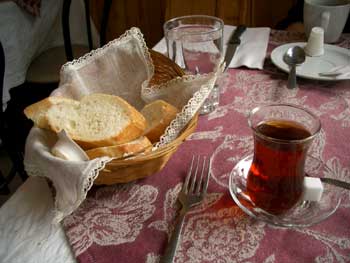
TURKISH TEA at "Merveilles d'Istanbul"
My husband, who is half Armenian, finds it difficult to enter Turkish establishments, but as we walked into this tiny restaurant he said, "It's all right, I don't need to let the past affect everything about my life today." The restaurant was run by one man, working alone, and on the menu, which came to the table in a small, tooled leather cover, were many dishes my mother-in-law used to cook. We ordered two versions of kebab; cut marinated beef on skewers for J., and the ground, spiced lamb-and-veal on flat skewers for me. The wonderful kebabs came with a shredded carrot salad dressed with vinegar, a salad of lettuce and onions, and fried potatoes so good that we each saved them for last. But the best part of the meal was the tea; perfect, fragrant, amber.
Here is Osip Mandelstam, from his Journey to Armenia:
"The Armenian language cannot be worn out: its boots are made of stone. And of course its word is thick-walled, its semivowels seamed with air. But is that all its charm? No! Then where does one's craving for it come from? How to explain it? Make sense of it?
I felt joy in pronouncing sounds forbidden to Russian lips, secret sounds, outcast - and perhaps, on some deep level, shameful.
There was some beautiful boiling water in a pewter teapot and suddenly a pinch of wonderful black tea was thrown into it.
That's how I felt about the Armenian language."
8:14 PM
|
Monday, February 16, 2004
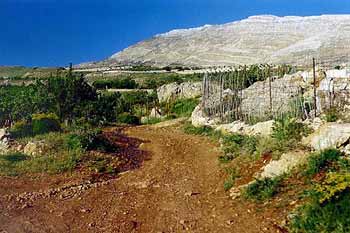
The anti-Lebanon Mountains, Bludan, Syria, from a site (this amazing web!) devoted to longhorn beetles (Cerambycidae) of the West Palaearctic*, and accounts of expeditions to find them.
A Postscript on outdoor eating, and Food and Place
Last week, at the retirement home, my father-in-law slowly made his way to the table carrying a plate of food from the lunchtime buffet. "Ah," he said, sitting down heavily. "Chili con carne." To my surprise, the usually bland menu had included chili, and it was spicy.
"It's good," I said.
"Yes!" he replied, eating a big forkful. "I have such happy memories of chili con carne." He said the word as if he were tasting it, in his Damascene accent, more as if it were Italian than Spanish. I raised my eyebrows; this was not what I expected. "You see, we were in Bludan once, myself and two of my students" (he mentioned their names, both people we have met who are now old men) "and we had hiked up in the mountains all day long. We made our camp for the night, and made a fire, and one of them brought out a can of chili con carne and heated it over the fire. That was our dinner. And it was so delicious! So wonderful!" I watched him eat his chili against a backdrop of other white-haired residents, some in wheelchairs, in the bright light of a midwinter noon, snow piled against the windows outside. "Ah!" he said again. "It brings it all back. The smell of the bougainvilla, the clean air in the mountains. Our youth." In all our meals together over twenty five years, I never remember my father-in-law eating chili. We ate Middle Eastern food, or Chinese food, or more-or-less American food- under protest - like what he was served now nearly every day. I wish I had known. Food and memory are indelibly linked for him, and my husband and I know that the stories a meal sometimes triggers are no longer infinite. It made me happy to watch him, one forkful after another, eyes partly closed, remembering.
*in case you were wondering what the West Palaearctic is, as I was: "The eastern border is formed by the Ural mountains (Russia), and passes southwards through the Caspian Sea and the north-western part of the Persian Gulf; the southern border runs through the Sahara desert and integrates the massifs of Hoggar Kibo, Air, Tibesti and Ennedi as well as a large part of Saudi Arabia. Canary Islands, of course, are part of the West Palaearctic region too." This particular expedition went to Syria and Turkey, and there are some other lovely pictures.
4:49 PM
|
I'm guest-blogging on GLUTTONY today, as part of the series on the vices at CommonBeauty - so I hope you'll go there!
11:03 AM
|
Sunday, February 15, 2004
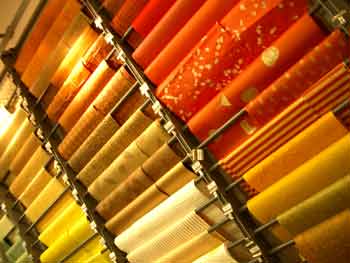
Back home, laden with baked goods from the Belgian boulangerie/patisserie we discovered down the block, and various Arabic breads from our favorite grocer. But it was not only the food that delighted my eye: above is a very small selection of the hundreds, maybe thousands, of fine and decorative papers available at Omer de Serres, a huge art supply store near UQAM (University of Quebec at Montreal). If you can believe it, I didn't buy a single sheet.
We hardly ever just take off on the spur of the moment, so this felt like a few stolen days in the middle of intense work. We slept and slept, in spite of a terrible bed that sank toward the middle both from the ends and the sides and was both small and short - the price of a last-minute reservation in the non-luxurious hotel we frequent there. We like it, though; as another guest told J., "I stay here because it's so close to all the art." The Place des Arts, Montreal's relatively new performing arts complex which also houses the contemporary art museum (this link wasn't working tonight; I'll check again tomorrow), is just a short walk away. The latter is one of our favorite places in the city, and we saw a fine show of political art by Dominique Blain. (It was, I have to add, not only political in content but good art as well; usually I would find such a show heavy-handed but she won me over.)
Has anyone seen a new Hungarian film called "Hukkle" (that's Hungarian for "hiccup")? Bizarre, original, and wonderful - but I'd love to hear what someone else thought of it.
9:39 PM
|
Saturday, February 14, 2004
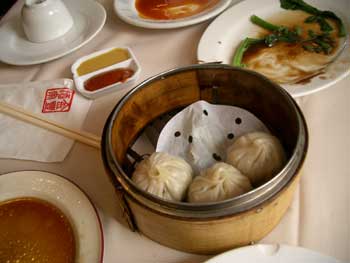
Remains of a dim sum lunch (in Montreal again).
12:01 PM
|
Friday, February 13, 2004
I’ve appreciated the recent, thoughtful entries on “envy” at CommonBeauty and a related one about competition and generosity by Chris at Creek Running North. Writing about my recent good fortune was something I did here with a little reluctance, because I know that although the congratulations are absolutely sincere, some may hide a “what about me?”
To be honest, if I had read here, a year or two ago, about somebody else’s book finding a publisher, I would have felt envy or worse, as well as feeling happy for my friend. Having spent most of my adult life in the arts of one sort or another, I’ve gotten used to rejection (and still hate it) as well as understanding my own mroe or less constant desire for approval and encouragement.
Two things rise to the surface. One: we all have to get to a place where we are creating for ourselves, and satisfied to do that even if the big doors never open. The work is far better that way, and you have a chance of staying both sane and decent. Two: Mixed feelings about other people’s success are normal and to be accepted, and then let go, like the thoughts that arise in meditation. “Oh yes, there that is again. OK. Back to my work.” I often think of an artist whose wife, years ago, was doing far “better” in the art world than he was, and had just gotten a big show somewhere. Some one of us asked him how he felt about it, and he answered, “This life is so difficult for any of us. As an artist, I just try to think, ‘her success is my success’.” I thought that was rather remarkable, because I knew he really meant it.
I’ve always wanted to write a book, and one of the best parts about this project and its horrendous deadline is that it will force me to actually do it. It will require a lot of discipline, and no time for self-doubt, and that’s going to be good. But I doubt that the writing itself will be as satisfying as what I do here, mainly because the audience will be much more anonymous and distant, and yet I will have to write for them. It’s a different thing. I can’t tell you how glad I am that I will have this place to talk about what it feels like in the process. Stay tuned.
5:07 PM
|
Wednesday, February 11, 2004
Thank you all for your encouragement and loving comments; I'm really pretty overwhelmed by them and very, very appreciative.
It was a long, interesting, productive day. The editor (I liked her) has gone back to Manhattan after getting a little hit of New England - we took her to a beautiful converted mill overlooking a river for lunch, and at the end of the day drove her up onto one of the ridgelines that gives a view of the mountains and snowcovered fields stretching in every direction, bordered by deep, dark evergreen woods striated with thin white birches, with a weathered barn thrown in every now and then. She was speechless. "Do you feel like you're driving through a postcard?" I asked. "I do!" she said. "I really do."
The meeting part was good, and very helpful to me - we went over the entire outline in detail, chapter by chapter, talking through issues of content, order, pacing, voice, and emphasis. We talked about the book's audience and how to deal with such problems as "Episco-speak" (the specialized lingo the church uses for practically everything - which can feel anything but inclusive to non-members). Over lunch there was a long, as-yet-indefinite discussion about the title (any ideas??). We talked about design, and how to integrate the photographs with the text. And we left the schedule discussion for last, but the final deadline will be around July 1. We'll be going to NY in a few weeks to give a presentation to a large group during their twice-yearly review of upcoming titles.
Deep breath... pending a contract, seems like the project is on its way. Don't worry, though: Cassandra is a top priority and will not be going away. And I need you all to see me through this.
5:52 PM
|
Tuesday, February 10, 2004
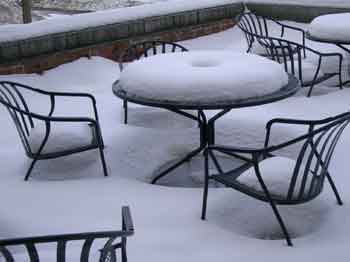
FEBRUARY
8:27 PM
|
SOME NEWS
Tomorrow I have a big meeting. An editor is flying up here from New York to meet with J. and me about doing a book on Gene Robinson. We've been talking to the publisher and editor by phone and e-mail for a couple of weeks; their entire editorial board has read our proposal, outline, and one chapter, and they want to go ahead. So this meeting is to talk about editorial content and make sure we all feel like we can work together; if all goes well we'll go down to New York later to negotiate the business side and meet the other people involved. Tomorrow's meeting was supposed to be last Friday, but the plane ended up circling overhead in a snowstorm for an hour and then was diverted 150 miles away. We managed to get through the weekend without messing up the house...
It's a beautiful morning here, but it has taken me an hour to get cheerful. ("Why?" you ask. "Are you nuts?") Well, part of it is that I am not at my best in the morning. It takes me a long time, sometimes, to make the transition from sleep to being awake, and after a somewhat restless night I often feel dogged by unremembered but uncomfortable dreams, like ghosts pulling at the corners of my clothes. Today I think there was some of that, but going deeper I also detect anxiety. It's not the meeting itself, which I'm actually looking forward to a lot; I've had enough years in business and performance to be able to handle meetings and presentations, and I'm anxiosu to meet this editor and get to know her. I'm not really worried about my ability to do the writing and research, although the deadline they're proposing is daunting. I want to do it; this is a chance I've been waiting for for a long, long time.
What I sense is more a kind of fatalistic dread that something will happen to make the project impossible; I'll get sick, some tragedy will befall my family -- that sort of thing. Stepping back from this I see that there's no rational reason for this anxiety, and that it is a product of my spinning mind - just the sort of thing that meditation helps us to see and to stop. As the vestiges of sleep leave me, and the sun brightens on the clouds and the snow-covered rooftoops outside, and I write here to you, I can feel my natural optimism and equanimity returning. I know that no matter what happens, all will be well, and I'll find a way to handle it. I can even pinpoint some of the cause of this sort of existential anxiety, which became worse for many of us, I think, after September 11th. It's rooted in lack of control: tragedy, falling out of the skies upon unprepared souls, followed by wars we were powerless to stop, cloaked in a disguise made of lies. In these years there have also been a disproportionate number of personal sadnesses and losses. On the other hand: new friends, new-found means of communication and encouragement, new places that I love, greater confidence and appreciation of what writing is and can be for me, well apart from any sort of commercial "success", greater awareness of my own strength and ability to handle adversity. It is so important to keep one's head on one's shoulders and not to lose oneself. It's important to wake up.
9:30 AM
|
EXTREMISM OF DIFFERENT KINDS
France about to vote on headscarf ban. This article has reaction, pro and con. My personal view is that this is a very big mistake, setting a dangerous precedent in Europe. (via BBC)
American Airlines pilot tells frightened passengers "non-Christians are crazy". (via BBC)
The pilot, whose name was not released, asked Christians on Friday's flight to raise their hands. He then suggested non-Christians talk to the Christians about their faith. He went on to say that "everyone who doesn't have their hand raised is crazy", passenger Amanda Nelligan told CBS news.
"He continued to say, 'Well, you have a choice: you can make this trip worthwhile, or you can sit back, read a book and watch the movie'," she said.
8:52 AM
|
Sunday, February 08, 2004
Yesterday we saw the movie Himalaya and I was stunned by it - both visually and by the story. Have any of you seen it? In the morning we had been at the ordination of an Episcopalian priest, a beautiful ceremony full of color and spirit and sincerity, and in the afternoon, this movie took us into a Tibetan Buddhist temple where the monks in red robes were chanting, prayer wheels were spinning, and offerings were being placed on the gold feet of the Buddha. Worlds apart, and yet the essential desires were so much the same; it really felt like one continuous human expression. The movie is much more than that, although human beings and their relations to the divine is a major theme.
I've been having a conversation with Dale over at vajrayana practice that has been more interesting than anything else I can think to write about today, so I'm going to quote some of it, and commend you to Dale's original posts. On his blog, Dale has been writing, in part, about identity; both the way we are known by others, and the ways in which we "know" ourselves. He said, in (very small) part:
I am also a prudent, even calculating, man, the sort who hedges his bets, keeps his insurance up to date, and carefully chooses when & where to come unglued. It's just a story. All these characterizations of myself are just stories. "Essentially unknowable" -- you are so right -- not only because even the paltriest of us is too large to fit into any story, but also because there's nothing essential there to be known. The wind blows through us, whether we acknowledge it or not, and what it blows through is air.
I replied:
I think most of us want to be known down to our deepest core by *someone*, and some of our greatest sadness and frustration comes from the near misses and the fleeting true connections that we would so much like to freeze, like a movie segment, and play over and over. And then there are the moments when we actually know ourselves (or is it when we finally forget ourselves?) and everything falls into place, timelessly. But most of life isn't like that; most of the time the wind is blowing through a self we can't see or pin down, and others certainly cannot although they do try, fixing us in roles shaped by the partial truth they can see, and by their own imaginings and desire.
As I get older I find myself more interested in what happens in the spaces between people. Love, for instance, or compassion, or moments of real listening. I think these things are real and eternal, even though they pass through our insubstantial and changing selves, and hover between us like smoke.
Dale wrote back:
We get things so completely backwards, so often. Taking this body and this identity for permanent, and the moments of connection as ephemeral and unreal. Exactly wrong. Its the moments of connection that move beyond us. Buddha Shakyamuni's long gone, and so is whatever notion Siddhartha Gautama had of who he was when he lived in the palace: but his love for Ananda is still echoing through the world. And that's just one we know well enough to name.
My daughter wrote recently, for school, about our read-aloud time, over the years. Remembered books I'd long forgotten -- Pig William must be from fifteen years ago, now. We went through MIddlemarch, Ivanhoe, pretty much all of Dickens's and Tolstoy's novels, Wodehouse, Douglas Adams... "Reading time" has faded away -- but I was astonished, delighted, humbled to learn how vividly that time, & the sharing of those books, lived on in her. It's the connections that are real.
I wonder what you think? Feel free to join the comment thread over at vajrayana instead if you go there to read the original posts, since this is really Dale's topic.
3:42 PM
|
Friday, February 06, 2004

A gesture from one man to another, is more noble than pearls and coral.
(Ibn Al Habbab, VIIIème s.) Calligraphy by Hassan Massoudy.
Last Sunday we were invited by our Muslim friends to attend the celebration of Eid Al-Adha, the Day of Sacrifice, that comes forty days after the end of Ramadan and coincides with the end of the Hajj. The day is a special commemoration of the faith and submission of Abraham, who was willing to sacrifice his son before God saved him (Muslims believe this was Ishmael, who they consider the founder of their people, not Isaac.)
In a backwater like this area, the Muslim community is small and scattered. When we arrived at the non-denominational campus chapel at 8:00 am, a few of the men where unrolling rugs and mats in a larger room than the usual Muslim prayer room. "How many people do you expect?" I whispered to Shirin as we sat down in the back. She shrugged and smiled, "I have no idea." It was dark in the room, with just the faint morning light filtering in through the Tiffany windows that are the chapel's pride and problem, since most of them were Christian-inspired. This wing of the chapel is mainly used by Jewish groups, and the window shows Moses - who is mentioned often in the Qu'ran and revered as a prophet, as Jesus is. We sat quietly, and in a few minutes the call to prayer began, and the men began chanting the Takbeer. This is a long, repetitive chant used on Eid. Our friend Mohammed from Morocco told us that people leave their homes chanting, and walk through the streets chanting, gradually joining others who are making their way toward the mosque, where you join a throng of people all doing the same thing, and that this experience is very moving.
Here the chant began with three or four people, and gradually more students and community members came in until we numbered about twenty. We were delighted to see a friend and former student who has been living in the midwest after graduation; he looked well and happy. There were six women, Shirin, who is Iranian, and myself, in headscarves; a mother and daughter who are Indonesian and brought their country's typical embroidered white cotton veils that covered the whole body except for the face; an American woman convert who had driven sixty miles with her husband to be there; and the local Lutheran pastor; she and her husband spent the past three years in Jerusalem working with Palestinian refugees. The chant went on and on for nearly half an hour. Shirin sang along, and I tried but I never got the tune exactly or the Arabic words, despite the repetition. But it didn't matter; it was a meditation, and both lovely and calm. Following the chant there were prayers, and then a sermon about Abraham, and six ways in which a Muslim should follow his example. But because Abraham is the father of all three Abrahamic religions - Judaism, Christianity, and Islam - the sermon also talked about our commonality, and encouraged Muslims to reach out, especially on this day, to their brothers and sisters of other faiths.
I was touched by this, and honored to be invited. I was sad that I had to rush off to choir rehearsal before church at 9 am, but J. stayed behind, had tea, and talked. "They always make me feel so welcome," he said afterwards. "Of course everyone mistakes me for a Muslim - it's the beard. But even when I say I am a Christian, it doesn't seem to matter to anyone."
Feeling this comfortable together has taken time - we have known some of these friends for three years now - and I recognize it for the great gift that it is. No one is trying to convert anyone else, btu over time we've shared our religious practices and traditions, explaining them and what they mean to us, and developing both respect and true friendship. It's a small thing, perhaps insignificant, but it gives me hope.
8:46 AM
|
Wednesday, February 04, 2004
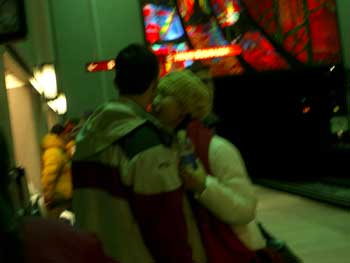
METRO
Here in my village, the only thing that's moving is the wind. Today, a sunny bright day with new, wet, snowman-snow that fell overnight, there were stiff winds more like what we expect in March than early February. On my mid-afternoon walk, I had trouble keeping upright against the gusts. Now, from my upstairs window, all I can see moving is the neighbor's picket-fence gate, blowing back and forth behind three feet of snow left by the snowplow.
Although the pace of things in my head is not necessarily akin to what's outside, the slowness and unchanging quality of rural life mean that I'm like a kid in the city, and one of my favorite destinations in Montreal is the metro. I meant that sentence literally: I think of the metro as a place in itself, not just a means for getting between places. Although I am not one who avoids the New York subway, at least in midtown, I love the cleanliness of the Montreal stations, the art (like the stained glass mural above), the wide platforms, the big advertisements, the bilingual chatter, the French announcements of the prochaine station, and especially the singing whirrr of the rubber-wheeled trains.
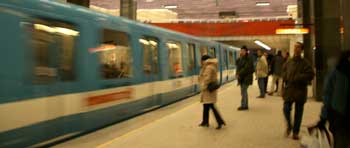
I know I'm becoming more local because I'm learning which car to get in depending on where the exit is in the destination station. When J. lived in Paris for a year, before we knew each other, he had the entire system memorized and knew exactly which end of the train to get on. Funny - I used to think he was crazy.
5:21 PM
|
Tuesday, February 03, 2004
FOOD AND PLACE: Ecotone Topic for February 2
Since I read the name of the current topic, the memory of one meal has kept pushing itself forward, like a special dish insistently proffered by a Middle Eastern hostess. I don’t know why. There have been many more spectacular or romantic places, and many meals in which I can remember virtually every bite, every taste. Of this one, I cannot even remember what we ate. But it has insisted that I tell about it, so I will try.
My parents and my husband and I decided, one early summer day, to drive up, away from the lake, into the wild state land ten miles or so to the east. Let’s take a picnic, I said, so my mother and I packed sandwiches and something to drink, and we piled into the car. When we crossed from the regular class C roads onto state land, none of us could remember the way, so we crisscrossed on roads that all looked the same through the deep woods, looking for familiar landmarks. Our destination was a pond, invisible from the road but marked by a small place where the underbrush had been cleared beneath large evergreens, known mostly to people like me who had worked for the state environmental or forestry departments. I hadn’t been there for some years. We stumbled onto a riding encampment where a group was beginning an overnight trail ride; we found the old fossil pit full of shattered shale, and stopped so that my husband, who had grown up in granite-boned New England, could find some fossil shells of his own. Eventually we found the right combination of turns and dips and culverts, and came to the clearing. We parked, and walked in through the woods to the dam at the end of the pond, where we spread ourselves out on the grass, unwrapped the food, and ate.
It was a beautiful day in late June, and the sun had been shining on our grassy couch long enough to send up the fragrance of hayscented fern and Indian paintbrush. The “pond” such as it was, is a remnant, slowly filling in. The dam at this end, built in the thirties by the CCC, probably, was small, only twenty-five or thirty feet long: a grassy knoll with a small stream spilling out on the other side. There were lots of dead trees in the center of the water, and thicker brush beyond, and every time I had visited I’d seen ducks, and often an osprey or blue heron, whose nest you could see in a tall dead tree. Of the four of us, I was the only one who had explored the real secret of this place: from the far side of the dam, an unmarked trail led to a path where a person in hip-waders could enter the water, dark with tannic acid, and carefully wade toward the middle, where, beyond the brush and dead trees, a large, ancient, quaking bog opened like a magical field. The sphagnum moss was thick and easily supported the weight of adults. Tall pitcher plants stood in lethal readiness; cranberries and bog rosemary grew lushly underfoot, and the air buzzed with the sound of thousands of insects. From the dam, all these wonders were invisible; in fact few people knew about the bog’s existence. The only clue close by was a patch of sundews who raised their sticky green flower-pads to the light near the stream behind us.
We ate our sandwiches in silence, watching the life of the pond – the big bullfrog tadpoles and green salamanders that lazily moved on the bottom, the water-striders delicately navigating the surface, the tentative nose of a turtle, the flash and cry of a kingfisher - and then each of us turned to the grass around us and began eating the tiny wild strawberries that we could smell in the sunlight. We ate in circles around ourselves until our fingers were pink with strawberry juice, and then lay back, content. “Food always tastes better outdoors,” my father remarked, and he told a story about a simple meal he remembered when he was a young soldier somewhere in Europe during World War II, hungry and not knowing if the sun would come up another day.
Why do I remember this? Because it was unusual for the four of us to be there together? Because it had always been a mysterious and special place for me? Or perhaps it was simply the condensation of that moment: the sun, the strawberries, the people I love best, all safe and happy, while beyond us, out of sight, continued a prehistoric drama of eaters and eaten, of plants and animals switching roles, of specialized species locked in a dance of survival.
Nothing else happened; I checked to see if the sundews were still there, and we walked out through the woods.
7:51 PM
|
Sunday, February 01, 2004
TAKE A LITTLE WALK
I'm guest-blogging today over at Heart@Work, where Lois has invited some friends to talk about why they blog. I hope you'll visit her place and read the whole series. (I invite you blushingly, however, because she wrote some really nice things about me in her introduction. Thank you, Lois, for your own warm and generous heart.)
1:25 PM
|
|
|


