Sunday, November 30, 2003
THE FIRST SUNDAY IN ADVENT

The Annunciation: the angel Gabriel (left) speaks to Mary.
From a 6th century Ethiopian manuscript in the British Library.
I love that pointing finger - and what is Mary doing? Embroidering, maybe? It's worth searching on "annunciation" at the British Library, and comparing the 48 returned images. In nearly every case, the same subject - the angel Gabriel giving the news to Mary - is rendered in a culturally consistent manner for the audience of the time, with the pair dressed as medieval British royalty, for instance. This is not art history news, of course, but it never fails to amaze me, when, in all likelihood, Mary was a poor Palestinian girl, not unlke those of today, who would have been fortunate to have a pair of sandals and a warm cloak.
Advent, the Christian season of preparation for the celebration of the birth of Jesus, began today. Many people (including a number of Christians who see it as the sacred equivalent to the secular run-up to Christmas) don't know it is meant to be a season of atonement and reflection, not unlike Lent. Today our choir sang the great Bach chorale, "Wachet Auf!" or "Sleepers, Wake", which begins "Sleepers wake, for night is flying,/The watchman on the heights is crying/"He comes, prepare, ye virgins wise..."
I like the Biblical story of the wise and foolish virgins, the first who trimmed their wicks and kept their lamps burning, staying awake to meet their bridegroom, and the latter lazy ones who slept through the night and missed him. Jesus told this parable as a warning about his unannounced appearance on the day of judgement, but it's also just so human. Every year when this story comes around again I smile to myself: are we ever prepared for what will come, be it love, or death, or the many messages we are meant to hear and act upon throughout our lives? As the preacher said today, thank God the wake-up call doesn't only come once, but continues throughout life, so that we have many opportunities to hear who we are called to be, and finally take it to heart.
One such contemporary call is from Natalie d'Arbeloff at Blaugustine, who reminds us continually that "another world is possible". If you haven't done it yet, check out her Bloggers' Parliament and the responses of many readers.
Another wonderful Advent gift comes from Heather at Soul Food Cafe, who has prepared a virtual Advent Calendar, with one 'door' to be opened every day beginning tomorrow, Dec. 2, through Dec 26. Like everything at Soul Food, this is a labor of love packed with good writing, thoughts and ideas both for making this a rewarding an fruitful time, and especially for navigating the sometimes stormy and difficult waters of the holiday season.
5:47 PM
|
Saturday, November 29, 2003
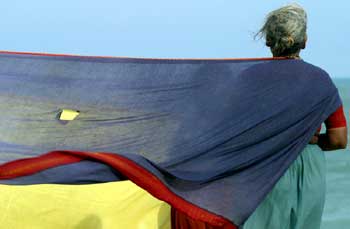
Just because it's beautiful.
More photographs of saris at PBase, via under the fire star.
After being in a place that feels like pure Americana for a few days, today I feel like I've been around the world. First there were the blogs to catch up on, and world news. After lunch J. opened a beautiful heavy pomegranate for us, filling a bowl with the glistening, crimson seeds. Then tonight I made tadik (Iranian rice with a crust) and a chicken stew with cilantro, and afterwards we watched a Vietnamese movie called "Vertical Ray of the Sun" - a most beautiful film, full of color and sensitivity, especially toward its women who move through rooms of yellow, pale blue, green and red; prepare vegetables and exotic fruits in leafy gardens; drink tea; care for children; worry; make love. What startled me most about it was the realization that I had no idea of what city life is like now in Saigon or Hanoi; my images of Vietnam are frozen in the 1960s and 1970s, and they are almost all desperately unhappy images of the countryside.
Perhaps this virtual travel to warm places is also a last refuge against the winter, which has come to beat against the windows, chilling our house by the hour until now we are ready to crawl into bed and huddle under the comforter. There have been high winds all day, and snow squalls; back in central New York, my parents report that six inches of snow are on the ground. I'm not ready!
Today, glad for their company, I paid some attention to my plants. A few inches from my hand, the Christmas cactus is in full bloom. On the windowsill, a crown of thorns, and next to them on a table, an overgrown jade plant and my rosemary bush, steadily shedding leaves as it tries to adjust to being indoors. On the coffee table there's a new addition, a big cyclamen filled with blooms so deep pink they are almost red. In a landscape that is about to become monochrome, color is imperative.
9:59 PM
|
Friday, November 28, 2003

For the first time since my aunt died, several years ago, my family had Thanksgiving dinner over at the farm where she and my uncle always lived. Uncle Lee is 80 now, still strong and vigorous. He ruefully said he “didn’t work much anymore” but his self-definition apparently doesn’t include the fact that he goes to the barn every morning at 3:00 am for the first milking, and doing a good part of the plowing and planting every summer, as well as overseeing the whole operation. When I was little, I remember seeing his father, at about the same age, heading out to the barn every day in his denims and railroad hat.
The farm has 160 milking cows and a number of young heifers, and many, many acres of fine, productive land. The talk at noon ranged from recent equipment purchases, to methods of storing corn, to the recent tragedy of a neighbor who had lost a barn and 50 head in a terrible fire. One of my uncle’s hired men had gotten trampled by frightened cows. I asked how badly he’d been hurt. My uncle, a man of few words, said, “He said he remembered seein’ one hoof comin’ down on his chest.” Then he added, “When I first saw him his eyes were pretty glassy.”
“How’s he doing?” we asked (the fire was two weeks ago.)
“Oh, still kinda sore. But he’s workin’.”
“Well, what about that time you fell into the heifer pen?” someone asked. My uncle laughed and shook his head. “Oh yeah. You see all those hooves. Hurts quite a bit when they come down on ya.”
We were fifteen for dinner, and we ate in the lace-curtained living room on my aunt’s antique flow-blue china, with oval-framed photographs of my cousins hanging against the flowered wallpaper, and a picture of the farm cows on top of the television. Afterwards I washed dishes in the kitchen with my cousin’s wife, looking out the window through a lilac bush to the barn where the hired men had already arrived for milking. I dropped a white mug into the heavy aluminum pot we were using for a dishpan. It read, “Oneonta Feeds: We Love Your Cows.”
A white-and yellow barn kitten with a hurt paw limped across the lawn in front of the old chicken-shed. I had gone out earlier, stopping to play with this thin kitten, who had runny eyes and fleas but a sweet disposition, and then stood in the milking parlor for a little while to watch the big cows and the hired men and listen to the whoosh of the milking machines.
“Is this the full circle?” I wondered. “Have we gone back to the farm?” Every Thanksgiving of my childhood was celebrated in a nearby town, in the house where my parents and I lived with my grandparents, who had moved from the family farm in Beaver Meadow several decades before I was born. Now we were back on a farm, and I was soon to be in the “great”-generation when my cousin’s daughter has the first child of the next generation in February. Washing the old blue plates, and my grandmother’s silverware, I listened to the young people chattering in the next room, and remembered how old I had thought the great-aunts and grandparents were when I was young. Now, it’s me, and that's all right.
9:18 PM
|
Thursday, November 27, 2003
Usually the lake where my parents live is covered with flocks of Canada geese and, if we’re lucky, their snowy cousins, during the Thanksgiving holiday, but a combination of efforts by residents to dissuade them (boats “manned” with fake humans made out of flannel-shirted hay bales with pumpkin-heads) and fewer nearby fields planted with corn seem to have kept the flocks to a minimum this year. Because I’m a visitor now, I miss hearing their cacophony as we go to sleep at night, and watching their slow, gliding, effortless descent, feet extended: air meeting water.
Yesterday, instead, we watched a small group of mergansers playing on the lake, red heads disappearing beneath the water, white breasts flashing as they displayed and fluffed, “standing” on their feet on the surface, and then great gleeful splashes and trails as they ran and chased each other on the surface. How earthbound and heavy they made me feel!
Often the lake freezes this week, and overnight the geese are driven from the wide black expanse of the nighttime water to a diminishing open area in the center. When the flocks leave, the weak or sick geese are left behind, huddled miserably on the ice at the edges of open water, trying to gather enough strength to go south with their companions. Most do, but one or two don’t, becoming prey to illness and cold and hunger, or, rarely, surviving on corn scattered by residents. The warmer winters of late, though, have kept many flocks right here, feeding in the open, cut cornfields and spending nights on the river. Tomorrow, driving home, we’ll see more flocks, swirling like low, inky brushstrokes over the Mohawk River and Erie Canal.
Yesterday we all walked along the old railroad right-of-way in back of the woods my parents own. Behind the woods is a field, planted to alfalfa this year and cut in late summer, and beyond the field, the Chenango River. When I was here in the fall I walked over to see the beaver dam that had stopped the flow from the lake to the river. Yesterday the water level in the swamp was much lower, and water flowed over the former dam – but two small trees in the swamp seemed to have been felled recently by strong beaver teeth. It was a great walk, in the bracing air, with many stops to look at dried, split milkweed pods shedding their silvery air-boats, or pick up nuts beneath the big shagbark hickories on the edge of the woods.
7:58 PM
|
Tuesday, November 25, 2003
I'll be on the road today but should be back here tomorrow. One thing I've been thinking about, as I've considered Thanksgiving this year, is how grateful I am that I started this blog and found (or was found by) all of you.
We're all pioneers in this medium, and the growing pains we experience - the fits of doubt, the frustrations with the technology and its misuse by the unscrupulous, the occasional outbursts or hurts, the insecurities caused by comparing oneself with others, the obsessions with "stats", the sad silence when a favorite voice goes away, the feeling that maybe we should be doing something else - something "real" - with our time and talent - all these, I think, are just hardships on this wagon train over the divide between old ways of communicating and distributing words and ideas, and the new.
I've always felt the vague vestiges of pioneer stock in myself, in a particular stubborn determination to not only stick with something difficult, but to see over the next ridge. I hardly thought blogging would be that sort of a journey, but I rather think now that it is. I know it is exciting, and for me at midlife, it may be a riskier venture than putting my energy and precious writing time into traditional publishing ventures, but I am tired of that world: tired of the slowness; the predation of artists' time, ability, and emotional stamina by non-artists who control choice and distribution; the need for "credentials"; the domination of ego, fashion, and connections; the limited and limiting definitions of "success".
Ideas have so much life! They are free! They come with being human, and we're meant to discover them, express them, share them freely. What is the purpose of writing, anyway, if not to reach out into that abyss of silent space that is the perceived distance between human beings, and suddenly find another hand touching yours?
10:48 AM
|
Monday, November 24, 2003

The Pleiades. Photo by Matthew Russell
"If you want to tell me that the stars are not words, then stop
calling them stars."
- Jack Kerouac (via whiskey river)
8:58 PM
|
ITALO CALVINO
My father's road likewise led far away. The only things he saw in the world were plants and whatever had to do with plants, and he would say all their names out loud, in the absurd Latin botanists use, and where they came from - all his life he'd had a passion for studying and acclimatizing exotic plants - and their popular names, too, if they had them, in Spanish or English or in our local dialect, and into this naming of plants he would put all his passion for exploring a universe without end, for venturing time and again to the furthest frontiers of a vegetable geneology, opening up from every branch or leaf or nervation as it were a waterway for himself, within the sap, within the network that covers the green earth.
Italo Calvino, The Road to San Giovanni
I went to bed last night with "The Road to San Giovanni", the only volume of Calvino that I own. Re-reading the title essay, a memoir about Calvino's father, it struck me again as one of the most perfect essays I've encountered: it's like an apricot plucked fresh from one of his father's trees. What makes Calvino's prose so luminous? How can he write sentences that go on for a page and yet feel -- I searched for the word and he supplied it in the remark below -- weightless?
... my working method has more often than not involved the subtraction of weight. I have tried to remove weight, sometimes from people, sometimes from heavenly bodies, sometimes from cities; above all I have tried to remove weight from the structure of stories and from language." (from Six Memos for the Next Millennium, 1988)
8:28 AM
|
Saturday, November 22, 2003
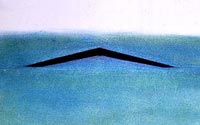
One of Maya Lin's original drawings from her proposal for the Vietnam Memorial.
Last night we watched a documentary about Maya Lin, the architect/sculptor who created the Vietnam Memorial in Washington, D.C. I've admired Lin for a long time, not only for her vision but for her sheer courage at standing up to huge pressure and criticism when she won the design contest (out of 1,491 entries) for the Vietnam memorial at the age of 20, while still a student at Yale:
"It was while I was at the site that I designed it. I just sort of visualized it. It just popped into my head. Some people were playing Frisbee. It was a beautiful park. I didn't want to destroy a living park. You use the landscape. You don't fight with it. You absorb the landscape . . .
"I though about what death is, what a loss is. A sharp pain that lessens with time, but can never quite heal over. A scar. The idea occurred to me there on the site. Take a knife and cut open the earth, and with time the grass would heal it. As if you cut open the rock and polished it."
How many of you have been to that memorial? I've gone a couple of times, and broken up each time despite my determination not to. It was the same, watching the film last night, and seeing veterans and their families standing, weeping, touching the Wall, as well as other people, like me, whose worldview was shaped by growing up during that war. Part of the brilliance of Lin's design is the way that you, and the world of trees and grass around you, are reflected in the black granite surface of the Wall, behind the litany of names. No monument with heroic mounted generals, this. The reality is inescapable: we were all in this war, we are all part of this list of names.
Reading the news I have to wonder if we have learned anything. It certainly seems that the people today wielding power have not; they are cut out of the same cloth as all rulers who have impoverished their people throughout history, and sent their young men off to fight in their wars of empire. But although it may not be apparent yet, I think people, even in this myopic country, have learned a few things. They're less trusting and more cynical about the government, and less tolerant of casualties. And I doubt they would ever accept a draft again - a draft of which we've heard the first rumblings this week. Those of you in other countries may wonder what it would take to wake this country up. That's one thing that would do it. Mounting casualties and an unwinnable war are others. Those of us who lived through Vietnam haven't forgotten what it was like.
Enough about politics! There's a pound cake and a loaf of date-nut bread in the oven, chicken marinating in a lemongrass/fish soy/brown sugar/lime/chili sauce, cilantro waiting to be chopped, and jasmine rice that needs to soak. Outside the window, the sky light is fading in that brief moment between dusk and the emergence of the first stars. As I wrote to a friend, last night the Pleiades hung over the house like a brooch pinned on velvet, Orion stretched his bow, and the Milky Way spanned the sky. Tonight should be the same. I can neither read the stars nor see my reflection in the black surface of the heavens, but it always feels as if, somehow, I'm meant to.
5:00 PM
|
Friday, November 21, 2003
ILLUSION?
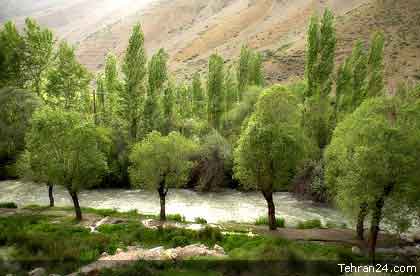
Our beautiful world. This is Karaj, Iran, in May. From Tehran24 (photos of Tehran everyday, and an archive of other locations in Iran.)
8:37 PM
|
Thursday, November 20, 2003
MR BUSH GOES TO LONDON
Yes, I know, I have repeatedly said this is not a political blog, but its hostess is actually extremely political; she's just trying to stay sane by writing about other things. So today, while our dear president is in London hiding behind unprecedented security, and Istanbul, among other locations, is exploding, let us at least join our British friends in solidarity with their protest.
Visit Coup de Vent at London and the North; she is at the demonstrations and has been posting some of her always-excellent pictures.
Blaugustine is also at the protest - no pictures yet, but I am sure she will be writing an account.
From The Guardian, 60 letters to President Bush from British and American citizens (via Conscientious).
1:07 PM
|
Wednesday, November 19, 2003
Most of my blogging time today has gone into a discussion, both on- and off-blog, of yesterday's post. So I'd like to call people's attention to the comments from yesterday, especially to the questions raised by Dale's provocative note:
Sometimes I think of the destruction of everything unmarketed and authentic is a calamity. But sometimes I think Capitalism's doing us a huge (unintended) favor: showing us the impermanence and artificiality of all worldly things. This world ain't home, and nothing makes that point more clearly, to me, than water-features and fake barns. Ludicrous attempts to make artificial homes: but not much more ludicrous than my own attempts to make my mind at home in this life. What are my attempts to surround myself with approving friends and reassuring books, but my own mental water-features and fake barns?
What do you think? Is the world "home", or are all worldly things artifical and illusionary? And depending on where you come down in that argument, what is our responsibility?
7:02 PM
|
Tuesday, November 18, 2003
ECOTONE TOPIC for November 15
How Visitors Affect Your View of Place
My earliest memory of being “visited” was a parents’ day in grade school. My parents were in our classroom, sitting along one wall near my regular seat, when I opened my flip-top desk. My father gasped. Loudly. I, of course, immediately turned bright red, and wanted to sink through the floor. He was right – my desk was a total disaster. But it was, after all, my desk. And because it was mine, and not connected to my room at home, I’d thought of it as private, not subject to the “pick-up-your-room” comments that were commonplace back in our house.
Housekeeping never did become a major priority in my life, although I like having things neat, and wish they were neater than they usually are. I did learn to pick up after myself, and am glad my parents dinned this concept into me. But I’ve always made a preferential choice when it comes to prioritizing housework, and my intellectual or creative life. It wasn’t a far step, therefore, from my second-grade desk to my adult kitchen. Shortly after I had married, I once spotted my new mother-in-law’s car pulling up outside. I quickly shoveled all the dishes from the sink into the oven, and went to calmly greet her at the door.
I do often see my personal space through the imaginary eyes of impending visitors; the cobwebs and dust become suddenly visible as well as the clutter and neglected tasks: the tiles that never made it up on the kitchen walls, the unsanded floorboards, the peeling trim on the doorframes. But I made a decision long ago that if people didn’t like me for myself, they weren’t going to be swayed by an impeccable house, nor did I want them as friends if this was how they were going to judge me.
It’s different, though, seeing the larger place where you live through people who come to visit, especially when you live in a postcard like we do. Visitors come here wanting to see the autumn leaves, or New England villages with white church steeples and narrow-clapboarded buildings; they want ducks on a river, and Christmas trees and sleigh rides; they want to drive through covered bridges and stop beside slightly ramshackle red barns with a thin heifer or two in the pasture – or, better yet, a flock of sheep - fenced in by old stone walls. Like most people who live here, we have a little “tour” that includes such sights, and satisfies guests that they’ve seen the real thing.
What they don’t know, and don’t want to know, is that in a neighboring town there is just one working farm remaining, compared to dozens a couple of decades ago. Or that the farms, residences, cemetery and dairy that lined the road between here and the university town exist now only in memory. I’ve watched them disappear, one by one, eaten up by bulldozers and their spawn: condominiums, dental offices, mail-order warehouses, upscale nurseries and farmstands bursting with pumpkins and cornstalks, a centralized elementary school. This is the new “New England” reality for the suburban and city people who move here, wanting their own piece of the country and bringing urban values and expectations that contribute inexorably to the diminution of rural life. For them a myth has replaced history: “new” stone walls, “water features” that imitate waterfalls, fake barns, pseudo-post-and-beam office buildings with white vinyl siding. A little further out into the country, new “colonial” homes sprout on five-acre sub-development plots, and older, gracious homesteads are turned into “gentleman’s farms” with Jacuzzis in the master bedroom suites, and horse barns for thoroughbreds instead of plowhorses. They exist not to impress the locals -- that would be absurd – but to impress a new crop of visitors from the city or suburb, and to convince the owner that he or she has finally “arrived”.
The disappearance of authenticity and its replacement by shallow, Disney-land theme-park imitations, no matter how expensive or detailed, makes me exhausted and sad. These concepts of “place” are dependent on the judgments of others: the visitor. They are something we can pursue if we read the right magazines, or acquire if we have enough money. They’ve become part of a marketed reality.
Maybe that’s why I like my virtual place, my blog. Here I can be fat or skinny, pimply or beautiful, neat or slovenly, and you won’t know or care. You will know, I think, if I’m telling the truth, if I’m speaking with integrity, if I’m revealing my heart. There is no authority that determines what my blog should look like, no design avant-garde to set artificial standards of chic-ness. You come here, or don’t, based on the content and based on how coming here makes you feel. It’s free, and pretty real: no games. I like that.
9:09 PM
|
Monday, November 17, 2003
A DREAM
Last night I had a dream in which I discovered a box with small, non-identical partitions wrapped on their vertical sides with shiny red paper, and inside them were small Capuchin monks wearing robes and those tight brown medieval caps with a chin-strap, sleeping. They were somewhat like little squirrels. But this was a scary dream, and I don't remember why, although in the night I swore to myself I would remember and write it down.
8:55 PM
|
WHAT EXACTLY ARE WE DOING HERE?
Poetry Chat and Blogging: Nick Piombino writes about the differences he sees between conversations in a particular poetry chat room, and blogging.
While you're there, read Nick's fascinating comments on a recent article in the London Review of Books (which I haven't gotten to yet) about Montaigne:
In discussing Hartle's book, Colin Burrow makes a point I liked very much. In saying that he feels that Montaigne is definitely not a philosopher, he makes the point that "...This does not mean, however that the *Essays* should be regarded simply as autobiographical writing. They are much more than either philosophy or autobiography, and should be thought of as belonging to a form of discourse which is more or less unnameable (unless one names it the essay), in which what is said is much less significant than the process by which it is said, and in which the movement of the mind matters more than the propositions that are advanced.
And then you might check out the speculative musings at commonbeauty about the desire for a new writing form:
I feel stirring within myself the beginnings of a manifesto, a call for a new kind of writing, maybe even a new arm of publishing that is devoted to excellent writers whose literary devotion is to a more modest project (and yet, less modest) than that of the novelist: mapping the peregrinations of their own minds.
10:46 AM
|
Sunday, November 16, 2003
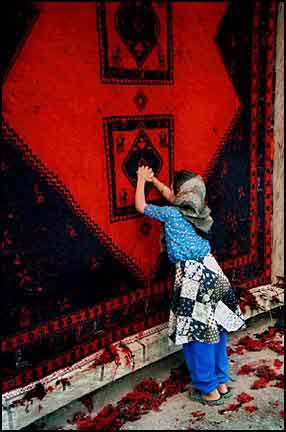
Untitled photograph by Naghmeh Jaberi, Iran, from her photo essay on the lives of women in Iran's northern provinces near the Caspian Sea.
The Ramadan dinner was a delicious adventure in Persian cooking, with fragrant chicken in turmeric, a beef and sabzi khoresh (stew of beef and green herbs), and jasmine rice with saffron, barberries, orange peel, slivered almonds, and pistachios. Then came dessert, a special and traditional saffron-flavored and colored pudding served with Iranian cookies and tea. That was when one of the guests started to talk about religion and engage the Muslims in theological debate. It gradually became apparent that he was a born-again, fundamentalist Christian (an articulate, seemingly affable and worldly man in his seventies) whose purpose in accepting the hosts' generous invitation for a special dinner was conversion.
I have never felt closer to my Muslim friends; I was appalled, embarrassed, and ultimately very angry at this man's behavior, despite the fact that we were all trying very hard to be cordial, patient and polite. I wanted to protect my friends from what felt very much like violence and great disrespect; as a result I'm sure the evening ended with him being sure I was as far from salvation as the Muslims! Thank God we have been having real interfaith dialogue, based on finding common ground, and have become good enough friends that this won't erode all the trust and friendship that has been built up over a long time. But when I called the hostess afterwards to apologize and commiserate, I couldn't deny that this was the sort of belief held by many people in the American administration today.
Before dinner, I joined the magrib prayer. My friend Shirin and I were side by side, and I felt that she was really praying for us both, since I don't understand the Arabic she was reciting, but I go through the postures with her. We both like doing this; we feel very close despite all the cultural and religious differences. I was thinking of all the Muslim friends I've been privileged to know through this relationship, especially people who have been in our local community for a year or two and then moved elsewhere or gone back to their original countries. I remembered their faces and manner with great affection. And then I felt a wave of longing for our world, for the ways in which we fail to make these bridges, to know each other as human beings, to love one another and strive for peace. I found myself asking for the strength to keep doing that as much as I can - and I was surprised to find easy tears running down my face.
When I opened my eyes, the others had gone back upstairs, and Shirin's husband was putting a new log in the woodstove at the end of the room. He looked at me with kindness. "May your prayers be answered," he said, and I thanked him, hoping the same.
It had been a much more religious experience than I had had in church this morning.
10:00 PM
|
After spending the morning in church, we're off to a Ramadan party this afternoon with our Muslim friends. I just called to ask what time they break their fast, and what time the prayers are, because I wanted to join in the prayers. Magrib, the late afternoon prayer, done at the time when the sun sets, is at about 4:25 today. My friend told me that they would be breaking the fast (with the traditional snack of dates) a little earlier, and then praying.
There's an interesting language aspect here - note that the word "magrib" is the same as "magreb", like "the Magreb", or the North Africanan states such as Tunisia and Morocco. This was where those in the original Arab world of the Middle East saw the sun setting, and thus it became the name for the coinciding prayer, one of five prayers performed every day. Maybe a native Arabic speaker can further illuminate this word for us.
In the meantime, here is a link to a fascinating account of an evening of prayer during Ramadan in Iran, by a Christian woman who, like myself, was trying to learn more about Islam.
More about today later on.
3:38 PM
|
Saturday, November 15, 2003
ON THE UP AND UP
OK, what do YOU think this expression means? I am betting that my UK readers think something different than those in the U.S., but it's not even that simple. This commentary by Geoffrey Nunberg on "Fresh Air" muses about this and other expressions which can mean something different, or even opposite, to various English speakers.
12:37 PM
|
Thursday, November 13, 2003
Over at The Coffee Sutras, Kurt has been discussing materialism and divestiture, and asking whether at midlife we come to a point where we start to want less, not more. That's certainly true for me. Several years ago, my husband and I started to consciously think about cleaning out our house (where we've lived for 25 years), lightening up, getting rid of everything that isn't important or necessary. This was also a practical decision - we realized there was no way we could ever move, downsize, swap, or rent our place and live elsewhere for a while, until we did this. Maybe it's that old, romantic hippie dream of putting a mattress in the van and setting out across the country; we both like the idea of being light on our feet and having a simple but hospitable home base.
As is probably obvious, we really like Montreal, and for us, being in a city is the contrast that we most crave at times. We're looking at various ways to satisfy those desires, and our little experiment of renting a studio apartment there last week was the first toe in the water. It had been important to be able to cook, so the place we rented had a little kitchen, or maybe I should say "kitchen". There was a fancy toaster-oven which worked all right, and a hotplate that burned out the second day we were there. After that we made our morning coffee using our travel coil after running the water as hot as we could out of the tap - but forget the pasta, soup, and steamed fresh vegetables we were expecting to make.
At home, we have a pretty big, old New England house - neither fancy nor elegant, but with plenty of room. We've done nearly all the work on it ourselves, and it's been endless -- both the renovations we've needed to make, and the ongoing maintenance of an older, not-very-well-built wooden structure in a harsh climate. Our business takes place downstairs, and we live upstairs. There's a yard in back with perennials, and a vegetable garden in back of a two-story garage/studio, a lawn to mow, trees and shrubs to prune or sometimes cut, snow to shovel, a dirt basement that's damp, ice dams to prevent.
Spending a week in a one-room apartment, on a street lined with the narrow, deep apartment buildings so typical of Montreal, was, to say the least, illuminating. Coming back home, walking through several rooms to even reach the stairs, and then climbing them to see again our spacious kitchen, living room, and bedroom immediately reminded me of the scene in Dr. Zhivago where Yuri returns from the war to his family home, only to find the same space occupied by half a dozen families. Looking down our street at the other detached, single-family houses, each with yards and porches and two floors of space, I felt more deeply than ever how luxurious even moderate living can be in this country (we live in a lower- to middle-class village in the middle of a very wealthy area). And yet, on the Montreal street where we were living, in the heart of the French section of the city, there was a wide mix of ages and everyone seemed to know each other and to be enjoying life quite fully - perhaps more than we do. A lot can be said for 99-cent baguettes, a little camembert au lait cru, available around the corner, and a pot of geraniums on the windowsill.
Could we live in less space, with fewer possessions and less comfort? Definitely. The divestiture has already begun, and it's liberating. I guess we've made a decision to trade some comfort for more choice, to use public amenities like libraries and parks rather than buying books and vacation spots, to choose a certain amount of freedom over security. We are a long way from having "only enough, and no more", and I wonder if I'd ever have the strength for that, although my definition of "enough" was never grand, and has been steadily shrinking.
What I'm discovering, most of all, is that emotional freedom and spiritual space cannot be bought at any price, and have little relationship to the physical world, once our basic needs are satisfied. It doesn't cost anything to open my mouth and sing, or hear a bird do the same.
2:43 PM
|
Wednesday, November 12, 2003
Today I finally had time to catch up on most of my favorite blogs and find out what some of my favorite people have been up to for the past couple of weeks. Also read all the responses to the Nov. 1 Ecotone topic, Coffee Shop as Place - a lot of good writing there, if you haven't read them already. (The next topic, for Nov. 15, is "How Visitors Affect Your View of Place." Rev up your mouse!)
Tonight I especially enjoyed reading Chris Clarke's vibrant account of his travels in the Mojave: the coyotes, the Joshua trees, the solitude, and coffee-drinking in a different kind of place all together. He writes:
And now the stars. How long has it been since I saw the Milky Way? A satellite zipped overhead not long ago; a spark of reflected sunlight heading from the zenith to the horizon in a minute and a half.
I sit burning fragrant juniper firewood - a casual gift from my mother a year ago - and ruminate. Dinner is eaten, dishes cleaned, tent ready for me in a few hours.
I miss Becky and Zeke. Cassiopeia smiles sweetly at brilliant Mars.
When we arrived back home from Montreal, the first thing I noticed when I got out of the car was Mars. And then the stars, and the Milky Way. It's so dark here in the village that you can see the Milky Way on any clear night, right from the skylight in the bedroom. I'm nearsighted, and sometimes, on an especially brilliant night, I put on my glasses if I get up in the middle of the night, just to take a sharp look at the sky filled with stars.
While I was in the seductive city, enjoying nights when people are up to all hours procuring just about anything they might want, I also considered that beyond its edges we might have been able to see the northern lights. I didn't think about the stars, per se, dazzled as I was by the city lights, but in any case, you can't see them. Coming home to our quaint village, already pretty dark by 6 pm, life seemed pretty sleepy and monochromatic, but I felt a surge of recognition and welcome when I looked up overhead. I might not miss the provincialism of this place if we lived elsewhere, but I can tell you one thing - I'd sure miss the stars.
7:40 PM
|
Tuesday, November 11, 2003
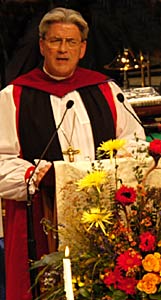
Rt. Rev. Douglas Theuner, current Bishop of New Hampshire
DEFINING MOMENTS IN THE CHRISTIAN LIFE: Consecration of Gene Robinson, continued.
(I don't know if it's necessary to say this, but these posts and photographs about the consecration are drafts and excerpts from a longer work, and they are copyrighted. I appreciate links very much, but ask you to please not reprint or publish any of this work without contacting me. Thanks.)
After the objectors had been heard and acknowledged, the Presiding Bishop asked if it was the will of the people to ordain Gene as bishop, and was answered with a resounding “That is our will!” He asked if we would uphold Gene as bishop, and again the people answered, “We will.” Then followed prayers and readings, and then the current Bishop of New Hampshire, Douglas Theuner, came to the lectern for the sermon.
Although I don’t know Bishop Theuner personally, I’ve seen him in action for years, heard him speak on many occasions, and worked with him during my years on my parish vestry. He gets kidded a lot about his unique and luxuriant hair (Barbara Harris, at a celebration of Bishop Theuner’s ministry earlier this fall, quipped that “he has a better hair-do than I do!”) and his booming voice, which can easily cut through a noisy convention hall. He is a tall, distinguished, handsome, energetic and authoritative figure, despite two serious heart operations in recent years. I think Gene Robinson was right when he said, “Doug takes the office of bishop seriously, but not himself.” I was astounded to hear some close associates greet him with a jocular “Hello, Your Eminence!” when he walked into a meeting; the bishop didn’t miss a beat but came back with a big laugh and fast rejoinder of his own.
Bishop Theuner has always been a progressive, never lacking in the courage to take risks. When I asked Gene, during an early meeting, “Why you, why now, why New Hampshire?” he replied, “The answer to all of those questions is ‘Douglas Theuner’.” Gene flatly states that after he came out as a gay man, he thought his ordained life in the church was over. But seventeen years ago, Doug Theuner hired him to be his assistant, at a time when there were no openly gay priests serving at that level anywhere in the church. (To keep the courage of this appointment in perspective, bear in mind that the heresy trial of the Rt. Rev. Walter Righter, Bishop of the Diocese of Newark, New Jersey, for knowingly ordaining a non-celibate gay man to the priesthood, took place in 1996, only 7 years ago. Seven of the nine bishops on the “ecclesiastical court”, one of whom was Bishop Theuner, heard the accusations and voted to dismiss the charges against Bishop Righter, writing that “neither the doctrine nor the discipline of the Church currently prohibit the ordination of a non-celibate homosexual person living in a committed relationship.”)
Bishop Theuner is one of the most impressive speakers – one is tempted to say “orators” -I’ve ever heard. He can deliver extemporaneous prayer that is mind-boggling in its ease, breadth, and beauty, but in the pulpit he’s in his true element. The sermon for Gene’s consecration was the only one I’ve ever heard him give from a prepared text, let alone substantial notes, and it was an example not only of his homiletic gifts but a declaration of his theology and vision for the Church in the future.
St. Francis of Assisi is supposed to have said, “Preach the Gospel at all times. If necessary, use words.” But how often do priests, let alone bishops, really preach the true Gospel that Jesus taught and lived – a message of humility before God and one’s fellow human beings, the equality of all persons, simplicity of spirit and living, and compassion toward all beings and the world? I once asked a priest, someone I knew to hold very progressive views about politics and theology, why we so seldom heard a sermon about the church’s responsibility for social justice. “You know why,” she retorted. “Because throughout history, prophets keep getting offed.”
On this occasion, though, Bishop Theuner seized the moment and without hesitation took on his own religious establishment, preaching a prophetic, courageous, moving, often funny, and inspiring sermon about our true call as Christians:
…And what is that Gospel of Christ which a bishop is to “boldly proclaim and interpret”? In preparation for this sermon I re-read the four gospels… specifically with a view toward discovering anew what they tell us of Him …who sought, as our new bishop will be charged to seek, to “show compassion to the poor and strangers, and defend those who have no helper.” And that, I rediscovered, was the entire focus of His ministry.
…Our Lord’s attention was entirely directed to the outcast and the marginalized; the poor, the halt, the lame, the blind, lepers, women, people possessed with demons, prostitutes, tax collectors, Roman soldiers, Samaritans, Syro-Phoenecians , thieves..... His wrath was reserved for the members of the religious establishment of his own faith community; Pharisees and Saduccees, scribes, elders and chief priests, money changers in the temple....and his own chosen disciples. And now we seek to incorporate a new member into the religious establishment of our time; to make him a bishop, a modern day chief priest... They were chastised by our Lord because they thought people were made for their religious establishment; not their religious establishment for people. They were condemned because they loved to go about in long robes, and loved salutations in the marketplaces and the best seats of honor in houses of worship and the places of honors at feasts...and for a pretense made long prayers...... Who are we kidding? Look around us! Have we met the enemy and found out that they are us?
The booming voice paused for dramatic effect. And, to their credit, the gloriously-robed “high priests”, who he had just “caught”, smiled and nodded knowingly, acknowledging the truth of these words.
In this time when the culture of violence seems to be all-pervasive, the disagreement over your election and consecration has been labeled by one of your detractors as “the defining BATTLE in the WAR for Anglicanism’s soul.” – Well, guess what? IT ISN’T! – I am quite sure that since the Holy Spirit came upon our apostolic forebears in an upper room in Jerusalem, no “defining” moment in the Christian life has ever taken place in a by-invitation-only gathering of ecclesiastical nabobs. Not in Concord, not in Minneapolis, not in Dallas, not in London, not in Rome, not even in Durham. New Hampshire!
Bishop Theuner's examples of "defining" moments in the Christian life were a church community giving enough
love and support to an abused woman to give her a sense of her own worth, and the strength and help to stand up for herself; the love and acceptance of a young man unsure of his sexual orientation; and a slum landlord being moved to treat people fairly and to “respect the dignity of every human being".
He spoke about the great need, if we are going to really mean what we say when we talk about welcome and inclusivity, for the “center” (of privilege and comfort and power) to move to the “margins”. Does “unity” mean excluding certain people for the sake of an institution, or does unity the equality and dignity of all people?
“Because of who you are, Gene,” he said, “You will stand as a symbol of unity in the church in a way none of us can.”
And then he talked about what this consecration was really about: the “raising up one of our own… to lead us through this world of violence and anger and into God’s coming reign of acceptance and forgiveness.”
(If anyone would like to read the full text of Bishop Theuner’s sermon, it’s available as a .pdf file. If you have trouble downloading it, right-click on the link and choose “save target to…” to save the file in your own directory.)
6:11 PM
|
Sunday, November 09, 2003
SOME MONTREAL IMAGES
(all photographs by J.)
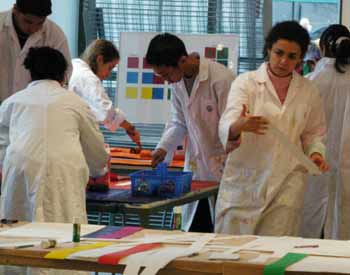
Art class, contemporary museum of art
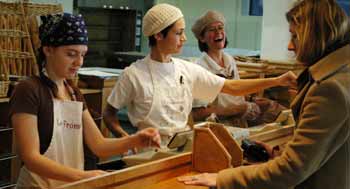
Boulangerie
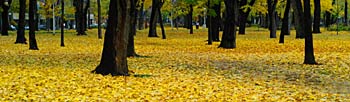
Fall leaves in Parc LaFontaine
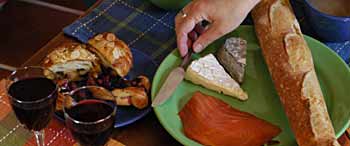
Today's lunch
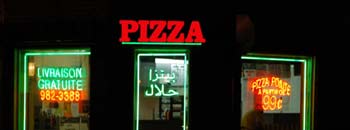
Pizza Mont Royal
10:54 PM
|
Saturday, November 08, 2003
It looks like most of my readers have been very loyal during the serialized narrative about Gene Robinson’s consecration, but I thought a digression from religion and politics would be welcome (for me, too). So here is a response, very belatedly, to the
ECOTONE TOPIC for November 1, 2003: COFFEE SHOP AS PLACE
Back home, I don’t go to coffee shops. There aren’t many, to begin with, and those that exist fall into the categories of “self-consciously-hip-and-pretending-to-be-urban”, or “here-we-are-in-a-mall-looking-at-books-let’s-have-latte”. Neither appeals. I prefer the atmosphere of a greasy diner, actually, with truck drivers and lumbermen next to bikers and local sad-sacks, all downing their java in shoulder-to-shoulder silence at the long stainless-steel counter. I’d rather sit in the Polka Dot, next to the train tracks, writing and drinking coffee, than go to the hip joints with the rural yuppies and artsy types who seem so desperate to bring Boston and Manhattan to rural New England.
But when I’m here, in Montreal, I’m in a city filled with bistros and cafes, with bookstores-avec-espresso; upstairs aeries for people-watching and chic basements for warmth and escape; internet cafes; outdoor spots for rendezvous and long afternoons. No city in North America can claim better food, although most can claim better weather. So I have my choice, but I keep going back to one little lunch/breakfast/café in particular.
It doesn’t have a name, or at least I don’t know it. It’s near the internet place I used to use, and I went in the first time to have some coffee in the middle of the afternoon, and immediately saw that the food in the small, refrigerated display case was all Middle Eastern, and homemade. There was shish taouk, fresh falafel, and spinach piestudded with sesame; bread with fresh zatar; and an array of homemade vegetable salads: taboulleh, cauliflower, beet, carrot, lentil, beans and chick peas – un plat, trois choix. And there was baklava. Not many things, but good ones. The grey-haired proprietor, a man of 40 or 45, didn’t look Arab or Persian or Greek or Armenian; I decided finally he might be Turkish. I ordered a café au lait, and he made it for me, and set the white china cup and saucer on the counter. Then I realized I only had a $20. He looked – disgusted. I apologized, embarrassed. He took it, made change, and turned away.
I drank the coffee, which was delicious, at one of the small marble-top tables arranged along the windows, trying surreptitiously to watch him. He spoke several languages, but to the patrons, mainly French. He rarely smiled, and at one point engaged in a heated argument with a North African reading a newspaper, but then they both broke out laughing. I had finished and needed to leave, so I put my cup on the counter, said “shukran” and left, getting barely a nod.
The next day I brought J. there for lunch. We ate shish taouk, in paper-thin lavash lightly grilled after the sandwich was made – fantastic - and some of the salads. But that day a new wrinkle appeared: the proprietor’s wife. She was very young, with a lovely face, wearing grey pants and a matching long tunic and her head and shoulders wrapped in a white veil. She worked behind the counter and moved back and forth between the café and the kitchen while her husband waited on customers. She never looked at the men, but kept her eyes down. I immediately liked her and wondered about her, with not a little concern – where had she come from? What was her life like? Did they have children? Had she left her parents and family halfway around the world? Was she happy? There was a door on the far end of the café that opened onto a little garden with nice trees, but there were no tables out there for eating. I wondered if she went out there and sat when she had a moment; I hoped so.
I’ve been back a number of times, and the wife is rarely there, but when she is, she smiles shyly at me and acknowledges my feeble Arabic greetings and thanks. I’m so obviously non-Muslim, but I don’t want to offend, even though they must be used to it; I put on my sweater on hot days and check to see if too much skin is showing, which, of course, it always is. This time, after several months away, J. and I went in for lunch and coffee, and the proprietor nodded his head and gave a small smile of recognition. “I think it’s better when you’re with me,” I told J. The food was great, and the coffee even better.
I guess the thing that keeps us going back to such places is that we’re equally drawn by the quality of the food or drink, and the mutual untold story. Cafes are not bars where everything hangs out and personal stories run freely out of people’s over-lubricated minds. In cafes you see other habitués, and you wonder about them, but there is discretion and distance. (Matisse went to a café frequented by many other artists every day for years, and no one ever came to sit with him, so respectful were they of his air of private dignity – Francoise Gilot mentions that this actually hurt Matisse.) I want to discover the stories, but I won’t ask. I also want, I suppose, to become regular enough that perhaps they will wonder about me. It is a game, perhaps, a gentle human game of curiosity, hunger, thirst: all satiable for a moment, but bound, like us, to return tomorrow.
6:33 PM
|
People who don’t come from liturgical traditions often find Anglican services pretty strange, at best, and intimidating and confusing at worst. Those of us who grew up in liturgically-oriented churches (Catholic, Lutheran, Episcopalian/Anglican, for example) often find the recitation and repetition of the words of the various liturgies (services for particular times and purposes) comforting, poetic, and moving, even during times of our lives when we’re estranged or voluntarily separated from the church and religion itself. On the other hand, certain parts of the liturgy can drives us right out of the church – the Nicene Creed, for example – if we find we cannot say it with conviction.
Gene Robinson started going to the Episcopal Church from a Disciples of Christ background (he was the son of tobacco sharecroppers in Kentucky – and his parents, simple, unassuming people, were honored guests at his consecration on Sunday) when, as a highly intelligent, questioning young man, he was told by D. of C. elders that “there are some questions you shouldn’t ask”. Gene says “I could always accept that there would be questions that couldn’t be answered – but I couldn’t accept that there were some I just shouldn’t ask.” He found a home for his searching as an Episcopalian, where his mentor told him about the Creed, “just say the parts you feel comfortable saying,” and Gene says he did that, gradually finding he could accept more and more of it.
I’ll never forget the first time I took my husband – the son of a Unitarian minister – to an Episcopalian service. I was finding myself drawn back to the church after a decade and more away, but we’d been married for all of that time so I was revealing, with trepidation, a side of myself my husband didn’t know. About halfway through a Rite II communion service during which he could barely follow which book was which, and when to stand, sit or kneel, he turned to me and said, “My God, you know all this by heart.” “Yes,” I said, sheepishly, “I’m afraid I do.”
In spite of the fact that most of us never attend the consecration of a bishop, the liturgy for that occasion can be found right in the Book of Common Prayer. I read through it before attending Gene’s. As in a baptism, confirmation, or the ordination of a priest, the special words and rituals for the consecration are folded into a fairly regular communion service, with readings from the Old Testament, a Psalm, the Gospel (a reading from the books of Matthew, Mark, Luke, or John), a sermon, the passing of the Peace, an offertory, and the administration of communion. The unusual parts are the presentation of the candidate, the “examination”, and the ritual of consecration.
The Presiding Bishop indeed “presides” over the entire event, sitting in a high-backed, somewhat throne-like chair, faced by the candidate. Those who wish, or are required, to speak address the Presiding Bishop. In the first part of this service, half a dozen representatives of various commissions and church bodies read testimonials that certified that Gene Robinson had completed the requirements to qualify as a Bishop, and had been duly elected and approved. Then, according to the prescribed form in the Book of Common Prayer, the Presiding Bishop says to the people that this candidate has been “duly and lawfully elected” and found suitable, but that “if any of you know any reason why we should not proceed, let it now be made known.”
This was the moment for a collective intake of breath. After the congregation was asked to please refrain from any demonstrative response of approval or disapproval, three groups approached the Presiding Bishop, and one by one, they read statements. The first was a priest, and in the most explicit language possible, he began to describe, in escalating detail, sexual acts that he accuses homosexuals (and only homosexuals, apparently) of engaging in. Four thousand lay people and hundreds of bishops and priests -- including Gene Robinson himself, and his daughters, partner, and parents -- were forced to hear words like “fisting” and “rimming” being not only read aloud, but described, in the middle of a worship service -- and this was the true obscenity. Barbara Harris cradled the side of her head in her hand, a young woman near me burst into tears and ran up the stairs; Gene Robinson simply sat and listened, with the rest of us, in silence. Mercifully, the Presiding Bishop cut the litany short as quickly as he could, and said, “I am sure we all know what you are saying. This is a worship service. Please spare us the details and come to your point.” The priest, who was speaking for some breakaway parishes, finished and yielded the floor to a woman who spoke, much more generally, on behalf of disapproving families in the diocese. Finally, the Bishop of Albany read a formal statement on behalf of the bishops in the American church who had not voted for Gene’s ordination. The Presiding Bishop paused to allow everyone time to reflect, and then thanked those who had come forward to speak from their consciences in what he acknowledged were painful and difficult circumstances for many.
“However,” he said, “these objections are known to us, and I believe they have been carefully considered. Therefore, we will proceed.”
10:07 AM
|
Thursday, November 06, 2003
3:45
By now, nearly all the seats are full. The service begins with a fine performance by a hand bell choir, and then the organ and brass begin Richard Strauss’s “Festival Entry”. The crowd gets to its feet, thinking this will be the first hymn, and then, laughing, sits down again. I still can’t gauge the tone of the event: it feels more like a crowd waiting for a performance than a worship service in this bizarre mix of sensory inputs. But when the organist actually does begin the first hymn, I know where I am. It’s “The Church’s One Foundation". What a perfect choice: we’re going to begin by singing about, and remembering, what unites us.
This is a theme that Gene Robinson stresses whenever he speaks. A few days ago we heard him give a talk, and he said,
“And the thing that concerns me, from those who want to leave this church, in America, or leave it worldwide, is that they’re saying that this one thing that divides us is more important than all the other things that hold us together. This one thing. It’s more important than the creeds that we’ve held up for, what, 1700 or 1800 years; it is more important than our baptismal covenant, it’s more important than the doctrine of the Trinity – the list goes on forever, of the things that hold us together. And these people are saying this one thing trumps all of that. And I just don’t believe that for a minute. I really don’t. I think it’s important. I think we have to figure it out. But I think that as Christians we can continue coming to the altar of God, and receiving the body and blood during Holy Communion, and be brothers and sisters in Christ -- and then fight like cats and dogs over some of these things.”
The first acolytes come in, carrying crosses and torches, wearing bright red robes with white cottas, followed by a person holding a very long, extremely flexible wire, at the end of which is a white dove with white ribbbon streamers. This dove "flies" into the arena , before any human except those who have just come in with the crosses, and it leads the procession, slowly flying back and forth across the path that the participants will take. Now comes the procession of clergy and wardens behind the banners of each parish in the diocese. Then another group of acolytes leads in a huge contingent, of non-diocesan clergy and interfaith guests, two by two, all in festival white robes: these are clergy who have come to show their support for what is happening. I see yarmulkes, the black hat of an Orthodox priest, the radiant face of a lesbian priest I know well…the procession is so long that the organist has to improvise interludes between every verse of the hymn. Then he segways into the second hymn, and a roar goes up from the crowd as the procession of bishops enters behind a third group of acolytes. The bishops are all wearing white albs with sleeveless red cassocks over them, and individually chosen stoles – some embroidered, appliquéd, woven - and the effect is stunning.
Then another roar: this time for the entrance of the co-consecrators, the six bishops who will carry out the formal “examination” of the candidate during the liturgy, all in their most elaborate festival white vestments, including copes (floor-length cape-like garments) and tall mitres (the pointed hats found on real bishops, and ivory ones in chess) except for Barbara Harris, the diminutive black woman who was the first woman bishop in Christendom, who is resplendent in bright blue satin. People are continuing to sing, but many of us have tears running down our faces; the sight of so many clergy in partnership with so many lay people, all of us knowing we are doing something either very foolish or very courageous, is intensely moving, and none of us, even the most seasoned Anglican groupies, have ever seen anything like this.
Finally Gene enters, in a simple white monk’s robe with a hood; followed by the Presiding Bishop, Frank Griswold, (known informally as “the PB”) of the Episcopal Church of the United States; the participants all take their places; the hymn ends with a soaring descant by the choir sopranos; and the liturgy begins.
10:49 PM
|
Wednesday, November 05, 2003
CONSECRATION, continued:
Up in the Sky Lounge, about thirty bishops have already gathered, with more arriving each time the private elevator opens. Doug Theuner, the current Bishop of New Hampshire and a very charismatic figure, is playing host, greeting and hugging his colleagues. To my surprise, the bishops are not snobbish at all, but greet me pleasantly even though I’m staying in the background - maybe because I have a “Consecration Committee” ID around my neck, but I appreciate it all the same. The air is rarified up here, nevertheless, in this sea of purple shirts and gold pectoral crosses on heavy chains.
There’s an acrid smell of hot wax. Two sheepskins with elaborate calligraphy are spread out on tables, one bordered by heavy purple grosgrain ribbon. Two pots of hot red wax are melting in little burners, stirred by two monks. Informally, one by one, the bishops approach the table and sign the sheepskins. Then they remove their gold signet rings, lick the surface, and as the monk places a glob of hot wax on the purple ribbon, they press the signet seal onto the wax. With each signature, the fate of the Anglican Communion grows more uncertain, but no one hesitates. It is a strange and powerful moment – a medieval ritual that is also propelling the Church into a future many are reluctant to acknowledge. What impresses me is the lack of hesitation. The signatures are made, the signets pressed firmly, decisively, but not arrogantly. The mood in the room is both convivial and determined: the decisions have already been made; today holds the formal ways that they are being acknowledged and set into history.
When I come down from the Sky Lounge, I can’t believe the crush of people in the lobby. There are long lines in front of the metal detectors outside, and here beyond the entrance a milling crowd of clergy, carrying their robes, looks for where the procession will form. Volunteer Lay Eucharistic ministers who will help administer communion head for their training session. Young people carry church banners; later-arriving choir members rush toward the music rehearsal that has already begun; acolytes carry crosses and torches; even bishops wait patiently to pass through security; and the first members of the general public, some wearing round blue, red, and white “Proud to be Episcopalian” stickers on their lapels, start to fill up the seats of the hockey arena.
From this side of the arena, the choir sounds magnificent. When I go over to join my own choir for a few minutes of the rehearsal, even though I’m not going to be able to sing during the service, I’m amazed at how difficult it is to hear the organ and one another. The director is working very hard. He can’t hear well either, there are about two hundred singers, the organist, tympanist, and a contingent of brass players who’ve never rehearsed together, and he has an hour to get all the music together. He doesn’t know how wonderful it sounds.
Scanning the steep banks of rapidly-filling seats, I wonder if it’s really possible to control or secure a crowd like this. What a nightmare. No wonder stadium crowds and concerts can be so volatile. But along with the problems comes the excitement that you never feel except in a crowd of human beings united for a single purpose. Nearly everyone here is smiling, joyful, excited, expectant, and proud.
5:19 PM
|
When you live in northern New England, you think you’re always prepared for the weather, and, more specifically, for the weather to change. But I certainly wasn’t prepared to come to Montreal and find it sleeting, snowing, and freezing. Yesterday, as the weather turned colder, nastier, and darker, the local citizens began to look more dour and bundled, and by today they have all retreated into winter-mode: black, grey, and brown clothing, heavy scarves, winter coats, hats and boots, and a general tone not of depression, because these are hardy Canadians, but of stoic resignation. Nothing could be more different from the exuberance of July – the celebratory quality of Canada Day and the jazz festival - when navels are bare; clothing bright, flimsy, and colorful; dining is al fresco; and the nights of music and partying never seem to end.
Montreal’s “underground city” of shops and metro stations is never more welcome than when the weather takes a turn for the worse. We spent today drinking coffee in smoky cafes (yes, Jo:rg, it’s Europe here), in movie theaters, and, this evening, at the symphony (and lest you think I’ve gone upscale, last-minute tickets were available for $17.00 Canadian apiece).
The movie we saw this afternoon was a new documentary on the Weather Underground (titled by the same name), and it was excellent. (For those who weren’t alive int hose years, the Weather Underground were the militant radicals of the largely white, college-student mass movement called SDS, Students for a Democratic Society. The Weathermen (and women) eventually went “underground” and carried out a series of bombings of public spaces, including the U.S. Capital and State Department. Very few people were hurt in these bombings, and the perpetrators tried to ensure that innocent people weren’t hurt. Nevertheless, casualties occurred and property was destroyed, and the public never sympathized with the means they chose. Most of the Weather Underground came “up” around 1980 and turned themselves in, but few ended up doing jail time – probably a result of being white, not black.) I don’t need to ever see footage of the Vietnam War again, and I certainly don’t want to see Nixon. But it was quite a trip to go back 30 years to the late 1960’s and early 70’s, when I was a college student, and re-live the tumult of that extremely difficult time in America. I’m not sure we’ve learned anything, and that was really the instructive part of the film – to see how deeply our society has bought into capitalism. But it was also a film about terrible choices made by essentially well-intentioned people who allowed hate to seep into their souls and twist their minds – good, intelligent minds – into the justification of violence.
Bernadette Dohrn, a leader of the Weather Underground, was one of the people interviewed for the film. She said, in retrospect, “I cherished my hate as a badge of moral superiority” -- an interesting comment in the face of last week’s discussion. Mark Rudd, who was a student leader at Columbia and later of the WU, expresses his mixed feelings very well – “guilt and shame, along with awareness that I didn’t know then, and still don’t know, what to do in the face of the injustice and enormous violence done by the U.S. government”.
Tomorrow I hope to write more about the consecration.
12:13 AM
|
Monday, November 03, 2003
CONSECRATION NOTES: PART ONE
Saturday, November 1, 2003
Noon
It’s a beautiful, bright, unseasonably warm autumn day in Durham, New Hampshire, a town near the New England seacoast that is home to the University of New Hampshire. I’m at the Whittimore Center, site of tomorrow’s consecration of Gene Robinson to be Bishop Coadjutor of New Hampshire – an event that the entire world is watching because it will be the first ordination to the episcopate of an openly gay man. Outside, girls in shorts are playing field hockey on brilliantly green artificial turf. Here, under the cool fluorescence, a hockey rink is in the first steps of its transformation into a holy place.
The ice has been covered by a layer of Homosote, but when you stand on it, it’s cold. My friend who is chairman of the Consecration Committee came here for the first time a month and half ago, and when she stepped onto the ice, she felt rain falling from a "cloud" hovering above it. “Yes, it rains in here,” she was told. “The rink has its own atmosphere, its own weather.” Today though, the air is dry, and the overall impression is of blue, the predominant color of the seats. Then there are the grey of the covered ice and the concrete structure itself; the colored college banners hanging from the white ceiling struts: Boston University, Maine, Northeastern, Amherst, Providence; and advertising banners above the seats. I can detect a faint smell of locker room. It’s very hard to imagine a worship service here, let alone a grand ecclesiastical event with hundreds of priests and bishops, an audience of thousands, a choir of two hundred, an altar and the administration of Holy Communion to everyone who wishes to receive.
Right now there’s a crew of electricians at ice level working on two huge banks of silver lights that will, apparently, be raised into position around the cubical scoreboard near the ceiling. Over in one corner, two technicians are poking at the Rogers electronic organ that will be used for tomorrow’s hymns, printed in blue in the service program I was just handed, hot off the press, from one of the cardboard printers’ cartons out in the receiving area. Two carts of folding chairs, silver with blue cloth seats, have been wheeled onto the ice: these must be for the “altar party”, as the contingent of celebrants and preachers is called, and for the visiting bishops – 52 at last count. A blue rug leads in from one of the central doorways, from which a team in shoulder pads and helmets would normally emerge. This must be for the ecclesiastical procession – but the big genie bucket which is used to lift lights and adjust the scoreboard has been driving over it all morning. Organ, chairs, carpet: all seem dwarfed by the size of the rink and the omnipresent sports atmosphere. I try to suspend my worries and find myself repeating, “All will be well, all will be well”.
3:00 pm
It’s happening: a holy space is being created. The ornately carved Bishop’s chair now stands on the beautiful carpet, flanked by chairs for the celebrants. There are seats for the bishops, the other clergy; an altar table and side tables, still uncovered, for the bread and wine, the chalices and patens. Most important, four processional crosses have been brought in, and now rest in their stands: three in the back, near the organ, and one directly behind the altar. I see them shining from here: silent symbols of who we are and what we are about. They surprise me by making me feel better instantly, the moment I saw them carried in, the shining brass glimmering against the blue rows of seats.
I look out to the side of the rink, at the anvil cases filled with electrical cords, the trollies of lighting and sound equipment, the bustling workers, the noise of scraping metal and thudding drawers and latches, motors and squeaking wheels, voices in pods of disconnected conversations. And then my eyes return to the crosses and I’m amazed by their power, their calm, their silence in that face of all this human activity.
It may be a mystery, but it’s real, and how grateful I am to be able to feel it.
Sunday, 11:15 am
Because J. and I are working with and on behalf of the Consecration Committee to create a photographic and written record of the process leading up to this day as well as the consecration itself, we’ve had special access to this place. But today, no one, not even the chairperson of the Committee or the Bishop-elect, or the visiting bishops (there are 52 of them expected), will be able to enter this arena without a ticket and without passing through metal detectors and having bags searches and sniffed by dogs. Frankly, I feel a lot better knowing this is happening.
Right now the rehearsal for the procession and liturgy is taking place down on the ice. There are celebrating bishops in purple shirts; Bishop-elect Robinson; his family, including his partner, parents, daughters, former wife; and his newborn grandson; the presenters; the clergy who are part of the altar party. Meanwhile, on the edges of the worship space, wine is being poured into the vessels, and Gene’s vestments laid on a table. The members of the committee, who have knocked themselves out to get to this day, pace anxiously around the periphery. And beyond them are the “secret service”, a number of very intense bodyguards with curly cords behind their ears. Outside this venue is a huge contingent of state police, one foot and on horses, plus police and plainsclothes security forces. One area near the outdoor soccer/field hockey field has been fenced off with orange snow fence for demonstrators who have received a legal permit.
I think many people outside of the New Hampshire diocese don’t know that the Bishop-elect has received death threats serious enough that the FBI has been involved for several months; at this moment he's wearing a bullet-proof vest. Right now, though, and at a reception last night in the beautiful, historic St. John’s church in Portsmouth, the Bishop-elect looks like the most relaxed person here.
1:45
The rehearsal is over, the worship space deserted, the lights turned off. Gene’s golden vestments seem, however, to give off a light of their own. We’re waiting now, in a lull before the choir rehearsal begins and congregation begins to arrive. To my right, three of the security guys are seated in an empty press box, talking to each other. Opposite, across the rink, choir members trickle in in robes of bright blue, black, powder blue, red. Jerry, the music director, leans on the organ flanked by three copper tympani and seats for the rest of the brass section. Douglas Theuner, the Bishop of New Hampshire, who’s often been described as “the bishop from central casting”, so perfectly does he fit the part, just came across the ice. He’ll be preaching today, and I for one, am thrilled that the rest of the world will have a chance to hear him.
2:00 pm
More activity now. Choir seats filling up; trumpeters warming up their lips with a few flourishes, church delegations of clergy, wardens, and banner-bearers beginning to come in the far doors and mill around. A flock of ushers-in-training have made a complete circuit of the arena.
Still, with the rink so empty, the floor so bare and grey, it still seems incredible that this event that ought to be in a cathedral will take place here in a matter of hours. But maybe that is America: seat-of-the-pants ingenuity, making-do, riding a wave of infectious human enthusiasm rather than relying on history and stones and tradition. A hockey rink for a consecration? Why not?
Last night, my chairman-friend told me that she had been talking to the director of the Whittimore Center, who had been watching the transformation of the rink during the afternoon, sitting back in a chair, hands on his head. She spoke about how amazing the transformation had been already to her. "But you must know all about that,” she said.
“Wait until tomorrow,” he replied. She raised her eyebrows, puzzled.
“It’s the people,” he said. “It’s the people who make it happen. They’re the magic that makes the rink come alive. You'll see.”
Evening:
Back home, it's late, and I haven't got the energy to write about the consecration itself now - but it was glorious, an extraordinary, once-in-a-lifetime event that I feel privileged to have witnessed. The arena-director's prediction did come true: the people made the day, in compact with the pageantry, personalities and determination of the clergy who came and put themselves on the line for a vastly more inclusive vision of what the Church and Christianity could be. Most of us wept at various times during the ceremony; it was deeply moving and at the same time, very joyful. At any rate - more soon.
8:30 AM
|
|
|


