Who was Cassandra?
In the Iliad, she is described as the loveliest of the daughters
of Priam (King of Troy), and gifted with prophecy. The god Apollo
loved her, but she spurned him. As a punishment, he decreed
that no one would ever believe her. So when she told her fellow
Trojans that the Greeks were hiding inside the wooden horse...well,
you know what happened.
the cassandra pages
words, pictures, and a life
Saturday, May 31, 2003 Today, the first without rain for a week and a half, I was able to get out into the garden. We have a persistent weed here – its real name is goutweed but J. insists on calling it kudzu, after the rampant southern plant – and during the rains it grew as wildly and suddenly as a young girl who overnight becomes lanky and langorous, occupying entire rooms with a new presence too large even for herself.
Goutweed, especially in its variegated form, is sold as a ground cover in garden centers here, tempting me to accidentally spill a bottle of herbicide over the entire display, or put up a sign saying, “purchase at your own risk.” Only the sturdiest perennials, those that are close to weeds themselves, can compete with it: gooseneck loosestrife, mallow, the coarsest daylilies.
So each year I set out to free the peonies, the struggling biennial foxgloves, the lilies-of-the-valley and Japanese painted fern from the insidious roots of their co-inhabitant. Once, in an energetic young fervor, I dug up the entire perennial bed, set the plants aside, and sieved all the soil to remove every last bit of regenerating goutweed root. The next year it simply thanked me for loosening the soil by putting on an even more splendid display. I put down landscape fabric and mulch. Under it the weed sent out long underground runners, white as Golum, and cropped up luxuriously in every available opening.
Now the gardens have tripled or quadrupled, and I have given up. I spend large amounts of time pulling and yanking, cursing and grudgingly admiring this plant’s tenacity. Shunryu Suzuki’s words, “a weed is a treasure,” perpetually arise in my mind as I fill yet another wheelbarrow with torn leaves and stems, most without any root system at all. I realize that in some small part of my heart, I have actually come to love this weed that is determined to share my space – or which, perhaps more accurately, yields a share of its space to me. We have, whether I like it or not, a relationship, and I have much more to learn.
One thing might be to use it as a poultice for my aching joints. This entry on Goutweed is from Botanical.com, A Modern Herbal: "The generic name is a corruption of the Greek aix, aigos (a goat) and pous, podos (a foot), from some fancied resemblance in the shape of the leaves to the foot of a goat. The specific name (Aegopodium podagraria) is derived from the Latin word for gout, podagra, because it was at one time a specific for gout...It was (also) called Bishopsweed and Bishopswort, because so frequently found near old ecclesiastical ruins.
Medicinal Action and Uses: Diuretic and sedative. Can be successfully employed internally for aches in the joints, gouty and sciatic pains, and externally as a fomentation for inflamed parts...The roots and leaves boiled together, applied to the hip, and occasionally renewed,have a wonderful effect in some cases of sciatica.
Culpepper says:
'It is not to be supposed Goutwort hath its name for nothing, but upon experiment to heal the gout and sciatica; as also joint-aches and other cold griefs. The very bearing of it about one eases the pains of the gout and defends him that bears it from the disease.'
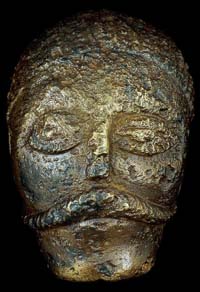
"Grandfather?" Bronze model of a human head, Iron Age, about 50-20 BC; From Welwyn, Hertfordshire, England
To the Victors Belong the History Books
I always thought I was descended from Anglo-Saxons, but a new genetic study shows that my ancestry -- and that of a majority of those of British heritage -- might actually be Celtic. Not only did the Celts dominate Europe in the centuries before the Roman invasions, but their genetic stock seems to have survived far more vigorously than that of later the invaders. What didn't survive was their version of history, "because they saw writing as a threat to their oral tradition". Well, no wonder I like singing Cwm Rhondda...
History books favor stories of conquest, not of continuity, so it is perhaps not surprising that many Englishmen grow up believing they are a fighting mixture of the Romans, Anglo-Saxons, Danes, Vikings and Normans who invaded Britain. The defeated Celts, by this reckoning, left their legacy only in the hinterlands of Ireland, Scotland and Wales.
A new genetic survey of Y chromosomes throughout the British Isles has revealed a very different story. The Celtic inhabitants of Britain were real survivors. Nowhere were they entirely replaced by the invaders and they survive in high proportions, often 50 percent or more, throughout the British Isles..
British historians have generally emphasized the Roman and Anglo-Saxon contributions to English culture at the expense of the Celtic. A recent history of Britain, "The Isles" by Norman Davies, tried to redress the balance. The Celts were ignored, he noted, in part because no documentary histories remain, the Celts having regarded writing as a threat to their oral traditions. Generations of historians saw British history as beginning with Roman invasions of the first century A.D. and indeed identified with the Romans rather than the defeated Celts.
"So long as classical education and classical prejudices prevailed, educated Englishmen inevitably saw ancient Britain as an alien land," Dr. Davies writes. The new survey indicates that the genetic contribution of the Celts has been as much underestimated as their historical legacy.
Past midnight. Never knew such silence.
The earth must be uninhabited...
Perhaps my best years are gone...
But I wouldn't want them back.
Not with the fire in me now.
No, I wouldn't want them back.
Oh, Beckett sure knew how to talk about those thoughts, didn't he? And he's always comforting to me, maybe because he just says it, puts it out there --age, anxiety, drool, stumbling, pain, confusion, longing -- and says, "yes, and I'm still here." I was just writing to a friend about mid-life angst, and how 99% of mine centers around my creative life, and whether or not I put enough emphasis on it, and made the right choices -- all of which were based on the hope that there would be a lot more years after midlife when the focus could gradually shift. There's no indication that this won't be the case -- but as we all know, no guarantees either.
I suppose I'm thinking more about this this week because of the memorial last weekend for one of our parents. But we also just learned of the death of a friend our age, an artist, and though it was expected, her death is still a shock and an affront to the natural order.
The deal in my early years was that I didn't have the fire Beckett talked about. What I had was natural ability, desire, technique -- but technique doesn't make art. I actually had to unlearn a lot of what I had thought was important, stop hiding behind skill and intellect, and search inside myself before anything authentic emerged.
It's curious: we lose the precious, primitive spontaneity we have naturally as un-formed, un-taught children, and spend years trying to recapture it, or to integrate its vague memory with technique, mind, teaching, observation. And then when we can finally see something, when there's fire inside, we sense the brevity of time.
5:31 PM
|
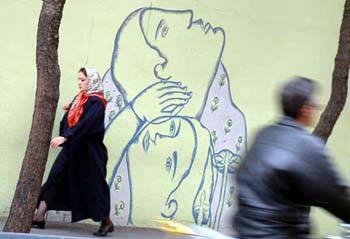
Wednesday, May 28, 2003 Iranian Women: a photo exhibition from Nafise Gallery, Iran
Strict Dress Code for Summer: Iranian conservatives crack down on looser interpretations of women's clothing:
Clothing shops and factories have been given a written order to stop producing clothes that stray from the strict female dress codes... (BBC)
This is not Living (Hay mish Eishi)
A new film by a Palestinian woman is winning awards. Al-Ahram Weekly talked to Alia Arasoughly about her film, which describes the lives of eight women - all known to the filmmaker - during the current Intifada.
As a growing number of Palestinian filmmakers are lending their gaze to events in their own country Arasoughly's film may mark a fissure with the rest. Here one encounters voices that are left unheard in the barrage of imagery that the collective consciousness has come to associate with the occupation and its discontents.
At a time when occupation has been commodified and aestheticised through the depiction of Hizbullah militants, screaming children and grieving matriarchs, Arasoughly's film pays tribute to a group of unheard voices -- those of middle-class women -- that do not gravitate toward any sensationalised pole. These are exceptional women only insofar as they face exceptional circumstances.
"I wanted to tell the stories of women like me, productive women who had lives of their own, women who had struggled to create a professional identity for themselves that has been erased by the war. " 4:57 PM
|
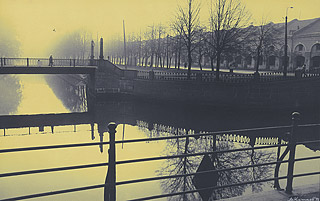
Today the city of St. Petersburg is celebrating its the three hundredth anniversary. Legend has it that on May 27, 1703, Peter the Great stood on the future site of his city and mused,
“From now on we shall threaten the Swede
And here a city we shall found
To spite our overweening neighbor.
Here it has been ordained by nature
To cut a window into Europe,
And gain a firm foothold by the sea.”
The other night I read a new translation by Peter Norman of Pushkin’s long poem “The Bronze Horseman”, which begins by sketching St. Petersburg’s history, as quoted above, and goes on to tell the story of one young Yevgeny and the great flood of the Neva in 1824. Here is the poem’s third stanza:
Alexander Pushkin
THE BRONZE HORSEMAN
I love thee, creation of Peter,
I love thy stern and graceful view,
The imperious flow of the Neva,
Thy embankments clothed in granite,
Thy wrought iron gates in tracery,
Thy translucent dark, the moonless shine,
When in my chamber I am writing,
And without a lantern reading,
And the vast buildings all asleep
On the deserted streets are clear
And bright the spire of Admiralty,
And without allowing the murk of night
To mount into the gold of heaven,
One dawn hastens to succeed another,
With hardly half an hour of night.
I love the windless air and frost
Of thy cruel winter season,
The dash of sledges by the broad Neva,
The cheeks of girls, brighter than roses,
The brilliance, noise of balls and chatter,
And the hiss of foaming goblets,
And the blue flame of the punch
At the bachelors’ hour of feasting.
I love the military liveliness
On the playing fields of Mars,
The monotonous magnificence
Of the mounted troops and infantry,
The tatters of those trophy banners,
Waving in their orderly array,
The lustre of those brazen helmets,
Shot through from side to side in battle.
I love thee, city filled with soldiers,
The smoke and thunder of thy forts,
When the northern empress bestows
A son upon the royal house,
Or Russia celebrates once again,
When victory is won against
The enemy, or breaking through its
Dark blue ice, the Neva bears it out
To sea, exulting at the scent of spring.
This translation is from Leopard IV, “Bearing Witness”, an anthology published by The Harvill Press, London, in 1999. It’s hard to find Pushkin in English, and he is supposed to be notoriously difficult to translate. I couldn’t find a reference to Norman’s poetry translation of Pushkin in book form, although I did notice that his translation of Akhmatova’s journals has recently been published (can't wait!). Here’s a collection of Pushkin’s poems by another translator, and here is The Bronze Horseman read aloud in Russian by Laura Paperno.
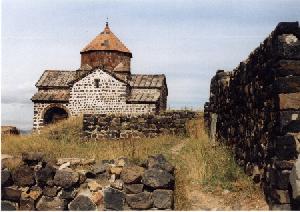
The Sevan Monastery (c. 874)
At this point the configuration of Gokcha forms a strait some five times broader than the Neva. The magnificent freshwater wind would tear into the lungs with a whistle. The clouds moved with a velocity that kept increasing by the minute and the incunabular surf would hasten to publish by hand in half an hour's time a plump Gutenberg Bible under the graveling glowering sky... Osip Mandelstam, The Noise of Time "Journey to Armenia: Sevan"
Yesterday we celebrated the life of my mother-in-law, who died on December 31st. She was born into a Christian Armenian family in Konya – the city of whirling dervishes - around 1914, and was a survivor of the Armenian Genocide. Her father and all her other adult male relatives were killed by the Turks. As well as I knew her, for 25 years, much of this remarkable, elegant, educated, generous woman remained an enigma to me. Until the last few years of her life she chose not to speak much about her early experiences. “I didn’t want my children to grow up to hate,” she said. She herself was a Quaker, committed to peace and non-violence. Even during this past year, when she had become very fragile, she sat with us at many anti-war demonstrations; her presence always encouraged me, and brought me close to tears.
At the memorial celebration yesterday the spare, light-washed Quaker gathering room was packed with people who she had touched, and many of them shared their memories. Afterwards we feasted on tiny spinach and lamb pies, beautiful cookies, cheeses and grapes, and a mountain of fresh strawberries piled on a huge blue-and-yellow majolica platter that always hung on her wall. The tables were covered with her best linens, intricately but subtly embellished with Armenian beige and grey embroidery and elaborate drawnwork, and there were big bouquets of the kind of flowers she loved: deep blue irises and salmon-colored quince blossoms. Afterwards the family came to our house for dinner and more memories, and this morning after breakfast everyone dispersed, back Maryland, Pennsylvania, New York, California. We're exhausted, but happy. She hadn't wanted us to do anything, but I hope she would have approved.
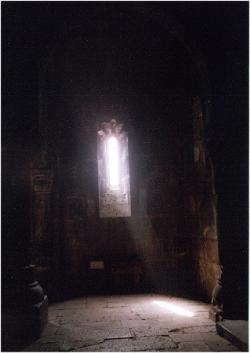
Geghard Monastery The oldest chapel is about 8 metres square. Monks lived at Geghard since the 4th century, in cells cut into the rocks.
I’ve never been to Armenia; I hope someday my husband and I can go. Today I’m thinking about a picture of my mother-in-law standing in a field of Armenian poppies. She loved color, and flowers, and beauty of all kinds. That picture was taken on a trip she made to her birthplace with a granddaughter several years ago. In Konya she searched in vain for traces of her people. “On this corner was the Armenian church,” she said. “This section was once all Armenian.”
“No,” the Turkish guides repeated. “No, no Armenians ever lived here.”
At yesterday's service that granddaughter spoke about this trip. "All the time we were there she kept saying the same thing," she said. "Nothing. Nothing."
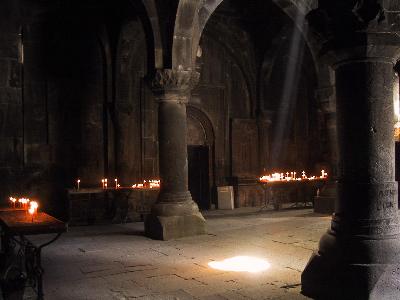
Geghard Monastery: The Main Hall. The churches and the monastery date from the 13th century.
The Armenians' fullness with life, their rude tenderness, their noble inclination for hard work, their inexplicable aversion to anything metaphysical, and their splendid intimacy with the world of real things - all of this said to me: you're awake, don't be afraid of your own time, don't be sly...Wasn't this because I found myself among a people who, though renowned for their fervent activity, nevertheless lived not by the clock in the railway station nor by that in some institution, but by the sundial such as I saw among the ruins of Zvarnots in the form of an astronomical wheel or rose inscribed on stone? Osip Mandelstam, The Noise of Time "Journey to Armenia: Sevan"
The pictures in today's post are from a favorite site, Avantart. Browse the author’s “Armenia” section for her photo essays and haunting music from Armenia, some of it recorded in the chapels you see here.
5:59 PM
|
Friday, May 23, 2003
Last night, Shirin made us one of the best meals in recent memory: chicken khoresh (stew) with yogurt; a Palestinian kibbeh-like dish of ground beef cooked in a tray with tahini sauce on top; my favorite eggplant/garlic/walnut served with sabzi (fresh greens) and Afghani barbari bread; cold salad of yogurt with spinach; and another salad of cucumbers, onions and tomatoes -- all served with perfect basmati tadik (rice cooked with a golden crust). I think I skipped right to the seventh heaven.
Afterwards we watched Asian and Middle Eastern TV from their new satellite dish - a melange of totally comprehensible shows like the all-day carpet-selling channel and a chador-clad woman reading Hafez in a voice matched by her loveliness, to mind-bending Western-imitation (and very trashy) Iranian and Middle East music videos, news, and a "So You Want to be a Millionare" rip-offs. Fascinating.
And today, I cooked all day long for tomorrow's family gathering and memorial for my mother-in-law -- mainly with my mother, sister-in-law, and niece. Frankly, forget the celebration - it was the day of cooking and chatter with other women that my mother-in-law would have loved most.
5:02 PM
|
Sainteros has a thoughtful post today about weblogging and self-representation, in which he raises the question, "in weblogging, are we building a genuine community, or are we acting out some high-tech collective fantasy?" He also asks, "Will we be blogging in five years?"
I wrote a comment:
"I think we'll be communicating/publishing, maybe not in this form exactly, but it's not the form that's important, it's what we are trying to do --and that's a universal human thing. I'm not overly concerned with a "filtered" web persona; we are trying to communcate something coherent, after all, and we can't write about EVERYthing that comes into our lives or head. I am more concerned about deliberate deception (as opposed to honest fiction writing). I'm trying hard to be honest in my blog while protecting some aspects of my privacy and protecting the identities and feelings of the people I write about - same as I would if publishing books.
It feels like genuine community to me, and like all community-building efforts, I suspect I will get out of it what I put into it."
I'm not a Buddhist, but I practiced zazen for a number of years, and continue to return to it and to the teachings of Zen. (Zen means "concentration of the mind", and za means "seated".) The BBC reports today that Buddhists Really Are Happier . I don't know if they are or not, although i suspect they are calmer. What I do know is that I've learned more about myself, and about how to cope with being in this world, from Zen than from any other religion or religious practice.
I find myself turning to this (and to my breath) today because we're preparing for a memorial celebration for the life of my husband's mother this weekend. She died at the very end of December, and we decided to wait until spring to gather and celebrate her remarkable, nearly 90 years of life. But today the family is beginning to arrive, the phone is ringing, people are asking a million questions -- and I need that calm place. Today it is a calm I must find while cutting carrots, polishing the silver, inside the pauses in conversation.
Here is a little excerpt from Shunryu Suzuki's Zen Mind, Beginner's Mind, the book that introduced me to Zen teaching and practice:
When the alarm rings early in the morning, and you get up, I think you do not feel so good. It is not easy to go and sit, and even after you arrive at the zendo and begin zazen you have to encourage yourself to sit well. These are just waves in your mind. While you are sitting these waves will become smaller and smaller, and your effort will change into some subtle feeling.
We say, "Pulling out the weeds we give nourishment to the plant." We pull the weeds and bury them near the plant to give it nourishment. So even though you have some waves while you are sitting, those waves themselves will help you. So you should be not be bothered by your mind. You should rather be grateful for the weeds, because eventually they will enrich your practice." 1:53 PM
|
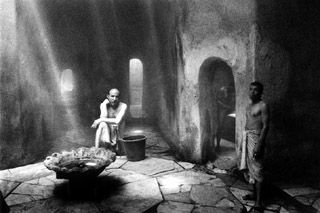
Wednesday, May 21, 2003 Turkish Bath, Fernando Moleres
The evocative black-and-white photographs by Fernando Moleres of Turkish Baths (panos, via conscientious) reminded me of a film we saw several years ago. Its English title was "Steam: The Turkish Bath", and it was a strange and, I thought, wonderful film by Ferzan Ozpetek (1998). It involves an Italian architect or interior designer who inherits a traditional hamman in, I think, Istanbul, and goes there to dispose of it -- but becomes seduced by the place itself. What follows is a tale of a family, the infusion and persistence of culture, love, and the effect of an ancient timelessness on modern beings. An interesting contrast/comparison with the recent and also wonderful Chinese film "Shower". Take a look at Moleres photos...I love the men in the pool playing chess...
The conversation that’s been going on among a few “place bloggers” is going public on Wednesday with our collective submissions to this week’s Carnival of the Vanities (thanks, Susannah!).
A small group of us have been kicking around our own reasons for writing about place, and out of that has emerged the hope to define “place” broadly, and to give it greater expression within a larger community of people on the web.
My blog is about many subjects. Some reflections on how they all fit into “place blogging” is in the archived entry from May 14th, or can also be read if you click on “writing about place” to the left.
I think one major reason I write about nature is a desire to share what I find there: the beauty in the dramatic sweep of landscape or starlit sky, the amazing detail in a flower or an iridescent green beetle. But it’s also a desire to express some of the universal qualities that lie at the root of our experience of nature – experiences that can range from solace and peace to absolute terror. Despite the fact that most of us live in houses with temperatures regulated for comfort year-round, and buy our potatoes in plastic bags rather than grubbing for them in the earth, human beings haven’t evolved far enough to avoid feeling some pretty basic emotions in the presence of the natural world. One of the most prevalent is longing – a longing that can variously be felt as fear or desire, but often involves a sense of longing for home, and a return to something we’ve lost and can barely remember. Thoreau wrote, “from the forest and wilderness come the tonics and barks which brace mankind.” I think people who write about place are trying to make sense of their own search for home and meaning on this earth, and one of our greatest joys is sharing that with others. So here’s a poem and an invitation from me:
Come with me through the gateless gate,
I want to take you to a secret place
beneath the tiny-needled hemlock,
where light sifts through the branches
and falls, a golden powder,
on a banquette made of moss –
here little fishes play in shadows as the brook
races over pebbles, tumbles from the lake.
Enfolded by the dark arms of the trees,
we’ll rest together in the greenness, listening.
And I will show you the cardinal-flower, where it hides,
and find for you a baby perch, tender and striped,
holding itself still in the currents, eyes curious and wild,
like those of the girl-child who used to throw
her wrath and sorrows in these waters
and sit here, silent, watching,
until her throat could sing.
BBC: Chimpanzees are so closely related to humans that they should properly be considered as members of the human family, according to new genetic research.
Monday, May 19, 2003
As usual when reading Thomas Merton, I'm enjoying the mutual mind-stretching that is his journalistic style, and relishing his dry humor. And it is startling to read his thoughts on the world of the 1960s, in the light of today:
Father S--., who had to go to the doctor in Louisville, came back with a clipping about a man out in the Kentucky mountains, an old coal miner who, for thirteen years, has lived as a hermit with his dog in a pitiful shack without even a chimney. He used an old car seat for his bed. When he was asked why he chose to live such a life he replied: "because of all these wars." A real desert father, perhaps. And probably not too sure of how he got there.
Merton was also a writer of "place" par excellence; the solitude and integrity he craved and found in nature stood in contrast to an "official" monasticism that, in his opinion, often interfered with contemplation and continually compromised with the world yet refused to admit it. For Merton, nature was steadfast, honest and revelatory:
More and more I appreciate the beauty and the solemnity of the "way" up through the woods, past the barn, up the stony rise, into the groves of tall, straight oaks and hickories around through the pines, swinging to the hilltop and the clearing that looks out over the valley.
Sunrise: hidden by pines and cedars to the east: I saw the red flames of the kingly sun glaring through the black trees, not like dawn but like a forest fire. Then the sun became distinguished as a person and he shone silently and with solemn power through the branches, and the whole world was silent and calm.
It is essential to experience all the times and moods of one good place. No one will ever be able to say how essential, how truly part of a genuine life this is: but all this is lost in the abstract, formal routine of exercises under an official fluorescent light. Conjectures of a Guilty Bystander 7:20 PM
|
Sunday, May 18, 2003 Jaham on the Difficult Beauty of the First White Hair
What is lovelier than the dark
when it draws the heavy curtains of the day
and beds the sun in cushions of black cloud?
A passion of blackness gives their skulls
that onyz glossiness. Today I found
my first white hair. How could my light
be dying when my heart
is twined by black strands to the farthest star?
As always in distress I took my refuge in
the verses of the classics where I read
what Sharif al-Radi wrote of his first white hair:
Time rubs the swordblade free of tarnishes
youth’s impestuous loveliness imposes.
I picked up Araby last summer in "The Word", a small second-hand bookshop at 469 Rue Milton in Montreal. In addition to a good selection of literature, they had a shelf of new editions of local and selected poetry. There I found this recent book by Eric Ormsby, professor of Islamic Studies at McGill. The poems follow two characters, Jahan, a semi-nomadic poet and mechanic, and his sidekick Bald Adham, also a mechanic and "a pillar of Muslim piety"; Ormsby's view of the Arab world is descriptive, affectionate, intelligent, and often funny. I liked it then, and like it now.
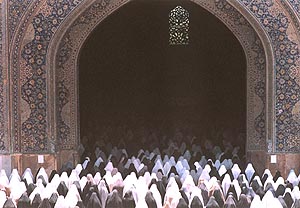
Saturday, May 17, 2003 Women entering the Imam mosque, Isfahan, Iran from Baraka: A World Beyond Words, by Mark Magidson. (An exhibition of stills from the film, through Soulcatcher Studio.)
CHADOR
"See, it's like this," said my Iranian friend (She needs a name, let's call her Shirin.) She held the large piece of cloth in her two hands so we could see how it was constructed. "And it goes on like this." She deftly swept the cloth over her head, twisted the two sides tight near her neck, and held it closed with one hand. I stared at her - had we suddenly taken a magic carpet to her family's living room in Iran? She looked at my expression and blushed. We were used to seeing Shirin in her customary headscarf (hijab) but this was something different. She sat and kept talking as if nothing had changed, but she knew what I was thinking. The chador transformed her too.
This wasn't a black one, but flowered in a pretty blue print. 'Would you wear that out on the street?" my husband asked. "No," she said. "Always black when you go out, and made of the best material. This kind you would wear in the house, it's more informal. And the lower classes wear these on the streets. I wear this here for prayer."
I hadn't known this; the times we've prayed together Shirin has been at my house, cooking, when prayer time came around, or at a Muslim event, and she had only worn her hijab. I'm Christian, but I cover my head too under those circumstances, out of respect. But I had no idea she ever wore a chador here in America. "Here," she said, "this is the other piece." She held up a circular piece of the same material, sewn into a kind of hood with a string tie, also of the same material, that secured the cloth over one's head. "This way I don't have to worry about my hair showing, it holds it all in," Shirin demonstrated. The hood covered her head except for her face, and then the chador went over it. She looked -- beautiful. Like a nun with a radiant face. "Want to try?" she asked.
"Ok," I said, "just the chador though." Shirin held it for me, and I awkwardly put the chador over my head, first pulling my hair back. I twisted the fabric along the neck like I'd seen her do. The chador immediately fell off my head. I tried again, and sat down, covered from head to toe except for my face. Ba maze, she said approvingly in Farsi. "Cute!" She went upstairs and came down with another bundle of cloth. "This one is Egyptian," she said, unfolding a gorgeous heavy piece of black cloth with widely-separated white ellipses, almost like feathers. This one had seams that gathered the cloth into "sleeves" with a hole for the hands, and had an opening for the face. "Put this one on," she said. We switched chadors and sat on the two ends of couch while our husbands stared at us, and occasionally we all burst out laughing.
How did it feel? Hot. Strange. but not unpleasant. What it reminded me of was being very small and "hiding" from the adults by putting a sheet or blanket over my head. In the chador I felt invisible but not invisible - as if there was a kind of magic protection around me. It was very odd. But for the first time I had an inkling of some of the positive aspects of "covering" that Islamic women describe - a separateness from men's eyes, the comforting feeling of being in a kind of cocoon, a feeling of specialness because of the way you are dressed -- which for them represents a gift to God. For a long time now I have been unwilling to judge these choices, when a woman makes them on her own. And what we in the West often fail to grasp is that this really is a choice for many Muslim women - modern, professional, educated women like ourselves.
"If I make hajj next year I think I will take the black one," Shirin said. "It would be good in Saudi Arabia..."
Well, in spite of all my philosophizing about "place" being everywhere, we got an immersion into the place-that-is-here today, during a drive around the breathtaking backroads of our state with friends from England. "So much land and so few houses," they exclaimed. "So beautiful! So many trees!" And this perennial comment from European visitors, "So many of the houses are made of wood!"
I love excursions like this because they force you to see with new eyes - "beginner's eyes", maybe (like "beginner's mind"). It's fun to notice the blue tubing strung between stands of sugar maples and think to explain what's going on, or to look even more closely for deer on the edges of woods. Not only did we see a number of white-tailed deer, we also saw a big loping coyote crossing a field, not a common sight around here. We stopped to gaze at a hillside of newly-needled tamarak (larch), soft as green fur. But perhaps most astounding was the intense green of the new maple and birch leaves, a green somewhere between lime and chartreuse, that only appears for these few spring days, before sunlight and rain begin to toughen and darken the leaves. You almost wish you could be a giant deer, able to graze the treetops for this delicate spring vegetable; instead we could dine on a mess of fiddleheads, or the cowslips carpeting the marsh.
5:39 PM
|
Fred at Fragments from Floyd has been talking to me about where we all might go with this notion of "place blogs". Is it possible to define what that is, and is there some way to consolidate posts about place, or increase the readership for these sorts of ruminations on nature and our place in it? Other bloggers involved in this conversation are Lisa at Field Notes and Pica and Numenius at Feathers of Hope.
To be honest, I haven't thought of my blog as being strictly a "place blog" since I do write about many other subjects. I used to be a naturalist and outdoor educator, and earlier in life spent a lot of time writing and illustrating trail guides, planning and constructing exhibits, writing articles and planning programs, leading nature hikes. Nature has always been a big subject in my writing, and one thing I've been grateful for is that blogging about nature and my surroundings has made me get out more and turn on that mental recorder - that's very welcome, from the perspective of this chair and desk, especially after the longest and most inhospitable winter I can remember. In my poetry and essays, nature is often a metaphor and a vehicle for me to talk about something else, and it's helpful to get back into a more constantly observant frame of mind.
I like the idea of having a central place where people who do this can post particular entries about "place"; potentially creating more interest in the subject, seeing it from a wider viewpoint (not just blogs from the "beautiful and unspoiled", for instance), and creating more traffic back to the originating blogs.
Which makes me think about what I'm doing here. I think what I am trying to do in my blog, as it evolves, is to talk about "place" both from an intimate and a broad perspective. It seems to me that everything I write is somewhat about "place", if we extend that definition concentrically to be one person's place in her locality, her region, her country, her culture, the world's culture, the life of the spirit. On another axis you might also say I'm writing about one person's place in time, extending forward (into questions of technology, science, human impact on practically everything) and backwards (toward a greater understanding of myself in history). I think this is all "place", and I'd like to see if there is a place in the blogosphere for this sort of searching and conversation but perhaps grounded in writing about our most fundamental "place" relationship - with nature. For years, we were devoted readers of Whole Earth Review/Co-Evolution Quarterly - I think they were forerunners in this sort of holistic and undefined conversation about place.
It's just like medicine or any other specialized field - if people focus only on one part they may miss a fundamental, underlying element on which the entire problem hangs. (Which is not to say one of the very best things about the internet is exactly that it's perfect for minute specialisation and exploration of any topic.) Without a sense of the natural world and who we are in relation to it, we are not fully aware of ourselves as human beings - and yet our lifestyle makes this increasingly difficult, as well as "unnecessary" for most practical purposes. Even worse, we are missing one of the great gifts of life - the solace and meaning that comes from seeing something we are, I believe, very much meant to see: the beauty, intricacy and wonder of the natural world, and the awesome awareness of being a human being with full powers of perception to see, hear, touch, taste, smell and consider these gifts.
Wednesday, May 14, 2003 Erotic Poems of the Ancient Tamil "The most ancient Tamil literature after the tolkâppiyam is the poetry of the cankam (pronounced sangam) anthologies, which date from around the time of Christ. The word cankam is from Sanskrit sangha, 'assembly' (of poetic masters). The poems are arranged into two main categories, the "interior" (akam), relating to love and family life, and the "exterior" (puram), relating to war and kings. The akam poems sampled here classify the five stages of erotic love according to the five types of landscape in Tamil Nadu, and each is associated with a tree or flower that evokes the particular type of love..."
Even if passion should pass,
O man of the hills
where
after the long tempestuous rains
of night
the morning's waterfalls
make music in the caverns,
would our love also pass
with the passion?
Thank you to friends who have asked about yesterday's trial. The case against the three women was dismissed because the place they were arrested was actually a street owned by the city. However, they were able to make their statements to the court. One of the women is 80 years old, and has been arrested and jailed a number of times for her witnessing for peace. Apparently she made quite an impression on the courtroom. My friend said, "The judge was very good at not betraying his emotions, but I can't believe he didn't go home and tell his wife over dinner, 'There are some remarkable people in this state, and that elderly woman is one of them.'" As for myself -- I'm very relieved.
8:08 PM
|
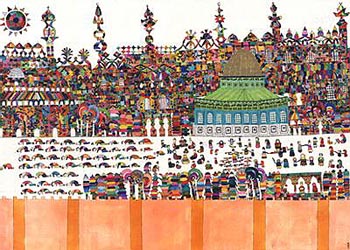
Jerusalem City of Peace by Adib Fattal
A new Arab optimism in arts & letters? The Washington Post profiles a new generation of young Egyptian poets and writers, frustrated with the typical themes of Arab literature and determined to tackle a more modern slice of life as well as striking a less melancholy, less nostalgic tone. They are also seeking new methods of publishing and distribution, including the Internet, both to avoid censorship and to explore the mediums themselves. It's interesting reading:
(Mona) Prince, 32, is one of Egypt's hottest young novelists, and her tale of young love and indecision is at the leading edge of a literary trend here. The story is distinctive for what it is not: not the traditional modern Arab narrative of family and nostalgia for the old ways; not nurtured on grief and melancholy over the Palestinian question or the lack of Arab unity; and most definitely not a prescription for finding solace in Islam.
"Why do I have to write about anguish and melancholy and victimhood?" Prince asks. "I want something where I don't have to talk about philosophy or ideology or Egypt. What am I going to say about it? It's bigger than me. I am living it. Why should I read and write about it? I want to tell a different story now."
Al-Ahram Weekly (Cairo) also reviews a Cairo show of Syrian artist Adib Fattal’s vibrantly colorful drawings of Palestine and Syria - art that is also unexpected for its color, energy, and refusal to locate itself in any particular Palestinian ideology or time period:
"His is a Palestine of folklore rather than of life or memory, a perfectly timeless place where there is no indication of history -- occupation, colonialisation -- or present-day struggle…You leave with a different, fresh imagination of Palestine; one that is decidedly colourful and perhaps increasingly needed."
Tuesday, May 13, 2003
A gloomy day here, cold and rainy, and I'm feeling kind of sodden myself. I'm waiting to hear word from my friend who is being tried today for trespassing on the grounds of an armaments manufacturer; she and two other women "crossed the line" at an anti-war demonstration this fall, knelt and prayed, and were arrested. They face up to a year in jail on a charge of "criminal misdemeanor". We talked last night, and I asked what she was going to say at the trial. "I'm going to hold the pictures of all the foster kids who have lived with us, all those faces of different colors, and say, "This is why I did it. Because we have to understand that we're one world."
Today I attended a short Anglican liturgy for peace, at noon, and was thinking of my friend as I drove home, since her trial was scheduled for 1:00 pm. I switched on the radio and the first and only words I heard, before switching the radio off, were Bush saying, in response to the bombings in Saudi Arabia, "We will FIND the people who did this, and we will SHOW THEM what American justice looks like." Yes, we're all getting a pretty good picture of what American justice looks like. Overwhelming military power unleashed on anyone who dares to threaten us, and Catholic women who've sheltered 25 children from Latin America, Rwanda, and American inner cities being put into jail. Now that is effective justice. Thank you, I feel so much safer.
On a personal level, I'm trying hard to move beyond my anger and alienation because I recognize that they aren't doing me or the world any good. The world has changed, not, in my opinion, for the better, but we are far from a point where the population recognizes that. I've put so much energy and effort into the anti-war movement and into efforts to educate people about the Middle East, and we've moved from a time of relative receptivity to exhaustion and passivity fueled by lies and acquiescence. I feel surrounded by people whose attitudes are alien to me, but I cannot hate them, for the same reason my friend is using for her defense. We are all one world, and that includes everyone from the president and his cronies to the most rabid redneck, to the child suffering from near-starvation, to the tortured prisoner, to the clueless rich woman I saw sashaying around the grocery store in pink patent-leather mules. Sorry, hatred is not allowed.
I'm trying to figure out what to do with my grief, though. For today: finishing a poem, and playing through two Brahms Intermezzi. Watching the rain on cobalt-blue pansies. Writing here.
Trying to Forget War
Be happy:
permission has been given.
Over the dewy grass
forsythia opens her golden purse;
flocks of dandelions
like well-schooled Chinese children
wave and dance in the meadow.
Cooing, soft dull
mourning doves
search the shrubbery in pairs,
the pregnant robin
cocks her head impatiently.
I’m coming.
Just let me feel
this moment of cool air.
Let me scatter the winter’s wood-ash
beneath the poppies.
4:20 PM
|
Today, in a major crackdown on free speech and internet access, Iran released a list of 15,000 websites and sent them to service providers telling them access to these sites must be blocked. The story says most of these are pornographic or rabidly anti-regime websites. The BBC seems to be keeping close tabs on this story, including the threat the Iranian regime apparently feels from bloggers (see Gagging the Bloggers, from May 2). Editor:Myself, a hub for Persian blogging, has further comments.
9:20 AM
|
Sunday, May 11, 2003
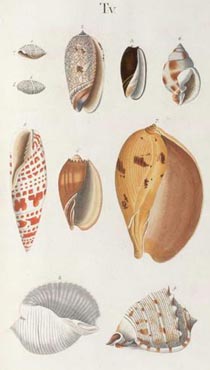
The beautiful Giornale Nuovo had a post this week entitled She Sells Sea Shells , with gorgeous illustrations from an illustrated treatise on conchology, or the study of marine mollusks, from the Smithsonian's collection of manuscripts, and it made me cast my eyes around my office to rest upon a white-and-pink shell that I realized has been with me for nearly (gulp) fifty years.
My maternal grandparents used to go to Florida every winter, and one of the things they always brought back - along with rakish straw hats; straw totes decorated with sewn-on cowrie shells; boxes of oranges and kumquats with green leaves still miraculously attached; and fat round jars of guava jelly -- were special sea shells. We had two large conches on a shelf in the pantry, and I'd often listen to the ocean in them when I became lonely for my far-away grandparents. I had cardboard sheets with small shells glued on, their names carefully typeset underneath. But more precious was a shoe box in which I collected the loose shells they brought me, white sand still tumbling out, imperfect but far more real and curious to me than the pre-assembled "collections" on cardboard sheets. My favorite shell was a pink-mouthed murex. It was small, fat enough to fit happily into my hand, and it somehow always felt like it was particularly mine - a little-girl shell of a rosy pink surrounded by a ruffled, snow-white exterior. For reasons unknown to me, I've carted that shell to college, to New England, from house to house, and it now rests on a shelf about five feet from my hand. I hadn't thought about it for a long time, until today.
One characteristic of old-fashioned amateur naturalists like me is that our workspaces tend to accumulate collections of odd rocks, lichens, pods, shells, bones. I never think anything of it until someone comes into my space and remarks on something - "where did this feather come from?" or "what's that, a fossil?" To me, they are so familiar I take their presence for granted, like old friends, but I'd miss them terribly if they were to disappear. Each is a reminder of a place, an experience. Each evokes a mood and a memory, and those associations lead me on a mental journey -- to the top of Mt. Mansfield on our tenth wedding anniversary, for example, where I picked up the small, flat, lichen-encrusted piece of granite that sits here just under my monitor. My pink-mouthed murex reminds me of my grandparents and the strange picture I had of the sea when I was very little, for I was a child of a landlocked Brigadoon in upstate New York. Sand existed in my sandbox; scallop shells were tiny fossils in the sedimentary local rocks; and fish was something that came frozen in a perfect rectangle after you peeled off the box, and tasted like cardboard. The shells my grandparents brought me were natural wonders of an exotic, far-away world totally removed from my familiar woods and lake. And even now, so many years later, I still think of the ocean that way: alien, a little frightening, seductive, beautiful, and far away, despite the fact that some of the undulating hills near my present home are, in fact, ancient sand dunes.
Today I was reminded that murex snails were the source of the famous royal purple dye used by the Phoenecians and Romans. The shells like mine that came from the Pacific side of Central America apparently yielded just as intense a dye as the ones from the Mediterranean. But as a classicist, I was fascinated to read this discussion of Tyrian Purple by William Harris, Prof. Emeritus at Middlebury College, in which he ponders the use of the word "purple" in Homer and Aeschylus:
But back in Greece, I remembered Homer's striking figure of the "purple sea" (porphurea thalassa), which had always puzzled me as a student. And equally odd was his "purple blood" gushing forth, and even a "purple rainbow" mentioned once in the Iliad. Our sense of the color "purple" does not fit these uses, it was clear to me even then that something was wrong with our color-sense, or that colors can shift as part of the process of social evolution. Yet all these three uses are by the same author and the identical time-frame, so I left Greece that summer puzzled and intrigued.
About that time a well known scholar tendered the opinion that "porphureos", which was used by Aeschylus in the gory death scene in which Clytemnestra hacked open her husband' s head so that the "purple blood" gushed forth. A late Byzantine glossator had suggested that blood when dried was a darkish brown, and the bookish Classicist followed his late source without hesitation. But that led to worse problems, for how could Homer's sea be brownish, or a rainbow be rusty? read on to find out how...
From a letter by Wallace Stevens to Rodriguez-Feo, October 17, 1945, (collected in Secretaries of the Moon: the Letters of Wallace Stevens and Rodriguez-Feo: Your group at the Villa Olga absorbs me. Of yourself you say that you read and write and cultivate your garden. You like to write to people far away about such unreal things as books. It is a common case. I have a man in Ceylon with whom I have been exchanging letters for some years. He is an Englishman, an Oxford man and a lawyer, I believe, but actually he makes his living and the living of his family by growing coconuts at a place called Lunawila in the province, or parish, or whatever it may be called, of Kirimetyana. In the depths of his distance from everything he extracts, because he needs to extract, from poetry and from his reading generally far more than you and I extract from the things that we have in such plenty, or that we could have because they exist in such plenty near at hand...
This has left me very little space to speak of things that you have been reading. I think, therefore, that I shan't speak of them at all, but instead try to raise a question in your mind as to the value of reading. True, the desire to read is an insatiable desire and you must read. Nevertheless, you must also think. Intellectual isolation loses value in an existence of books. I think I sent you some time ago a quotation from Henry James about living in a world of creation. A world of creation is one of the areas, and only one, of the world of thought and there is no passion like the passion of thinking which grows stronger as one grows older, even though one never thinks anything of particular interest to anyone else. Spend an hour or two a day even if in the beginning you are staggered by the confusion and aimlessness of your thoughts.
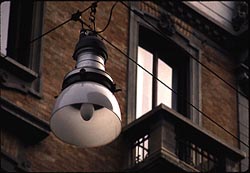
Friday, May 09, 2003 A lamp outside Primo Levi's house in Torino (Ari Frankel)
A few days ago languagehat published a comment about an article by Mark Slouka in this month’s Harper’s. I read the article and have been thinking about it since. How do different people react to – and later describe -- the ultimate moment of facing death: their own execution that is commuted at the last moment? The author takes two examples, the famous self-described mock execution of Dostoevsky, and a similar event that happened to Czech poet Jaroslav Seifert, to which the victims apparently reacted completely differently. How could this be? Were they both telling the truth? One of the author’s conclusions is that we come to such events already programmed; how we react, what we say, do, or remember is a product of who we were when we came to it. Dostoevsky could not help being himself (either at the time, or when recalling it); neither could Seifert, and neither can we.
Thus I read with special interest this transcript of an interview with Primo Levi, via Betacorpo during his “return” to Auschwitz in the spring of 1982, and thought perhaps it was characteristic of Levi to describe what had happened in terms of a strange breakdown in normal language:
“Thus it happened to all, a profound modification in their personality. Most of all, our sensibility lost sharpness, so that the memories of our home had fallen into second place; The memory of family had fallen into second place in face of urgent needs, of hunger, of the necessity to protect oneself against cold, beatings, fatigue... all of this brought about some reactions which we could call animal-like; We were like work animals.
It is curious how this animal-like condition would repeat itself in language: in German there are two words for eating. One is 'essen' and it refers to people, and the other is 'fressen', referring to animals. We say a horse 'frisst', for example, or a cat. In the lager, without anyone having decided that it should be so, the verb for eating was fressen. As if the perception of the animalesque regression was clear to all.”
One thing that distinguishes human from beast is our ability to view our plight with detachment, and make choices about how we will act. In fact, I’d go so far as to say that our nobility as human beings depends greatly on the extent to which we are able to do that. Turn, then, to the front of the same issue of Harper’s and read the so-called “interview” of Jeremy Glick, author of “Another World is Possible” (Glick’s father was killed in the Wolrd Trade Center) by Fox News’ Bill O’Reilly, and consider “animalesque regression.”
I was also glad to see that Salam Pax is back, writing from Baghdad. Describing the events of the past weeks, he says:
Life has a way of moving on. Your senses are numbed, things stop shocking you. If there is one thing you should believe in, it is that life will find a way to push on, humans are adaptable, that is the only way to explain how such a foolish species has kept itself on this planet without wiping itself out. Humans are very adaptable, physically and emotionally.
To be a solitary but not an individualist: concerned not with merely perfecting one's own life (this, as Marx saw it, is an indecent luxury and full of illusion). One's solitude belongs to the world and to God. Are these just words?
Solitude has its own special work; a deepening of awareness that the world needs. A struggle against alienation. True solitude is deeply aware of the world's needs. It does not hold the world at arm's length. Thomas Merton, Conjectures of a Guilty Bystander
In the aftermath of Iraq and two years of intense involvement with peace work and trying to educate others about the Middle East, I find myself turning away from politics and struggling toward a new and different balance of priorities and energy. This has practical dimensions but is, at its base, a spiritual question. How do we live responsibly and without blinders, yet joyfully, gratefully, and sanely, in a irreparably changed world? No surprise that I find myself turning to Merton, who I've always seen as a kindred spirit and a help in difficult times. While living in solitude and vowed silence at the Trappist monastery in Gethsemani, Kentucky, Merton was a passionate voice for peace and human responsibility during the nuclear arms race and cold war. His concept of the interdependency of action and contemplation rings true for me; what I've depleted over the past couple of years is my reservoir of sufficient contemplation and solitude to sustain the action. I have overdrawn my account. It's clearly time to go back and rediscover the spring, to drink deeply at the cool waters in the solitude of the forest, aware that my stay there is temporary...
Wednesday, May 07, 2003
Outside my window, the familiar drone -- J. is mowing the lawn for the first time this year. "Got to do it, it's going to rain for the next five days," he said. I sympathized. Early in our marriage we used to tell everybody we were going to plant a forest of bonsai maple trees on our front lawn instead of grass. Now (more than two decades later) we almost enjoy mowing. I can say "we" with impunity because last summer I did the mowing, for the first time in my life, because J. was recovering from a broken shoulder (yes, skiing, yes he should have known better, yes it was a real pain, yes you don't heal up so fast when you're, umm, "older"). I'm feeling a little nostalgic for mowing today. But if it's going to rain, at least I can plant some lettuce.
Today at lunch with my father-in-law, we had settled down with our bowls of soup and chicken salad sandwiches from the buffet when one of the retirement-home attendants -- a large dark-haired woman in a bright apricot tunic and white nurse's pants -- began hitting the rim of a coffee cup with a knife. Thick institutional china doesn't make a very convincing ring, especially for hearing-impaired guests, so most people went right on eating and talking, but she persisted, stopping every now and then to inspect the poor cup, and adding, in a loud voice, "May I have your attention" over the banging.
"I want you to know about a very special event that's happening this afternoon," she went on cheerily, carefully enunciating each word, when saw she finally had a few listeners. "A local Girl Scout troop applied for a grant to get money to do a community service project with senior citizens. And they chose as their project to do an ice cream social with you people. So today they're coming here at 3:00 and there will be ice cream for you down in the gathering room."
"What did she say?" my father-in-law asked.
"This," I said, pointing to the orange tent card in the middle of the table, announcing the same event. I shot a glance across the table at my husband.
"Can you believe it?" he said, sotto voce. "What is the world coming to when Girl Scouts get grants to bring ice cream to a nursing home?"
"You've got me," I said.
"This soup is tasteless," my father-in-law announced. "Either our food is getting worse, or I've lost my appetite completely."
"It tastes like it wanted to become onion soup but stopped short," I said, and he laughed. I watched while he tipped the soup bowl and ate the last drops without satisfaction. Was this how Girl Scouts get merit badges for community service these days? Would they talk to him? Would they ask him how his reading of Qu'ran commentaries was going? I thought about how we had made homemade fresh strawberry ice cream last weekend and hadn't brought my father-in-law any - our guests had eaten it all - and how it was his favorite and I wanted him to have some even though he shouldn't eat much sugar. He's about to be 94, I thought. I want to see him take that first bite and smile and sit back happily and say, "Ahhhh! It tastes strawberry!"
"Well, if there's going to be ice cream I won't get any more soup," he said, and pushed his bowl to the center of the table with a sigh that seemed to empty his entire chest. "OK, time to go. Ya'allah!"
Mercury Transit Day
Today, the planet Mercury passed in front of the Sun and was visible as a small dark point. This kind of astronomical event is called a transit and for the planet Mercury, it occurs approximately once every 7 years. A Venus transit is much more rare: the last was in 1882 but we're in luck, the next one will be in June of 2004. I've only seen Mercury occasionally, very low on the horizon at dusk, so I thought the transit was really cool. Here's a series of images of today's event taken by the Mercury Transit Webcam. The one above, taken in 1999, is from the Royal Observatory, Greenwich.
A moment of happiness,
you and I sitting on the verandah,
apparently two, but one in soul, you and I.
We feel the flowing water of life here,
you and I, with the garden's beauty
and the birds singing.
The stars will be watching us,
and we will show them
what it is to be a thin crescent moon.
You and I unselfed, will be together,
indifferent to idle speculation, you and I.
The parrots of heaven will be cracking sugar
as we laugh together, you and I.
In one form upon this earth,
and in another form in a timeless sweet land.
Satrapi's Persepolis has received a lot of commentary for its comic book style combining drawings and writing, while Nafisi's book takes on the unconventional subject of teaching Nabakov in Iran...
Nafisi describes her sense of detachment and helplessness during her years under the mullahs: "In Iran a strange distance informed our relation to these daily experiences of brutality and humiliation. There, we spoke as if the events did not belong to us; like schizophrenic patients, we tried to keep ourselves away from that other self, at once intimate and alien."
For both Nafisi and Satrapi—one a well-respected professor, the other a pampered schoolgirl—government edicts ravage external and internal life. Marji wonders how she'll ever become the next Marie Curie, while Nafisi's whole sense of herself begins to unravel:
"Now that I could not wear what I would normally wear, walk in the streets to the beat of my own body, shout if I wanted to or pat a male colleague on the back on the spur of the moment, now that all this was illegal, I felt light and fictional . . . as if I had been written into being and then erased in one quick swipe."
Farhad Moshiri at the Leighton House Museum Moshiri’s exhibition is a series of large-scale paintings on the simple vessel form “that have mostly one colour that he associates with a word, sentence or childhood memory: favourite juices (Ab Anar Tazeh – fresh pomegranate juice), fruits (Miveh va Tareh bar – sweet Isfahani melons or the grapes of Shahroud) and traditional dishes (Kaleh Pache). Sometimes he employs lines of juxtaposed texts, extracts of poems or vernacular words used in daily life in Tehran.”
Monday, May 05, 2003
I almost lost myself today. Off-center. Edgy. Over-emotional. But I did the smart thing for once (the stupid thing is to pick a fight with your spouse) and took myself off to the woods.
Our town has a tract of land given to it a decade ago; it's a heavily-wooded hillside with a cascading brook that flows through a mixed white pine and deciduous forest, into a small pond, and steeply out again to plunge down to the big river. There are trails for hiking in summer and snowshoeing or cross-country skiing in winter, but hardly anyone goes there, so you can be assured of having the mirror of the pond and the solitude of the woods pretty much to yourself -- which was exactly what I needed today.
This was my first visit to the woods this spring. Things are further along down in the valley where I live, but up on the hill, the forest canopy wasn't yet leafed out, and the ground was mainly brown with dry leaves, punctuated here and there by the fuzzy grey fiddleheads of cinnamon ferns, or the smooth dark green ostrich ferns that are gathered here by the basketful and sauteed in butter for an asparagus-like, system-cleansing spring tonic. I walked through the woods along the pools and singing falls of the narrow brook, on a cushioned path of pine needles, leaves, and the fallen red flowers of a thousand maples.
The path comes out along the edge of the pond on the far side, and there I settled down. Between me and the shore, shrubby lowbush blueberries were being coaxed to life by moisture and afternoon sun. Lemon-yellow trout-lilies swayed above speckled leaves. And sure enough, under the ax-hewn log bench, next to a perfect deer-track in the damp mud, the oval evergreen leaves of trailing arbutus spread in a thick mat, unaware of their status as a rare and local species, hiding their shy pale pink blossoms in clusters under the leaves.
I stretched out on my stomach and buried my nose in the sweet, faint scent of the waxy flowers, and then sat up to stare into the shallows. A school of tender, lazy bass, swishing their black tails, swam above a fallen tree. Overhead, a squirrel cracked nuts that fell through the bare branches, and a delicate wind sent shivering ripples skimming across the pond.
My breath slowed, and I felt my self return.
7:12 PM
|
Sunday, May 04, 2003
Some blog house-cleaning this weekend. I've been meaning to update my list of links, and did: I took out the war blogs that I'm not reading anymore, and added some new favorites that enhance my life every day. If I had to categorize them, I'd say I'm leaning toward blogs that are mainly about the arts, literature, and honest reflections on daily life. Another criteria is that I'm mostly linking to blogs whose authors, like me, try to update nearly every day.
Today was what our choir director called "Saint Mozart" day. Organ prelude, postlude, offertory anthem and communion motet were all by Wolfgang. We sang the Laudate Pueri and Laudate Dominum from the Solemn Vespers, and although Mozart wrote them when he was still young, they look forward to the most dramatic operatic writing he did, as well as the Requiem. Terrific stuff. The Pueri is driving, emotional, rhythmically intense, and the Laudate Dominum, with one of Mozart's most famous melodies, sung first by a soprano soloist and then by the chorus, was just like the glorious spring day here -- leaves bursting out, intense green grass, bright yellow forsythia, a cloudless azure sky. I felt so fortunate to be singing music like this, with people I love.
Listen to Kiri te Kanawa singing the Laudate Dominum (scroll all the way down to song sample #3). Not my ultimate choice of performer for this piece, but I couldn't find an audio clip with Emma Kirkby or, even better, Elly Ameling...
7:21 PM
|
Saturday, May 03, 2003
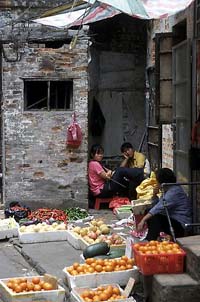
Fruit vendors in an alley. Guangzhou (Canton), Guangdong, China From a gallery of pictures taken mainly in the Qingping market, "the most famous and bizarre in China, full of strange foods, animals, and animal parts for sale. There is a saying: 'the Cantonese will eat anything with four legs, except the table'." Scroll down and see the pictures of two people sorting dried sea horses, with a huge bunch of eels or snakes hanging behind them.
I have a friend in Beijing who has been writing to me about the effect of the SARS epidemic on herself and her family. At first she described it as "a snake without shape scrambling in the brush". More recently she wrote:
"The situation is serious now and we have to stop to work tomorrow. Now all the school has closed. Many people stay at home. This morning when I drive to work, the street is so easy to go!. But I don't feel terrible as before. I am experiencing all of this and become still. There is a long days we will have, we will not work until 8, May. So I am planning read some books. It is a good time to me to read. That lets me in peaceful when facing SARS.
Up till now, nobody is ill in my family. So I dare say we are okay. But I dare not say we will be all right tomorrow or next tomorrow. Nobody know when who will be affected. However, I finally feel peace in my heart. I begin to read and recover to a simple life. I like it. Maybe it is a good thing to us, to human being--the disease attack us--we find a balance in our immunity - in our social life - in the economy, political, environment, in our mind. Facing it, I begin to find courage return to me. If I were weak, I should be dead, if I am strong enough, I shall not be damage, and if my child is strong enough, she will be not affected. We will be okay. When we face war, face disease, we must be in strong minded to it, or, we will be the failure."
Studies and conclusions about treating SARS with traditional Chinese medicine (TCM):
The combined treatment of traditional Chinese medicine and Western medicine have proved quite effective in Guangdong Province…Many TCM experts argue that the SARS patients mostly develop a symptom of heat toxin accompanied by dampness within their bodies. These two elements have combined to impair the lung qi or the vital energy in their lungs and fluids quickly. According to doctor Jiang Liangduo and Zhou Anping from the Dongzhimen Hospital attached to Beijing Chinese Medicine University, traditional Chinese medicine can help a lot in the prevention and treatment of SARS by improving the body's immune system and mobilizing every positive factor in the human body to fight against the disease. "The prescription we write out for prevention is kind of an antipyretic - fever-reducing - method, to help restore qi, promote the natural flow of bodily fluids, and drive away the dampness," said Jiang. from China Daily
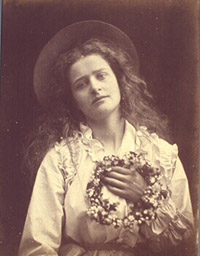
The May Queen, Julia Margaret Cameron, an illustration from Tennyson's "Idylls of the King" and Other Poems, London: 1875.
True Victoriana. "Why so tragic?" I wondered, looking at Julia Margaret Cameron's photograph. It sent me back to my volume of Alfred, Lord Tennyson, and this early poem in three parts. In the first, a young girl asks her mother to call her early, for she's going to be the Queen of the May. In part two ("New-Year's Eve") she is dying, and longing to see another flower before she departs. The final stanzas take place during 'the bleating of the lamb" in another spring, as our heroine who thought "to die before the snowdrop came, and now the violet's here" finally bids farewell to life and her family.
Last May we made a crown of flowers: we had a merry day;
Beneath the hawthorn on the green they made me Queen of May;
And we danced about the May-pole and in the hazel copse,
Till Charles's Wain* came out above the tall white chimney-tops... Tennyson, The May Queen
It all seems maudlin and silly now, but when I was little my great aunt Inez used to read me Tennyson and I loved it, because she did. Our favorites were the Idylls of the King and The Lady of Shalott, equally tragic stories that were naturals for Cameron to illustrate. My aunt Inez, a teacher of history and lover of literature, was born a few years before Tennyson died, in the early 1890s. People she knew and loved had died exactly this sort of slow, fading, lingering death, always at home, surrounded by other women. In my household even half a century later, there was an undeniable Victorian atmosphere perpetuated by my grandmother and her sisters, strong-minded women who knew how to use a bit of tragic effect to good advantage, as well as to pull out a good quote whenever they needed one.
On May Day, my grandmother and mother always encouraged me to make May baskets woven of colored paper, which I then filled with daffodils and candy and hung on the door of a chosen "secret beloved". The trick was to knock and then run away and hide before the person answered the door. They were supposed to see the basket, come and find you, and reward you with a kiss. I can still remember my heart pounding as I hid behind the barberry bushes waiting for the boy across the street, three years older than I was, to open the door and find my basket. Which he did. And then chased me, and kissed me. Victoriana has its thrills.
*Charles's Wain (Old English, Carles waegn) was a popular name for the constellation we call the Big Dipper. A "wain" (wagon) is a farm cart (as in Constable's "The Hay Wain"). The Charles in question may be "Carl", or Charlemagne, or "churl" (from Old Norse).
3:18 PM
|
Thursday, May 01, 2003
Yesterday, after lunch with my 94-year-old father-in-law, we had a long discussion with him about Arabic. He’s currently reading a six-volume commentary on the Qu’ran, and it has him so excited he can’t sleep. He’s not Muslim, but he has been a scholar and teacher of Arabic literature and Middle Eastern history all his life. In a moment of candid humor he recently said, “If you speak Arabic, you’re a Muslim.” He didn’t mean it literally, but culturally: that as a Middle Easterner and native Arabic speaker, it was impossible not to be influenced by Islam and its Holy Book.
The commentaries are arranged with quotations from the Qu’ran on the left, and the commentary on the right. “You see,” he showed me, “when he’s quoting the Qu’ran, the Arabic contains all the voweling. That’s because it’s a sin to make a mistake when reciting the Qu’ran, so the voweling is written out to make sure you can read it correctly. Over here,” he swept his hand over the righthand page, smiling, “there’re no vowels - you’re just supposed to ‘know’.”
He told us, “When a person memorizes the entire Qu’ran it is a big occasion, and everyone celebrates. There are young children, maybe 8 years old, who can do this. It’s a big deal because then you can sit with the elders and correct them when they make a mistake. And because the Qu’ran is considered to be perfect, it’s your duty to correct a person if you hear them making an error. I’ve been in halls where the Qu’ran was being recited and somone stands up in the back and says, “Excuse me, that should be…!”.
He went on to talk about the root verbs in the language. K-t-b, for example, is the root meaning “to write”. “Kitab” is “book”. “Maktab” is “school”. “Katub” is a big or famous author. Kataba, with a long “a” after the “k”, means “to correspond”, and “muktaba” is correspondence that goes back and forth…
why didn’t I start this twenty years ago?
The other favorite subject for our discussions is food. Here is a visit to a Syrian restaurant in Cairo:
The troubled times the Middle East is witnessing augur nothing to be jubilant about. I wish I had seen Baghdad before its destruction. I hope I will see other Arab cities before they are dealt unexpected blows. The only thing I can do for now, however, considering budgetary and time restrictions, is sample the food of the country I currently fear for the most. That's why my friend and I drove through crowded and driver- unfriendly Mohandessin streets trying to locate Abu-Ammar, a Syrian outlet of a certain reputation...